


Key cautions
- Do not self-treat anemia, fatigue or neurological symptoms with copper; their causes need assessment.
- Excess copper can injure the liver and cause gastrointestinal illness. People with Wilson disease need specialist guidance.
- High-dose zinc can reduce copper absorption. Review supplements with a clinician rather than adding a second mineral to compensate.
What’s inside
Copper participates in copper-dependent enzymes; it is not a plant extract.
Uses in brief

- Dietary adequacy
- Historical metalwork
Copper food reference
Copper in foods: compare portions
Approximate reference values for the exact form and portion shown. The label Daily Value (DV) is 0.9 mg for adults and children age 4+, not an individual intake prescription. Portions differ, so this is not a per-gram ranking.
Plants and mushrooms
Unsweetened baking chocolate
Unsweetened baking chocolate · 1 oz
0.938 mg copper · 104% DV
Comparison portion, not a daily recommendation; differs from cocoa powder, sweetened chocolate and cacao nibs.
Potato
Cooked, flesh and skin · 1 medium potato
0.675 mg copper · 75% DV
NIH does not specify a cultivar or more precise cooking method. Do not transfer to sweet potato (card 163).
Shiitake
Cooked, chopped · ½ cup
0.650 mg copper · 72% DV
Cashews
Dry-roasted · 1 oz
0.629 mg copper · 70% DV
Sunflower kernels
Toasted · ¼ cup
0.615 mg copper · 68% DV
Dark chocolate
70–85% cacao solids · 1 oz
0.501 mg copper · 56% DV
Finished chocolate; do not substitute this value for cocoa powder or cacao nibs.
Tofu
Firm, raw/as sold · ½ cup
0.476 mg copper · 53% DV
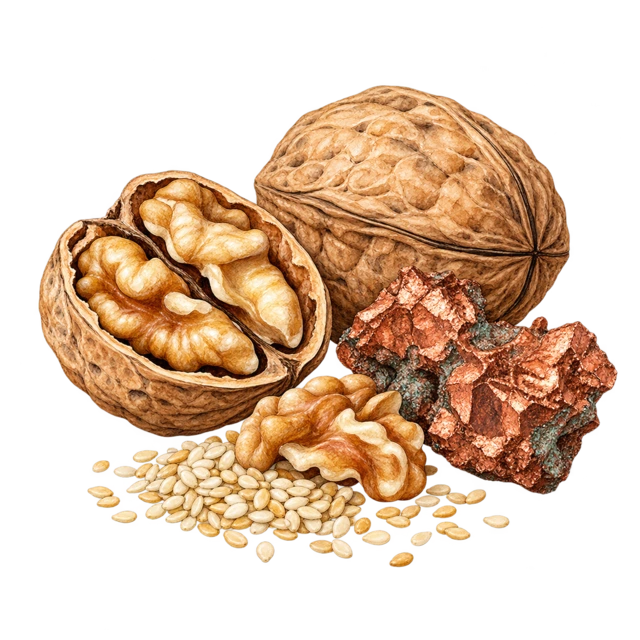
English walnuts
Kernels · 1 oz (28.35 g)
0.450 mg copper · 50% DV
English/Persian walnut; not black walnut hull tincture.
Pumpkin/squash kernels
Dried, shelled · 1 oz (28.35 g)
0.381 mg copper · 42% DV
Pepitas; not seed oil or an in-shell ounce.
Pistachios
Raw kernels · 1 oz (28.35 g)
0.369 mg copper · 41% DV
Sesame
Whole, dried seeds · 1 tbsp (9 g)
0.367 mg copper · 41% DV
Whole seeds retain hulls. Hulled dried kernels differ: 1 tbsp (8 g) = 0.112 mg, 12% DV, USDA 169412. Do not generalize by seed color.
Almonds
Whole kernels, unroasted USDA entry · 1 oz (28.35 g)
0.292 mg copper · 32% DV
Chickpeas
Boiled, no added salt · ½ cup (82 g)
0.289 mg copper · 32% DV
Millet
Cooked · 1 cup
0.280 mg copper · 31% DV
Generic cooked millet nutrient record; not species-specific historical grain evidence.
Whole-wheat pasta
Cooked · 1 cup (not packed)
0.263 mg copper · 29% DV
Related food form under the existing Wheat source-plant card, not a standalone pasta card. Do not transfer cooked-pasta values to dry grain or flour.
Lentils
Boiled, no added salt · ½ cup (99 g)
0.248 mg copper · 28% DV
Avocado
Raw flesh · ½ cup
0.219 mg copper · 24% DV
Avocado fruit flesh; avocado oil is a different edible form with different composition.
Figs
Dried · ½ cup
0.214 mg copper · 24% DV
Common fig; do not transfer to sycomore fig or fresh fruit.
Cocoa powder
Unsweetened, not alkalized · 1 tbsp (5.4 g)
0.205 mg copper · 23% DV
Not sweetened cocoa drink mix; alkalized cocoa is a separate record.
Animal-food comparisons (3)
Included for context. The liver portion below exceeds the adult 10 mg/day upper limit and is not an everyday copper target. Upper limits are lower for children.
Beef liver
Pan-fried · 3 oz
12.400 mg copper · 1378% DV
This comparison serving exceeds the adult copper upper limit of 10 mg/day. Not an everyday copper target.
Eastern oysters
Wild, cooked · 3 oz
4.850 mg copper · 539% DV
Species and preparation matter; oyster mushrooms are unrelated.
Dungeness crab
Cooked · 3 oz
0.624 mg copper · 69% DV
Food composition does not establish a deficiency or predict a treatment effect. Oils and extracts do not inherit these food values.
History, folklore and reported uses
History, folklore and traditional uses
Copper has two quite different histories: a metal worked into ornaments and tools, and a trace element required by living organisms. Bronze combines copper with tin; that material history does not make metal objects nutritional products.
This notebook treats copper principally as a food nutrient. A varied diet can provide it without turning a food comparison into a supplement regimen.
Traditional, historical and reported uses
- Dietary adequacy
Mixed/contextual sourcesWhy this label?
The consumer fact sheet supplies general physiological/nutritional context, with neither actual food nutrient measurements nor a specified intervention study.
Copper supports normal energy production, connective tissue and nervous-system function.
- Historical metalwork
Historical recordWhy this label?
The RSC historical account documents copper and bronze tools, coins, and objects as material history, not an ingestion claim.
Copper and its bronze alloy were used for tools, coins and other objects. This is material history, not an ingestion recommendation.
Culinary, material and historical uses are distinguished from medical claims. The number of uses reflects the reviewed evidence, not a fixed quota.
Historical-use additions reviewed 2026-10-08
Regional reading paths
These sourced notes describe cultivation, trade, food traditions or material history. A regional connection does not claim exclusive origin.
South America
geological and industrial; Chile
Industrial metal; ore is not a dietary supplement.
Identity & detailed reference
Identity
An essential trace mineral. Dietary copper in foods and regulated supplements is distinct from copper metal, industrial salts and agricultural products.
Ingredient details, preparation and research
Also known as: Cu; Copper mineral
Source plant or material
No single plant source; copper is a chemical element occurring in many foods.
Plant family / material: Not applicable: mineral element
Forms and route
Food-bound copper; multivitamin/mineral products and copper salts or chelates in supplements. Product labels report the elemental amount.
Vitamins and minerals
US adult RDA: 0.9 mg/day; pregnancy 1.0 mg and lactation 1.3 mg. These are total dietary targets, not suggested supplement doses. The adult upper limit is 10 mg/day from all sources, not an intake goal.
Absorption and preparation
Absorption varies with intake; the amount listed in a food is not the amount absorbed. No supplement form has an established bioavailability advantage in comparative studies.
Nutritional role and uses
- Dietary adequacy
- Historical metalwork
Contraindications and cautions
- Do not self-treat anemia, fatigue or neurological symptoms with copper; their causes need assessment.
- Excess copper can injure the liver and cause gastrointestinal illness. People with Wilson disease need specialist guidance.
- High-dose zinc can reduce copper absorption. Review supplements with a clinician rather than adding a second mineral to compensate.
- Industrial copper salts, fungicides and copper metal are not food supplements.
Similar items and how they compare
- Zinc
Both are essential trace minerals.
High supplemental zinc can interfere with copper; more of both is not automatically better.
Clinical boundary
A nutrient’s normal biological role does not establish that extra intake treats disease. Copper status requires interpretation in clinical context.
Evidence limits
Nutritional requirements and upper limits are reference values, not self-treatment instructions.
Entry sources
- NIH ODS: Copper, consumer fact sheet
- NIH ODS: Copper, health-professional fact sheet, food table
- Royal Society of Chemistry: Copper
Reference entry 239 · Recorded content review: 2026-10-08 · Review scope and dates