


Key cautions
- Do not apply fig sap, leaves or a homemade fig poultice to a boil or wound. Sap and leaf contact, especially with sunlight, can cause dermatitis or burns.
- Dried figs are compact carbohydrate portions; larger amounts may cause digestive discomfort.
What’s inside
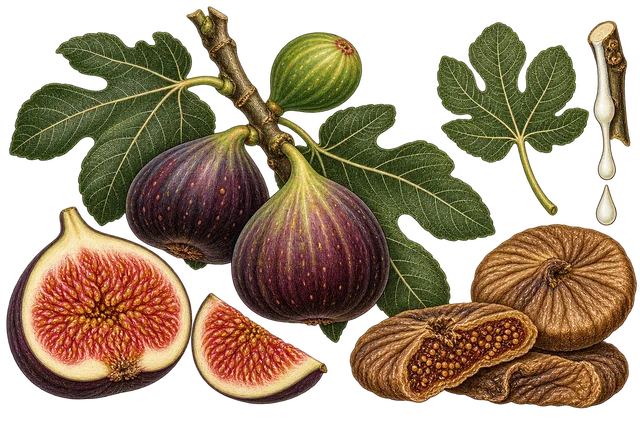
Naturally occurring sugars, dietary fiber, potassium and modest calcium; small vitamin contributions. Figs are syconia, fleshy structures enclosing many tiny flowers and fruits. Milky sap contains proteolytic and irritating constituents; it is not the ordinary edible serving.
Uses in brief

- Eat fresh figs or a measured portion of dried fruit; dried cakes and preserves have a long food history.
- Fiber-containing figs fit into a varied diet; a specific fig paste has also been studied for functional constipation.
Copper food reference
Copper in this food
Approximate reference values for the exact form and portion shown. The label Daily Value (DV) is 0.9 mg for adults and children age 4+, not an individual intake prescription. Portions differ, so this is not a per-gram ranking.
Figs
Dried · ½ cup
0.214 mg copper · 24% DV
Common fig; do not transfer to sycomore fig or fresh fruit.
Compare copper food sources and read the mineral cautions
Food composition does not establish a deficiency or predict a treatment effect. Oils and extracts do not inherit these food values.
In the King James Bible
In the King James Bible
Named material
Common figs are the edible fig structures of Ficus carica, conventionally identified with the ordinary figs and fig trees of the Bible. They are distinct from Ficus sycomorus. Fresh figs, dried fruit, pressed cakes, syrup and milky plant sap are different materials. The Hezekiah fig-poultice narrative is a historical account, separate from present-day wound care.
A land of wheat, and barley, and vines, and fig trees, and pomegranates; a land of oil olive, and honey;
Deuteronomy 8:8 (KJV)
And they gave him a piece of a cake of figs, and two clusters of raisins: and when he had eaten, his spirit came again to him: for he had eaten no bread, nor drunk any water, three days and three nights.
1 Samuel 30:12 (KJV)
Scripture and identification sources
Words & their stories
WORDS & THEIR STORIES
The name behind the KJV
Biblical Hebrew · Deuteronomy 8:8 (KJV)
וּתְאֵנָהūtəʾēnāh
“And fig trees,” among the land’s produce.
Dictionary form: תְּאֵנָה · təʾēnāh
The singular noun is collective here; ū- means “and.”
Biblical Hebrew · 1 Samuel 30:12 (KJV)
דְּבֵלָהdəbēlāh
A pressed fig cake, of which a piece is given to the Egyptian.
Dictionary form: דְּבֵלָה · dəbēlāh
The word names a prepared fruit cake, not the tree; the preceding word means a piece or slice.
What the language reveals
A preparation with its own word
Dəbēlāh distinguishes a fig cake from the ordinary tree-and-fruit term təʾēnāh.
Food in the narrative
The fig cake and raisins accompany the bread and water given to a man who has gone three days without food or drink.
The ordinary fig is conventionally Ficus carica. A fig cake is distinct from sycomore fruit, fig leaves or latex; this episode establishes no medicinal formula.
History, folklore and reported uses
History, folklore and traditional uses
The fig appears as both food and a familiar feature of a settled landscape. Deuteronomy includes fig trees among the land’s agricultural abundance, and 1 Samuel describes a cake of figs among the provisions given to an exhausted man. Drying and pressing transformed a delicate seasonal harvest into something that could be carried and stored.
The tree also offers shade and an unusually intimate way to notice the seasons: its leaves and developing figs are visible while its tiny flowers remain enclosed inside the fig. Biblical vine-and-fig imagery links everyday orchard security with peace. Later Mediterranean and other food traditions continued to value ripe fruit, dried figs and preserves, with dried fruit becoming an important trade item.
Medicinal heritage concerns several different materials. The Hezekiah narrative names a lump of figs applied to a boil; later sources record fig-fruit syrup for bowel complaints and milky sap for warts and calluses. Those are separate traditions, not one universal fig remedy. Sap and leaves can injure skin, while modern bowel research has investigated a particular oral paste.
Traditional, historical and reported uses
- Preserved fruit for provisions and trade
Food or household practiceWhy this label?
Fruit preservation for provisions and trade.
Drying and pressing turned perishable figs into stored food. First Samuel 30:12 records a cake of figs among provisions; NParks also documents dried figs as an important trade food. These are related uses of fruit preservation, grouped together here.
- Traditional bowel preparations
Traditional accountWhy this label?
Traditional medicinal fig-fruit syrup for bowel function.
Fig-fruit syrup has a recorded laxative tradition. Modern products may be mixtures, so the name alone does not identify ingredients or a dose.
- The Hezekiah fig-poultice narrative
Historical recordWhy this label?
Specific Kings passage documents the fig-poultice narrative.
Second Kings 20:7 records a lump of figs in the story of Hezekiah’s boil. It is presented here as a documented historical use, without instructions to put food on an infected lesion.
- Sap for warts and calluses
Traditional accountWhy this label?
Mediterranean topical sap-remedy tradition; skin source adds safety context.
Kew records a Mediterranean tradition of using fig sap on warts and calluses. This refers to the milky plant sap, not the edible fruit; skin irritation and phototoxicity are relevant cautions.
- Fig leaves in an Ethiopian milk-coagulation tradition
Food or household practiceWhy this label?
Traditional milk-coagulation food process investigated by researchers.
Researchers report that people around Ab’ala in Ethiopia’s Afar region traditionally use Ficus carica leaf extracts to encourage milk coagulation. Their 2020 study investigates that practice; the record concerns leaf extract, with no home preparation method or blanket safety claim.
Distinct documented uses are included. Drying and pressed provisions are grouped together rather than counted twice.
Historical-use additions reviewed 2026-10-08
Story sources
- 1 Samuel 30:12 (King James Version)
- Singapore NParks Flora & Fauna Web: Ficus carica, food and traditional uses
- 2 Kings 20:7 (King James Version)
- Royal Botanic Gardens, Kew: Edible fig, traditional sap use
- DermNet: Fig, skin irritation and phytophotodermatitis
- Application of Ficus carica and Solanum incanum extracts in milk coagulation: traditional practice in
Identity & detailed reference
Identity
Common figs are the edible fig structures of Ficus carica, conventionally identified with the ordinary figs and fig trees of the Bible. They are distinct from Ficus sycomorus. Fresh figs, dried fruit, pressed cakes, syrup and milky plant sap are different materials.
Ingredient details, preparation and research
Also known as: fig trees; figs
Source plant or material
Ficus carica L.; Ripe common-fig food, including fresh fruit and dried cakes; latex and leaves are separate materials.
Plant family / material: Moraceae (mulberry family)
Forms and route
Fresh ripe figs with edible skin and tiny internal fruits; dried figs, pressed fig cakes, jam and paste. Leaf preparations, latex and commercial laxative mixtures are separate products. A dried-fruit cake is not nutritionally identical to fresh fruit.
Vitamins and minerals
Two medium fresh figs (50 g each; 100 g total edible portion) provide about 74 kcal, 19.2 g carbohydrate, 16.3 g sugars, 2.9 g fiber, 0.75 g protein, 232 mg potassium, 35 mg calcium, 17 mg magnesium, 0.37 mg iron and 2 mg vitamin C. USDA SR28 food 09089. Dried figs have substantially less water and require their own portion and composition entry; these figures are not for sycomore figs.
Absorption and preparation
No special soaking method is required to obtain the nutrients in figs. Rehydration softens dried fruit without reversing its concentrated sugars. The modest plant-iron content is nonheme iron; vitamin-C-rich foods can help its absorption within a meal, but figs themselves are not an iron-deficiency treatment. Food fiber should be increased according to digestive tolerance.
Traditional and reported uses
- Eat fresh figs or a measured portion of dried fruit; dried cakes and preserves have a long food history.
- Fiber-containing figs fit into a varied diet; a specific fig paste has also been studied for functional constipation.
- The Hezekiah fig-poultice passage records a historical narrative and is not a modern home wound-treatment instruction.
Contraindications and cautions
- Do not apply fig sap, leaves or a homemade fig poultice to a boil or wound. Sap and leaf contact, especially with sunlight, can cause dermatitis or burns.
- Dried figs are compact carbohydrate portions; larger amounts may cause digestive discomfort.
- Avoid a fig product if it has caused allergic symptoms. Different ingredients in laxative syrups may have their own risks.
- Wash fresh fruit, keep it appropriately chilled, and discard fruit showing spoilage.
Similar items and how they compare
- Sycomore fig
Another biblical Ficus fruit.
Ficus sycomorus is a separate species; common-fig nutrition and treatment research cannot be assigned to it.
- Dates
Both can be dried or pressed into compact provisions.
Dates are palm fruit and have different serving weights and nutrient profiles.
- Fig syrup or laxative mixture
Uses the fig name and may contain fig-derived material.
The ingredient list and tested preparation matter; it is not automatically equivalent to a serving of fresh figs.
Fresh fruit, dried cakes and plant latex
These forms must remain distinct. The common fig is Ficus carica; the sycomore fig has its own card. The edible fig structure encloses many tiny flowers and fruits, while latex is a separate plant secretion.
A specific paste studied for constipation
An eight-week randomized double-blind trial assigned 80 people with functional constipation to fig paste or placebo. It reported improvements in transit time, stool type and abdominal discomfort. The result concerns the studied paste and population; it does not establish every fresh-fruit serving or mixed fig syrup as an equivalent treatment.
The topical tradition has a specific risk
Fig leaves and sap can produce irritant or light-associated skin injury. A scriptural poultice account supplies historical context, not contemporary evidence for treating boils at home.
Fresh serving basis
The numeric serving uses two USDA medium fresh figs. It cannot be substituted gram-for-gram for dried fruit, and neither the amount nor the measured nutrients are stated in the biblical passages.
Evidence limits
- Explicit KJV fruit; species identification conventional
- The historical Hezekiah poultice narrative does not establish a modern wound treatment.
Entry sources
- Singapore NParks Flora & Fauna Web: Ficus carica, food and traditional uses
- Lytton John Musselman, Old Dominion University: Common fig
- Royal Botanic Gardens, Kew: Edible fig, traditional sap use
- Baek et al. (2016): Randomized placebo-controlled trial of Ficus carica paste for functional constipation
- DermNet: Fig, skin irritation and phytophotodermatitis
- National Park Service, Tumacacori: Ethnobotany of Fruit Trees
- FDA: Selecting and Serving Produce Safely
- USDA SR28: Figs, raw, food 09089, PDF page 298
- NIH Office of Dietary Supplements: Vitamin C, Health Professional Fact Sheet
- 1 Samuel 30:12 (King James Version)
- 2 Kings 20:7 (King James Version)
- Deuteronomy 8:8 (King James Version)
- Application of Ficus carica and Solanum incanum extracts in milk coagulation: traditional practice in
Reference entry 146 · Recorded content review: 2026-10-06 · Review scope and dates