


Key cautions
- Avoid pistachios with a pistachio allergy; tree-nut allergy can be severe. Check mixed foods, bakery fillings and shared-equipment warnings.
- Remove hard shells and offer an age-appropriate finely ground form to young children or people with swallowing difficulties.
What’s inside
Kernels contain unsaturated fats, protein, fiber, potassium, copper, thiamin and vitamin B6, with carotenoids including lutein and zeaxanthin. Outer hull and resin chemistry should not be treated as the composition of a handful of kernels.
Uses in brief

- Enjoy plain unsalted kernels as a snack or chopped into grain dishes, vegetables and yogurt.
- Use the kernels or pure paste for flavor and texture in savory sauces and sweets; verify the nut proportion and added sugar.
Copper food reference
Copper in this food
Approximate reference values for the exact form and portion shown. The label Daily Value (DV) is 0.9 mg for adults and children age 4+, not an individual intake prescription. Portions differ, so this is not a per-gram ranking.
Pistachios
Raw kernels · 1 oz (28.35 g)
0.369 mg copper · 41% DV
Compare copper food sources and read the mineral cautions
Food composition does not establish a deficiency or predict a treatment effect. Oils and extracts do not inherit these food values.
In the King James Bible
Pistachios in the KJV
Probable botanical identification
The KJV says nuts in Genesis 43:11, not pistachios. Hebrew botnim is commonly understood as pistachio nuts, making Pistacia vera a conventional/probable identification. This is not a claim that every biblical nut is a pistachio or that pistachio oil is named. The gift passage is Genesis 43:11; the ODU pistachio profile’s Genesis 37:25 citation is an error.
And their father Israel said unto them, If it must be so now, do this; take of the best fruits in the land in your vessels, and carry down the man a present, a little balm, and a little honey, spices, and myrrh, nuts, and almonds:
Genesis 43:11 (KJV)
Scripture and identification sources
Words & their stories
WORDS & THEIR STORIES
The name behind the KJV
Biblical Hebrew · Genesis 43:11 (KJV)
בָּטְנִיםboṭnīm
The “nuts” carried as part of the gift to the Egyptian governor.
Dictionary form: בָּטְנִים · boṭnīm
BDB records the headword in the attested plural. Lexicons also supply a singular bōṭen; the verse’s first qamats is read o in boṭnīm.
What the language reveals
More specific than English “nuts”
The Hebrew gift list distinguishes boṭnīm from the almonds immediately following it.
A probable botanical identification
BDB identifies pistachio nuts while recording different Pistacia species in earlier scholarship. The modern edible pistachio is a conventional interpretation.
Pistachio is a strong conventional/probable identification, not an explicit English KJV species name. The verse does not name pistachio oil or every kind of biblical nut.
History, folklore and reported uses
History, folklore and traditional uses
Pistachio’s home range reaches from northeastern Iran into Central Asia and Afghanistan, according to Kew. Long cultivation carried its kernels into the food cultures of the Middle East and Mediterranean. An orchard also depends on an easily overlooked partnership: pistachio trees generally bear male or female flowers, so fruit-producing groves need pollen-bearing trees nearby. The prized kernel is only the innermost part of a fruit with an outer hull and a hard shell.
That precious inner food offers a persuasive reading of the nuts in Jacob’s gift to Egypt. The KJV leaves the English word generic, while botanical and lexical traditions commonly identify pistachios. The association should remain a probable identification rather than a rewritten quotation. The gift scene helps explain the nut’s place in this collection: a food valued enough to travel with honey, aromatics and almonds, not a biblical endorsement of modern pistachio oil.
The wider Pistacia story requires unusually careful naming. A species-specific review records P. vera oil in Jordanian facial cleansing and separate Iranian shell and Turkish resin traditions. Its relatives have their own histories, especially mastic and terebinths. More recent work has explored the discarded pistachio hull as a textile colorant. Together these records show how people use a tree’s different materials, while keeping the edible kernel at the center of this food card.
Traditional, historical and reported uses
- Food and hospitality
Food or household practiceWhy this label?
Edible kernels used in dishes and hospitality gifts.
Pistachio kernels are eaten and used in regional dishes; the probable Genesis identification places them among valued gifts rather than a medicinal prescription.
- Nourishing tonic in Persian tradition
Traditional accountWhy this label?
Iranian medicinal-tonic tradition uses attributed vocabulary.
The reviewed Iranian tradition describes the kernel as a tonic for several organs. This records the tradition’s vocabulary, without assigning those effects to a serving.
- Shell preparations for digestive complaints
Traditional accountWhy this label?
Iranian medicinal shell preparations, distinct from food kernels.
The review records Iranian P. vera nut-shell use for diarrhea and as a sedative or tonic. Shell remedies are distinct from edible kernels.
- Facial cleansing oil
Food or household practiceWhy this label?
Cosmetic facial-cleansing use of pressed oil.
Jordanian reports collected in the review describe P. vera oil for facial cleansing, an external use of the pressed fat.
- Tree resin in household remedies
Traditional accountWhy this label?
Attributed Turkish resin-remedy practice.
Turkish records cited by the review describe P. vera resin for asthma, stomachache and hemorrhoids. These are attributed historical uses, with no resin recipe or dose.
- Pistachio hulls as a Persian wool dye
Food or household practiceWhy this label?
Dye-master interviews document hulls used in wool dyeing.
A 2020 study based on interviews with dye masters in Isfahan records Pistacia vera fruit hulls among materials used for yellow wool dyeing. The outer hull is distinct from the hard shell and edible kernel; comparisons with historical carpets do not prove identical recipes in every old carpet.
Distinct documented uses are presented with the plant part or product specified; historical practices are not preparation instructions.
Historical-use additions reviewed 2026-10-08
Story sources
- Kew Plants of the World Online: Pistacia vera L.
- Lytton John Musselman, Old Dominion University: Pistachio (verse citation corrected to Genesis 43:11)
- Bozorgi et al.: Five Pistacia species, traditional uses, phytochemistry and pharmacology; species-specific Table 1
- Syrine et al.: Dyeing cellulosic fibers with Pistacia vera hull by-product extract
- Sharif and colleagues (2020): Traditional yellow dyes used in the 21st century in central Iran, NOVA
Regional reading paths
These sourced notes describe cultivation, trade, food traditions or material history. A regional connection does not claim exclusive origin.
Asia
Native/cultivated: Iran, Afghanistan and Central Asia.
Edible kernels eaten plain or incorporated in foods.
Identity & detailed reference
Identity
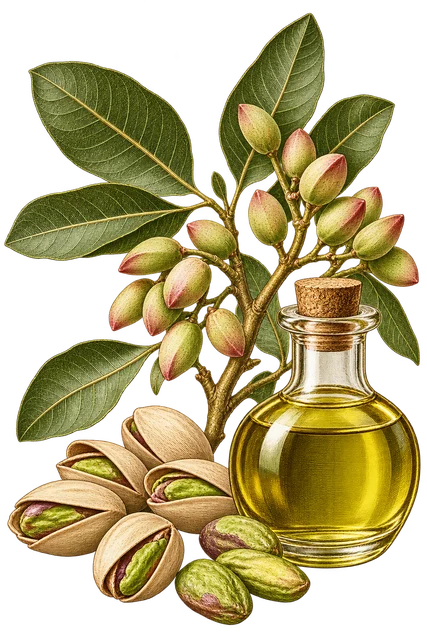
Pistachios are the edible kernels of Pistacia vera. The hard shell and outer fruit hull are removed. The Genesis word translated nuts is commonly identified as pistachios, but the English KJV does not explicitly say pistachio.
Ingredient details, preparation and research
Also known as: Pistachio nuts; Pista; KJV nuts in Genesis 43:11, probable identification
Source plant or material
Pistacia vera L.; mature edible seed kernels. Related terebinths and mastic trees supply different fruits, resins and oils.
Plant family / material: Anacardiaceae, the cashew family.
Forms and route
Shelled or in-shell kernels, plain or salted, raw-style or roasted; chopped nuts, paste, butter and pastry ingredients. Pistachio fixed oil is a separate fat fraction. Mastic resin is usually from Pistacia lentiscus, not this kernel.
Food sources
The edible weight is the shelled kernel. A weighed portion from in-shell nuts should exclude discarded shells. Pure pistachio paste retains kernel solids, while pistachio-flavored confectionery may contain relatively little nut.
Vitamins and minerals
For 28.35 g raw pistachio kernels, 1 oz or about 49 kernels: about 159 kcal, 5.7 g protein, 12.8 g fat, 7.7 g carbohydrate, 3.0 g fiber, 2.2 g sugars, 291 mg potassium, 34 mg magnesium, 30 mg calcium, 1.1 mg iron, 0.37 mg copper, 0.25 mg thiamin and 0.48 mg vitamin B6. USDA SR28 food 12151; shell weight excluded. Salted or coated products require their own label.
Absorption and preparation
Chewing and processing affect how much of the kernel’s fat becomes accessible. A USDA controlled feeding study measured slightly less metabolizable energy than predicted by standard factors. This does not justify subtracting an arbitrary percentage from every product label. Ordinary meals or snacks are suitable; no special companion food or fasting schedule is established.
Practical preparation
Shell before using; weigh edible kernels rather than a pile of shells. Chop or grind for the desired texture. Keep dry, sealed and cool, with refrigeration or freezing for longer storage. Choose a finished food-grade oil if using pistachio oil in cooking.
Combination context
A small portion can add crunch to lentils, cooked grains, roasted vegetables or plain yogurt. Pairing is culinary: adding several other nuts or oils does not establish a special absorption synergy. Count salt and sweeteners in the finished dish.
Traditional and reported uses
- Enjoy plain unsalted kernels as a snack or chopped into grain dishes, vegetables and yogurt.
- Use the kernels or pure paste for flavor and texture in savory sauces and sweets; verify the nut proportion and added sugar.
- Ethnobotanical accounts report distinct tonic, skin-care, shell and resin traditions for Pistacia vera. These are historical uses of named materials, not directions to ingest shells or resin.
Contraindications and cautions
- Avoid pistachios with a pistachio allergy; tree-nut allergy can be severe. Check mixed foods, bakery fillings and shared-equipment warnings.
- Remove hard shells and offer an age-appropriate finely ground form to young children or people with swallowing difficulties.
- Buy from reputable food suppliers, observe recalls and discard moldy or damaged nuts. Home roasting is not a reliable fix for suspect food.
- Salted nuts, sweetened pastes and dessert fillings differ from the plain-kernel reference; compare sodium, sugar and actual pistachio content.
- Do not copy historic shell or resin remedies. Mastic, terebinth oil and other Pistacia products are not interchangeable with edible P. vera kernels.
Preparation-specific cautions
- Pistachio allergy can be severe; identify all nuts in mixed foods.
- Remove shells and use a texture appropriate to age and swallowing ability.
- Use reputable food products and keep kernels dry, sealed and cool.
- These are not routine food ingredients or interchangeable preparations.
Similar items and how they compare
- Almonds
Shares the Genesis gift list and a culinary nut role.
Almonds are explicitly named there; pistachios are an interpretation of nuts.
- Mastic, Pistacia lentiscus
A related tree also used in traditional remedies.
Its traded resin is not pistachio kernel or pistachio oil; genus-level history must not be assigned to P. vera automatically.
- Pistachio oil
Pressed from the same food kernel.
Supplies the fat fraction, not the kernel’s protein, fiber or full mineral profile.
A probable nut behind a generic English word
The Hebrew term in Genesis 43:11 is commonly glossed as pistachio. Keep the KJV quotation unchanged. The ODU page has a mistaken verse reference to Genesis 37:25; Genesis 43:11 is the gift passage.
Nutrition refers to edible kernels
USDA’s ounce portion is 28.35 g without shells, approximately 49 kernels. This basis does not describe an ounce of in-shell nuts, a spoonful of oil or a sugar-rich pastry filling.
Food structure and energy measurement
Baer and colleagues measured pistachio energy in a controlled human diet and found a value below prediction from general Atwater factors. The point is that a nut’s intact structure matters; ordinary label and portion guidance should still be used for the actual food.
Species-specific heritage and newer materials work
The ethnobotanical review separates P. vera from four other Pistacia species, an essential precaution for oil and resin claims. Separately, a materials experiment used pistachio hull extract to color treated cotton. That is a documented modern by-product application, not evidence for eating hulls or an invented ancient dye tradition.
Parts and materials used
Food kernel. Hull, hard shell, tree resin and pressed seed oil must be identified separately.
Food forms and ingredient distinctions
The edible weight is the shelled kernel. A weighed portion from in-shell nuts should exclude discarded shells. Pure pistachio paste retains kernel solids, while pistachio-flavored confectionery may contain relatively little nut.
Practical preparation
Shell before using; weigh edible kernels rather than a pile of shells. Chop or grind for the desired texture. Keep dry, sealed and cool, with refrigeration or freezing for longer storage. Choose a finished food-grade oil if using pistachio oil in cooking.
Meal ideas and combinations
A small portion can add crunch to lentils, cooked grains, roasted vegetables or plain yogurt. Pairing is culinary: adding several other nuts or oils does not establish a special absorption synergy. Count salt and sweeteners in the finished dish.
Food reference portions
- Nuts, pistachio nuts, raw
1 oz (49 kernels) (28.35 g): about 158.76 kcal Energy. Calculated from the specified edible-portion reference; shells, oil and other forms excluded. Data: USDA SR28.
- Nuts, pistachio nuts, raw
1 oz (49 kernels) (28.35 g): about 5.715 g Protein. Calculated from the specified edible-portion reference; shells, oil and other forms excluded. Data: USDA SR28.
- Nuts, pistachio nuts, raw
1 oz (49 kernels) (28.35 g): about 12.848 g Total fat. Calculated from the specified edible-portion reference; shells, oil and other forms excluded. Data: USDA SR28.
Food composition reference
Nuts, pistachio nuts, raw · 1 oz (49 kernels) (28.35 g). Approximate values, rounded to about three significant digits.
| Nutrient | Per 100 g | Per stated serving |
|---|---|---|
| Energy | 560 kcal | 159 kcal |
| Protein | 20.2 g | 5.71 g |
| Total fat | 45.3 g | 12.8 g |
| Carbohydrate | 27.2 g | 7.7 g |
| Fiber | 10.6 g | 3 g |
| Sugars | 7.66 g | 2.17 g |
| Calcium | 105 mg | 29.8 mg |
| Magnesium | 121 mg | 34.3 mg |
| Potassium | 1020 mg | 291 mg |
| Iron | 3.92 mg | 1.11 mg |
| Copper | 1.3 mg | 0.369 mg |
| Thiamin | 0.87 mg | 0.247 mg |
| Vitamin B6 | 1.7 mg | 0.482 mg |
USDA SR28 reference data, currently accessible; not newly collected 2026 measurements; USDA NDB 12151
per-100-g value × edible serving grams / 100; displayed prose rounded
Evidence limits
- Pistachio is a conventional/probable identification, not an explicit English KJV name.
- Some folk-use evidence is available through a review’s species-specific table rather than independently inspected original field interviews.
- The food card does not transfer medicinal claims from P. lentiscus, P. atlantica, P. terebinthus or P. khinjuk.
Entry sources
- Kew Plants of the World Online: Pistacia vera L.
- Strong and Brown–Driver–Briggs lexicons: Hebrew 992, botnim
- USDA SR28: Nuts and Seed Products; foods 12061 almonds, 12151 raw pistachios, 12155 English walnuts
- Lytton John Musselman, Old Dominion University: Pistachio (verse citation corrected to Genesis 43:11)
- Bozorgi et al.: Five Pistacia species, traditional uses, phytochemistry and pharmacology; species-specific Table 1
- Baer, Gebauer and Novotny: Measured energy value of pistachios in the human diet
- USDA ARS: Nuts for Calories!
- FDA: Food Allergies, What You Need to Know
- University of California ANR: Nuts, Safe Methods for Consumers to Handle, Store, and Enjoy
- Syrine et al.: Dyeing cellulosic fibers with Pistacia vera hull by-product extract
- CDC: Choking Hazards in Infant and Toddler Nutrition
- Genesis 43:11 (KJV)
- Sharif and colleagues (2020): Traditional yellow dyes used in the 21st century in central Iran, NOVA
Reference entry 153 · Recorded content review: 2026-10-06 · Review scope and dates