


Key cautions
- Avoid all seed colors and sesame-containing foods with sesame allergy; check labels and bakery cross-contact.
- Food-grade seeds and seed oil are not interchangeable with essential oils or concentrated supplements.
What’s inside
Seed oil and protein; hull and kernel composition differ.
Uses in brief

- Bread and bakery topping
- Tahini paste
- Hummus ingredient
Copper food reference
Copper in this food
Approximate reference values for the exact form and portion shown. The label Daily Value (DV) is 0.9 mg for adults and children age 4+, not an individual intake prescription. Portions differ, so this is not a per-gram ranking.
Sesame
Whole, dried seeds · 1 tbsp (9 g)
0.367 mg copper · 41% DV
Whole seeds retain hulls. Hulled dried kernels differ: 1 tbsp (8 g) = 0.112 mg, 12% DV, USDA 169412. Do not generalize by seed color.
Compare copper food sources and read the mineral cautions
Food composition does not establish a deficiency or predict a treatment effect. Oils and extracts do not inherit these food values.
History, folklore and reported uses
History, folklore and traditional uses
USDA NRCS describes sesame as a crop cultivated for thousands of years, with seed coats ranging from pale to black. Its account credits enslaved people with bringing sesame to the southern United States; the name benne remains associated with that history.
Bread toppings and pressed oil represent different uses of one crop. Health Canada’s food-allergen guide also documents sesame in tahini, hummus and halvah, linking whole seeds with ground pastes and confectionery.
A closer look at its history
Benne and a documented oil experiment
Monticello records that enslaved Africans introduced benne to Georgia. After tasting its oil in 1807, Jefferson promoted it as an olive-oil substitute and sent seeds to acquaintances. His own extraction efforts were much less successful: by 1811, three years of attempts had yielded only a small seed crop and about a gallon of oil.
The capsule changed the harvest
Traditional sesame capsules split at maturity, making hand harvest essential. Oklahoma State traces a pivotal non-shattering mutation to 1943 and links subsequent breeding to the start of US commercial production in the 1950s.
Additional history reviewed 2026-10-09
Traditional, historical and reported uses
- Bread and bakery topping
Food or household practiceWhy this label?
Seeds used in breads and bakery products.
USDA records seed use in breads and bakery products.
- Tahini paste
Food or household practiceWhy this label?
Seeds ground into tahini paste.
Health Canada identifies tahini as a sesame food; grinding produces a paste rather than an extracted oil.
- Hummus ingredient
Food or household practiceWhy this label?
Sesame paste used in hummus recipes.
Sesame paste is present in many hummus preparations; check the recipe or label.
- Halvah confectionery
Food or household practiceWhy this label?
Sesame used in confectionery.
Halvah is a documented sesame-containing confection, a sweet food with its own added ingredients.
- Cooking oil production
Food or household practiceWhy this label?
Seeds pressed for culinary oil.
USDA documents pressing seed into oil; this historical food-processing use is separate from eating whole seeds.
Five distinct culinary applications are documented; these are food practices, not five medicinal indications.
Growing notes
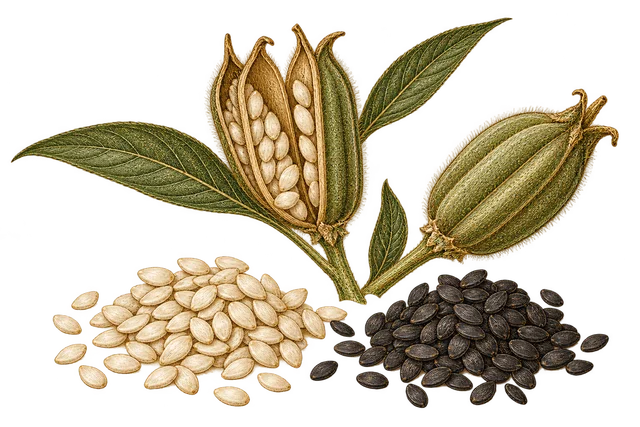
Sesamum indicum L.; culinary seed cultivars, including shattering heirlooms and shatter-resistant agricultural types.
- Climate and planting
- Warm-season annual needing a long warm growing window. Direct-sow once soil is about 70°F (21°C), with enough season remaining for seed ripening and drying. [1]
- Sun and soil
- Full sun and freely draining soil. Texture is less important than drainage; North Carolina trials include clay and sand. Optimal pH remains insufficiently established. [2] [1]
- Habit
- Upright, often branched, with bell-shaped flowers and capsules. Height varies greatly, approximately 2–8 feet in NC trials; lower capsules mature before upper ones. [1]
- Water
- Provide moisture for germination without compacting the seedbed. Seeds need several continuously moist days to germinate. Established plants tolerate drought, but cannot tolerate waterlogging; select cultivars suited to local summer humidity. [1] [2]
- Nutrition
- Base phosphorus and potassium additions on soil tests. Keep nitrogen modest: excess promotes lush, lodging-prone growth, and NC trials found inconsistent yield response. [3] [1]
- Harvest
- NC guidance gives about 100 days to seed maturity plus 7–14 days drying; Florida gardens may need up to five months. Collect dry stalks carefully before shattering capsules spill seed. [1] [2]
- Pollination and wildlife
- Self-pollinating, while flowers also attract bumble bees and other insects. [2]
- Pests
- Weed early while seedlings grow slowly. Scout for aphids, stinkbugs, corn earworms and leaf spots; pest pressure varies by region. [1]
Growing sources and regional guidance
Growing notes reviewed 2026-10-09
Women’s Health: traditions, evidence and cautions
Historical use does not establish benefit or safety. Pregnancy, breastfeeding and fertility care require particular caution: food, tea, essential oil and concentrated extract are not interchangeable. These records are not treatment, dosing or pregnancy-management instructions. Discuss supplements with a qualified clinician or pharmacist; do not delay evaluation of persistent symptoms.
Sesame seed / til
Sesamum indicum L.
- Plant part / material
- Edible seed
- Preparation studied or reported
- Seed foods; not sesame oil or isolated lignans.
The 2007 Warli/Dahanu field study records sesame seeds consumed by nursing mothers to encourage lactation.
Sesame is an ordinary food with a separate medicinal history in Persian medicine for infrequent menstruation. That record does not validate modern seed-cycling schedules or claim that normal food portions change fertility.
Lactation / milk-supply tradition
Primary ethnobotanical record; efficacy unestablished
Reported or traditional useSeed foods form part of a regional lactation-support tradition.
What the evidence supportsThat ethnobotanical record documents practice, not clinical efficacy. No convincing sesame-only human galactagogue trial was established in this source review.
Sesame is a major food allergen. Traditional seed use does not demonstrate medicinal pregnancy/infant safety or support applying oil to the nipple.
infrequent menstruation
Documented tradition; small exploratory trial, insufficient for fertility or cycle-regulation claims.
Reported or traditional useTraditional Persian use for oligomenorrhea prompted a small Iranian clinical trial.
What the evidence supportsA single-blind trial enrolled 56 women and compared sesame seed powder with progesterone treatment. Bleeding occurred less often in the sesame arm. This is preliminary evidence, not proof of restored ovulation, fertility or equivalence to medical care.
Sesame can cause serious allergy. If a period is late, rule out pregnancy and seek advice rather than attempting medicinal period induction. Pregnancy/lactation safety of medicinal regimens is not established; ordinary food is a separate context.
- This concerns an ordinary food, not a recommendation for medicinal quantities in pregnancy or lactation. The cited studies do not establish safety of concentrated extracts.
- Food seed, extract and oil evidence are not interchangeable.
- Not evidence for seed cycling.
Regional reading paths
These sourced notes describe cultivation, trade, food traditions or material history. A regional connection does not claim exclusive origin.
Africa
Cultivated and processed: Sudan; seeds enter confections and oil production.
Whole or ground food-grade seeds, including tahnia-type confections.
Asia
Cultivated/traditional processing: China, Japan and Korea; wider Asian seed crop.
Whole seeds used as food and garnish; separate from extracted oil.
Identity & detailed reference
Identity
Edible sesame seeds, including black- and white-seeded varieties; hulled and unhulled products must be distinguished.
Ingredient details, preparation and research
Also known as: black sesame; white sesame; benne
Source plant or material
Sesamum indicum L.; Edible sesame seeds, including black- and white-seeded varieties; hulled and unhulled products must be distinguished.
Plant family / material: Pedaliaceae
Forms and route
Whole food-grade seeds, raw-style or toasted; ground sesame paste such as tahini. Extracted sesame oil is a separate product.
Vitamins and minerals
Sesame is a fat- and protein-containing seed. A small garnish and a substantial portion of paste contribute different amounts; use the label for the actual hulled or unhulled product.
Absorption and preparation
The cited food sources do not establish that black seeds are better absorbed than white seeds. Grinding changes texture; no universal absorption percentage is assigned.
Practical preparation
Choose food-grade seed and follow its label. Toast only to the desired flavor without burning; store closed, cool and dry.
Combination context
Whole seeds provide texture; paste disperses into dips and dressings. Seed color alone does not establish nutritional superiority.
Traditional and reported uses
- USDA records seed use in breads and bakery products.
- Health Canada identifies tahini as a sesame food; grinding produces a paste rather than an extracted oil.
- Sesame paste is present in many hummus preparations; check the recipe or label.
- Halvah is a documented sesame-containing confection, a sweet food with its own added ingredients.
- USDA documents pressing seed into oil; this historical food-processing use is separate from eating whole seeds.
Contraindications and cautions
- Avoid all seed colors and sesame-containing foods with sesame allergy; check labels and bakery cross-contact.
- Food-grade seeds and seed oil are not interchangeable with essential oils or concentrated supplements.
Similar items and how they compare
- Sesame oil
Comes from the same seed.
The extracted fat does not retain the whole seed’s protein and fiber.
- Pumpkin seeds
Both are edible oilseeds.
They differ botanically, in size and in allergy considerations.
Food identity and preparation
Whole food-grade seeds, raw-style or toasted; ground sesame paste such as tahini. Extracted sesame oil is a separate product. Choose food-grade seed and follow its label. Toast only to the desired flavor without burning; store closed, cool and dry.
Nutrition and evidence limits
Sesame is a fat- and protein-containing seed. A small garnish and a substantial portion of paste contribute different amounts; use the label for the actual hulled or unhulled product. The cited food sources do not establish that black seeds are better absorbed than white seeds. Grinding changes texture; no universal absorption percentage is assigned.
Evidence limits
- Nutrient information is qualitative; no unverified USDA food code, portion or numerical analysis is supplied.
- Culinary history does not establish a treatment effect. No medicinal dose is proposed.
Entry sources
- USDA NRCS: Sesame Plant Guide, 2014
- NC State Extension: Sesame Production Fact Sheet
- Health Canada: Sesame, a priority food allergen and food examples
- FDA: Sesame as a major food allergen
Reference entry 161 · Recorded content review: 2026-10-07 · Review scope and dates