


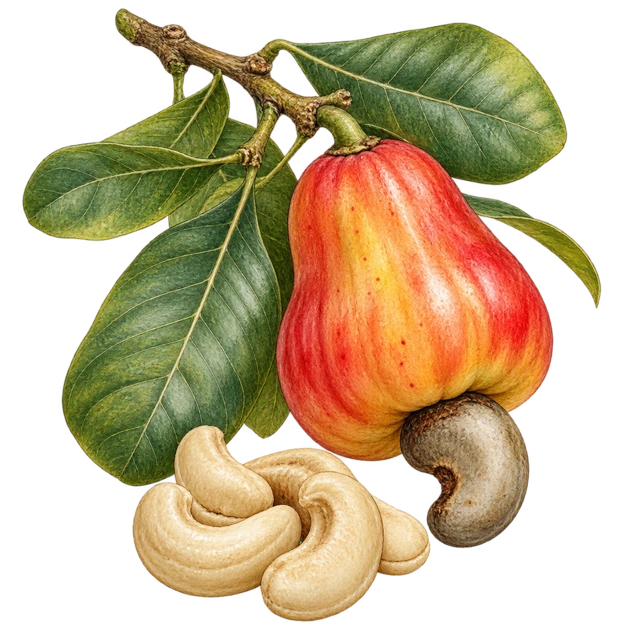
Key cautions
- Cashew is a tree-nut allergen; avoid it if allergic and check mixed-food labels.
- Use commercially processed food kernels. Do not handle or eat raw in-shell cashews or use cashew shell liquid as food or skincare.
- Cashew-apple juice, kernel foods and shell products are not interchangeable.
What’s inside
Fat, protein, carbohydrate and minerals, including copper. The irritant shell liquid is not an edible kernel oil.
Uses in brief

- Edible kernels
- Cashew-apple foods
- Shell-liquid industrial uses
Copper food reference
Copper in this food
Approximate reference values for the exact form and portion shown. The label Daily Value (DV) is 0.9 mg for adults and children age 4+, not an individual intake prescription. Portions differ, so this is not a per-gram ranking.
Cashews
Dry-roasted · 1 oz
0.629 mg copper · 70% DV
Compare copper food sources and read the mineral cautions
Food composition does not establish a deficiency or predict a treatment effect. Oils and extracts do not inherit these food values.
History, folklore and reported uses
History, folklore and traditional uses
Cashew makes more than one useful material, which is why naming the plant alone is not enough. Commercial kernels are food; the apple has regional fruit uses; the shell yields an industrial liquid.
World Agroforestry documents the apple as a food and drink ingredient in Brazil, Mozambique and Indonesia. Those fruit traditions should not inherit nutrient figures measured in the roasted kernel.
Traditional, historical and reported uses
- Edible kernels
Food or household practiceWhy this label?
The claim documents edible kernels as a culinary, craft, gardening, or practical material use; it reports neither a treatment outcome nor measured nutrient content.
Commercially processed kernels are eaten as a food or snack.
- Cashew-apple foods
Food or household practiceWhy this label?
The claim documents cashew-apple foods as a culinary, craft, gardening, or practical material use; it reports neither a treatment outcome nor measured nutrient content.
The separate fleshy apple is eaten fresh and used in juices, sweets and preserves in producing regions.
- Shell-liquid industrial uses
Food or household practiceWhy this label?
The claim documents shell-liquid industrial uses as a culinary, craft, gardening, or practical material use; it reports neither a treatment outcome nor measured nutrient content.
Shell liquid has uses in resins and protective materials. This is a separate nonfood product, not a skin or dietary remedy.
Culinary, material and historical uses are distinguished from medical claims. The number of uses reflects the reviewed evidence, not a fixed quota.
Historical-use additions reviewed 2026-10-08
Regional reading paths
These sourced notes describe cultivation, trade, food traditions or material history. A regional connection does not claim exclusive origin.
South America
native and cultivated; Brazil
Safely processed kernel; shell is excluded.
Identity & detailed reference
Identity
The edible seed kernel sold as a cashew nut. Its shell and the fleshy cashew apple are separate materials.
Ingredient details, preparation and research
Also known as: Cashew nut; Kaju; Caju (regional name)
Source plant or material
Anacardium occidentale L.
Plant family / material: Anacardiaceae
Forms and route
Commercially processed edible kernels, including dry-roasted cashews; salted, flavored, ground and blended products differ.
Vitamins and minerals
Cashew kernels supply fat, protein and copper. The copper comparison uses dry-roasted edible kernels; added salt and coatings change the finished food.
Absorption and preparation
The serving figure describes total copper content, not a measured absorbed dose or proof that soaking improves uptake.
Practical preparation
Choose labeled food-grade kernels; use the label for added sodium, sugar and storage guidance.
Combination context
No special herbal pairing is required.
Combination notes
Use in an ordinary mixed diet; the food’s mineral content does not establish a medicinal combination or treatment.
Traditional and reported uses
- Edible kernels
- Cashew-apple foods
- Shell-liquid industrial uses
Contraindications and cautions
- Cashew is a tree-nut allergen; avoid it if allergic and check mixed-food labels.
- Use commercially processed food kernels. Do not handle or eat raw in-shell cashews or use cashew shell liquid as food or skincare.
- Cashew-apple juice, kernel foods and shell products are not interchangeable.
Similar items and how they compare
- Pistachio
Another culinary tree nut in Anacardiaceae.
A different species and food; neither nutrient values nor allergy tolerance should be assumed identical.
Which part?
The nutritious kernel is distinct from both the swollen fleshy apple and the shell’s caustic industrial liquid.
Evidence limits
Food composition varies by variety, preparation and product. A reference serving is a comparison, not a therapeutic dose.
Entry sources
- Kew POWO: Anacardium occidentale
- World Agroforestry: Anacardium occidentale, Agroforestree Database
- NIH ODS: Copper, health-professional fact sheet, food table
- FDA: Food Allergies, What You Need to Know
Reference entry 240 · Recorded content review: 2026-10-08 · Review scope and dates