


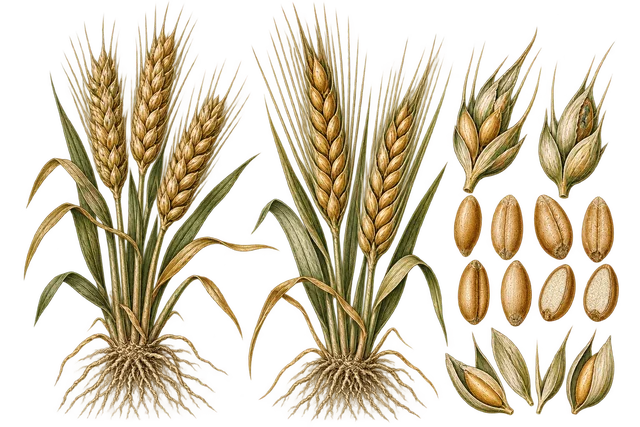
Key cautions
- Wheat, including durum, bulgur, semolina, couscous and ordinary wheat pasta, contains gluten and is unsuitable for celiac disease.
- Avoid wheat if you have a diagnosed wheat allergy. Gluten-free and wheat-allergy labeling answer different questions, so check the actual ingredients and clinical advice.
What’s inside
Starch; protein including gluten; fiber, B vitamins and minerals, with amounts affected by milling and enrichment. Bran, germ and refined endosperm are different fractions.
Uses in brief

- Bulgur and cooked wheat for grain meals; flour and semolina for properly cooked breads, pasta and couscous.
- Traditional roasted green wheat and other distinct regional preparations, with nutrition matched to the actual food.
Copper food reference
Copper in this food
Approximate reference values for the exact form and portion shown. The label Daily Value (DV) is 0.9 mg for adults and children age 4+, not an individual intake prescription. Portions differ, so this is not a per-gram ranking.
Whole-wheat pasta
Cooked · 1 cup (not packed)
0.263 mg copper · 29% DV
Related food form under the existing Wheat source-plant card, not a standalone pasta card. Do not transfer cooked-pasta values to dry grain or flour.
Compare copper food sources and read the mineral cautions
Food composition does not establish a deficiency or predict a treatment effect. Oils and extracts do not inherit these food values.
In the King James Bible
In the King James Bible
Named material
The KJV explicitly names wheat in Deuteronomy 8:8 and Ezekiel 4:9, without identifying one modern wheat species or cultivar. KJV corn is generic grain in context, not necessarily maize. Ezekiel’s mixed bread accompanies measured rations and siege symbolism; it is not evidence for an optimal or medically prescribed diet.
A land of wheat, and barley, and vines, and fig trees, and pomegranates; a land of oil olive, and honey;
Deuteronomy 8:8 (KJV)
Take thou also unto thee wheat, and barley, and beans, and lentiles, and millet, and fitches, and put them in one vessel, and make thee bread thereof, according to the number of the days that thou shalt lie upon thy side, three hundred and ninety days shalt thou eat thereof.
Ezekiel 4:9 (KJV)
Scripture and identification sources
Words & their stories
WORDS & THEIR STORIES
The name behind the KJV
Biblical Hebrew · Deuteronomy 8:8 (KJV)
חִטָּהḥiṭṭāh
Wheat, first in the list of the land’s produce.
Dictionary form: חִטָּה · ḥiṭṭāh
The crop name is singular and collective here.
Biblical Hebrew · Ezekiel 4:9 (KJV)
חִטִּיןḥiṭṭīn
Wheat, included with other ingredients in the bread.
Dictionary form: חִטָּה · ḥiṭṭāh
This plural has the ending -īn; the more usual Hebrew plural elsewhere is ḥiṭṭīm.
What the language reveals
Singular crop, plural grain
The changes in form do not identify separate wheat species. They reflect how Hebrew presents the crop or grain in each setting.
Abundance and scarcity
Deuteronomy celebrates the land’s produce; Ezekiel’s bread appears with measured rations. The settings should remain distinct.
Wheat is explicit, but neither noun form identifies a modern species or cultivar. The grain references establish no optimal or medicinal diet.
Language and identification bibliography
History, folklore and reported uses
History, folklore and traditional uses
Wheat stands near the beginning of Deuteronomy’s portrait of agricultural abundance. In daily life, a grain harvest had to pass through threshing, storage, milling and cooking before it became bread or a bowl of food. The Bible’s many bread scenes therefore speak to a staple and to the work around it, without identifying one flour type in every passage. The English corn in the KJV can simply mean grain; importing modern maize into each occurrence would change the setting.
The modern Mediterranean wheat kitchen preserves a range of preparations rather than one universal loaf. Durum becomes semolina for pasta or couscous, cracked prepared wheat becomes bulgur, and wheat harvested green becomes freekeh after roasting and drying. UNESCO’s couscous record also emphasizes the social knowledge around growing, rolling, steaming and sharing food. This heritage is most useful when its distinctions remain visible: refined semolina, cooked bulgur and whole kernels do not share one nutrient panel.
Traditional, historical and reported uses
- Bread as staple food
Food or household practiceWhy this label?
Wheat flour used as staple bread.
Wheat flour has a major role in Mediterranean bread traditions. This records a food use of the grain; an unspecified biblical bread should not automatically be assigned one wheat variety.
- Bulgur and cooked cracked grain
Food or household practiceWhy this label?
Prepared wheat used in cooked grain meals; nutrient-source attachment does not change the claim.
Bulgur is a traditional prepared wheat product used in cooked grain meals. It is a distinct food form and provides the clearly defined modern portion used on this card.
- Pasta from semolina
Food or household practiceWhy this label?
Durum semolina processed into pasta.
Durum wheat’s properties suit semolina and pasta production. Forming and cooking pasta is a different grain-processing route from baking bread or boiling intact kernels.
- Couscous and shared food knowledge
Food or household practiceWhy this label?
Couscous preparation and communal food practice.
Couscous preparation includes milling grain, rolling semolina, steaming and cooking. UNESCO recognizes the associated skills and communal practices across Algeria, Mauritania, Morocco and Tunisia.
- Freekeh from green wheat
Food or household practiceWhy this label?
Traditional green-wheat roasting and drying; processing research is contextual.
Freekeh is wheat harvested green, roasted and dried, a traditional Middle Eastern food studied in food-processing research. Its moisture and processing differ from mature plain boiled wheat.
- Straw for thatched roofs
Food or household practiceWhy this label?
Cereal stems used for roof thatching.
Historic England identifies cereal straw, especially wheat, as the main roofing material in much of lowland England from medieval times. Long straw and combed wheat reed describe prepared stems used by thatchers, not the edible grain.
- Plaited hats and market bags
Food or household practiceWhy this label?
Wheat-straw plaiting and sewing for hats and bags.
The straw museum at Crosara di Marostica documents wheat-straw braids sewn into hats and bags by local households. The craft supported rural work from the seventeenth century into the first half of the twentieth century.
Historical-use additions reviewed 2026-10-08
Story sources
- Traditional Mediterranean Durum Wheat-Based Food Products (2015), FAO AGRIS record
- UNESCO: Knowledge, know-how and practices pertaining to the production and consumption of couscous
- Al-Mahasneh et al.: Fuzzy and Conventional Modeling of Open Sun Drying Kinetics for Roasted Green Wheat
- USDA Standard Reference 28 (2015): cereal grains and pasta, food group 20
- King James Bible: Project Gutenberg eBook 10
- Historic England: Conservation of Traditional Thatch, history of thatching materials
- Musei AltoVicentino: Eco Museum on Straw Farming Traditions
Regional reading paths
These sourced notes describe cultivation, trade, food traditions or material history. A regional connection does not claim exclusive origin.
Asia
Domesticated/cultivated: West Asia, with longstanding spread across Central and South Asia.
Flour, grain and regional breads or noodles.
Identity & detailed reference
Identity
Edible grains of cultivated wheat species. Biblical wheat does not specify one modern cultivar. KJV corn is a general grain term in relevant passages, not automatic evidence of modern maize.
Ingredient details, preparation and research
Also known as: Wheat grain; Bread wheat; Durum wheat; Bulgur (processed wheat); KJV corn (generic grain, not a species synonym)
Source plant or material
Triticum species; modern foods commonly use T. aestivum L. and T. turgidum subsp. durum; Edible grains of cultivated wheat species. Biblical wheat does not specify one modern cultivar. KJV corn is a general grain term in relevant passages, not automatic evidence of modern maize.
Plant family / material: Poaceae (grass family)
Forms and route
Cooked kernels, bulgur, flour, bread, semolina, pasta, couscous and roasted green wheat (freekeh). Whole-grain and refined products, and dry and cooked weights, need separate nutrient references.
Vitamins and minerals
Modern food reference: 1/2 US cup cooked bulgur, about 91 g, provides approximately 76 kcal, 2.8 g protein, 16.9 g carbohydrate, 4.1 g fiber, 0.87 mg iron and 29 mg magnesium. Calculated from USDA SR28 NDB 20013 (1 cup = 182 g; pages 36–38). Bulgur is a prepared cracked-wheat food, not raw kernels, bread, couscous or pasta. These values are a practical modern wheat-food example, not an analysis of a biblical bread or grain variety.
Absorption and preparation
Pair a cooked wheat dish with beans or lentils and a vitamin-C-rich vegetable for a varied meal and better use of plant iron. The benefit is meal composition rather than a unique wheat combination. Use food-form-specific cooking instructions: preprocessed bulgur needs different handling from intact wheat berries. Ordinary soaking, sprouting or sourdough fermentation does not make wheat safe for celiac disease.
Traditional and reported uses
- Bulgur and cooked wheat for grain meals; flour and semolina for properly cooked breads, pasta and couscous.
- Traditional roasted green wheat and other distinct regional preparations, with nutrition matched to the actual food.
Contraindications and cautions
- Wheat, including durum, bulgur, semolina, couscous and ordinary wheat pasta, contains gluten and is unsuitable for celiac disease.
- Avoid wheat if you have a diagnosed wheat allergy. Gluten-free and wheat-allergy labeling answer different questions, so check the actual ingredients and clinical advice.
- Do not eat raw flour, raw batter or raw dough unless the product is specifically made ready-to-eat. Flour can carry pathogens independently of eggs.
Similar items and how they compare
- Barley
Both are named together among the land’s grain crops.
Barley has different dough and malt properties; neither grain is gluten-free.
- Ancient hulled wheat (KJV rye and grain fitches)
Emmer and spelt are related wheat crops.
The separate card addresses a disputed Hebrew grain term, while this card covers the broader wheat-food family.
Wheat is broader than one variety
Modern wheat foods commonly use bread wheat or durum. Scripture’s wheat term does not determine a present-day cultivar, and the separate hulled-wheat question should not be collapsed into ordinary modern bread wheat.
Bread does not supply a universal nutrient panel
Bread ingredients, milling, enrichment, fermentation and added salt or fat all matter. Bulgur is used as one transparent cooked-food reference, not a stand-in for all wheat or all bread.
Gluten, allergy and raw flour
Celiac disease, wheat allergy and flour-borne infection are different concerns. Gluten-containing wheat is unsuitable for celiac disease; wheat allergy needs specific ingredient avoidance; raw flour requires safe cooking.
Food portion and nutrition
Modern food reference: 1/2 US cup cooked bulgur, about 91 g, provides approximately 76 kcal, 2.8 g protein, 16.9 g carbohydrate, 4.1 g fiber, 0.87 mg iron and 29 mg magnesium. Calculated from USDA SR28 NDB 20013 (1 cup = 182 g; pages 36–38). Bulgur is a prepared cracked-wheat food, not raw kernels, bread, couscous or pasta. These values are a practical modern wheat-food example, not an analysis of a biblical bread or grain variety.
Preparation and meal pairing
Pair a cooked wheat dish with beans or lentils and a vitamin-C-rich vegetable for a varied meal and better use of plant iron. The benefit is meal composition rather than a unique wheat combination. Use food-form-specific cooking instructions: preprocessed bulgur needs different handling from intact wheat berries. Ordinary soaking, sprouting or sourdough fermentation does not make wheat safe for celiac disease.
Evidence limits
- The text cannot identify a modern cultivar or standard loaf recipe.
- Bulgur’s nutrient figures cannot be substituted for bread, raw grain, flour or pasta.
Entry sources
- Kew Plants of the World Online: Triticum aestivum
- Traditional Mediterranean Durum Wheat-Based Food Products (2015), FAO AGRIS record
- UNESCO: Knowledge, know-how and practices pertaining to the production and consumption of couscous
- Al-Mahasneh et al.: Fuzzy and Conventional Modeling of Open Sun Drying Kinetics for Roasted Green Wheat
- NIDDK: Eating, Diet, & Nutrition for Celiac Disease
- FDA: Food Allergens/Gluten-Free Guidance Documents & Regulatory Information
- FDA: Handling Flour Safely, What You Need to Know
- USDA Standard Reference 28 (2015): cereal grains and pasta, food group 20
- NIH Office of Dietary Supplements: Iron, Health Professional Fact Sheet
- FAO: Nature’s nutritious seeds, 10 reasons why you should opt for pulses
- King James Bible: Project Gutenberg eBook 10
- Lytton John Musselman, Old Dominion University: All the Plants of the Bible
- Historic England: Conservation of Traditional Thatch, history of thatching materials
- Musei AltoVicentino: Eco Museum on Straw Farming Traditions
Reference entry 157 · Recorded content review: 2026-10-06 · Review scope and dates