


Key cautions
- Soy is a major food allergen; avoid tofu if allergic.
- Follow the package’s refrigeration and use instructions. Ready-to-eat tofu is still perishable once opened.
- Concentrated isoflavone supplements are not equivalent to eating tofu. If medicines impose soy-food restrictions, follow the medicine-specific advice.
What’s inside
Soy protein and fat; isoflavones; minerals that vary with bean content, water content and coagulant. Calcium-set tofu can provide substantial calcium.
Uses in brief

- Culinary soy food: choose the texture
Copper food reference
Copper in this food
Approximate reference values for the exact form and portion shown. The label Daily Value (DV) is 0.9 mg for adults and children age 4+, not an individual intake prescription. Portions differ, so this is not a per-gram ranking.
Tofu
Firm, raw/as sold · ½ cup
0.476 mg copper · 53% DV
Compare copper food sources and read the mineral cautions
Food composition does not establish a deficiency or predict a treatment effect. Oils and extracts do not inherit these food values.
History, folklore and reported uses
History, folklore and traditional uses
Soybeans have a long cultivation history in Asia, and tofu remains important in many East and Southeast Asian cuisines. Coagulating soy milk creates a curd that can be sold with different water contents and textures.
The food-database word raw describes tofu before additional home cooking. It does not mean the soybeans were never processed, and it is not a warning that store-bought tofu behaves like raw dried beans.
Traditional, historical and reported uses
- Culinary soy food: choose the texture
Food or household practiceWhy this label?
The claim documents culinary soy food: choose the texture as a culinary, craft, gardening, or practical material use; it reports neither a treatment outcome nor measured nutrient content.
Firm and extra-firm tofu can hold their shape in stir-fries, grilling and pan-cooked dishes. Seasoned, baked tofu can be used in salads and other meals; already-baked commercial tofu needs no pressing. Softer regular tofu can be crumbled or mashed; texture choice affects the finished dish. Silken tofu blends into sauces, dips, smoothies and desserts. This is a separate form from the firm-tofu copper reference.
Culinary, material and historical uses are distinguished from medical claims. The number of uses reflects the reviewed evidence, not a fixed quota.
Historical-use additions reviewed 2026-10-08
Health topics: evidence and cautions
These notes describe a specific research context and preparation. A topic link is not a treatment recommendation.
Injury and recovery · Support during care
Form and route: tofu as food · oral food
Tofu can help meet protein needs while a wound heals.
Evidence: clinical nutrition guidance
NHS wound guidance lists tofu among protein foods.
Limits
It is not a tested stand-alone wound treatment.
Cautions
- Avoid with soy allergy; protein targets need individual advice in kidney disease.
Cardiovascular health · Risk reduction
Form and route: Plain tofu · oral
Tofu is a useful plant-protein option in a heart-healthy diet.
Evidence: agency_food_pattern_guidance
NCCIH reports a small cholesterol effect for some soy foods.
Limits
This is a food choice, not evidence for isolated isoflavones or fewer heart attacks from tofu alone.
Cautions
- Avoid with soy allergy; check sodium in seasoned products.
Muscle mass · Support during care
Form and route: Ordinary tofu eaten as food; its protein content depends on firmness and product. No therapeutic muscle-gain serving is established. · oral
Condition and setting: Food-first protein adequacy during resistance training
Tofu supplies protein and can help build meals that meet daily protein needs during resistance training.
Evidence: Food-first protein support only
USDA identifies tofu and tempeh as vegetarian protein foods. The cited evidence is food guidance, not an individual-food hypertrophy trial. Supports their role as protein sources only; no isolated tofu- or tempeh-specific muscle-gain effect is claimed.
Limits
Soy-isolate study amounts and results do not transfer to tofu. Tempeh is a separate fermented soy food; neither has an isolated hypertrophy effect established here.
Cautions
- Avoid with soy allergy; read prepared-food labels.
Regional reading paths
These sourced notes describe cultivation, trade, food traditions or material history. A regional connection does not claim exclusive origin.
Asia
Traditional processing: tofu developed in China and spread to Japan and elsewhere in Asia.
Cooked soybeans and coagulated soy milk foods; ordinary tofu is not fermented.
Identity & detailed reference
Identity
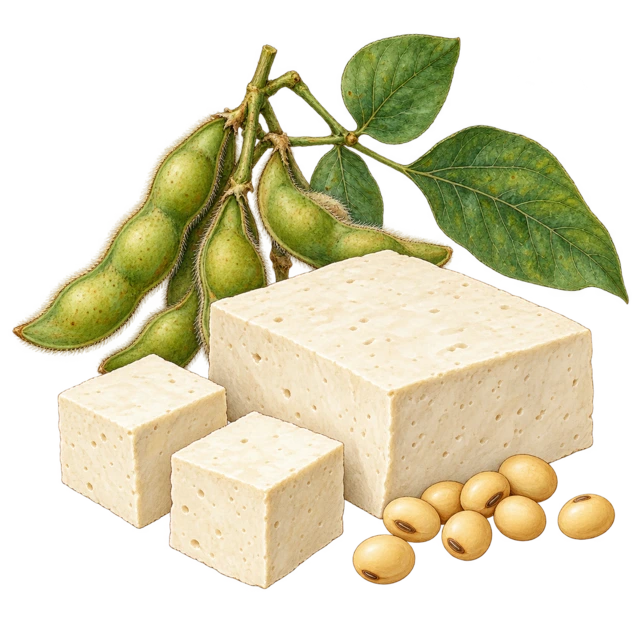
Tofu is a prepared soybean food made by coagulating soy milk. The copper comparison here is firm tofu as sold, not uncooked whole soybeans.
Ingredient details, preparation and research
Also known as: Soybean curd; Bean curd; Soy food; Firm tofu
Source plant or material
Glycine max (L.) Merr.
Plant family / material: Fabaceae
Forms and route
Regular firm or extra-firm tofu; soft and silken tofu; separately, other soy foods such as edamame, tempeh, miso and soy drink. They are not one nutrient record.
Vitamins and minerals
The copper comparison is firm tofu, raw/as sold. Calcium depends on the coagulant; check the label rather than assigning one calcium value to all tofu.
Absorption and preparation
Calcium content and availability depend partly on the coagulant. A copper value for one firm tofu is not transferable to all brands or soy foods.
Practical preparation
Read the packaging. Press regular firm tofu if the desired texture calls for it; silken tofu should not be treated as a pressable firm block.
Combination context
No special herbal pairing is required.
Combination notes
Use in an ordinary mixed diet; the food’s mineral content does not establish a medicinal combination or treatment.
Traditional and reported uses
- Culinary soy food: choose the texture
Contraindications and cautions
- Soy is a major food allergen; avoid tofu if allergic.
- Follow the package’s refrigeration and use instructions. Ready-to-eat tofu is still perishable once opened.
- Concentrated isoflavone supplements are not equivalent to eating tofu. If medicines impose soy-food restrictions, follow the medicine-specific advice.
Similar items and how they compare
- Tempeh
Another soybean food.
Tempeh is fermented whole-bean material, not coagulated soy milk.
Calcium is product-specific
NIH’s calcium reference distinguishes tofu made with calcium sulfate. Coagulants and moisture content prevent a universal calcium claim for every tofu.
Evidence limits
Food composition varies by variety, preparation and product. A reference serving is a comparison, not a therapeutic dose.
Entry sources
- Kew POWO: Glycine max
- NCCIH: Soy
- University of Illinois Extension: All About Tofu
- University of Illinois Extension: Tofu Shouldn’t Scare You
- NIH ODS: Copper, health-professional fact sheet, food table
- NIH ODS: Calcium, health-professional fact sheet
- FDA: Food Allergies, What You Need to Know
Reference entry 242 · Recorded content review: 2026-10-08 · Review scope and dates