


Key cautions
- Avoid with coriander allergy; keep cilantro intake consistent when taking warfarin.
- Concentrated supplements need a medicine review. Aromatherapy oil should not be swallowed.
What’s inside
Dried fruits contain fiber, fixed oil and a small volatile-oil fraction often rich in linalool, with terpenes such as pinene and terpinene, and geranyl acetate. Leaf aroma instead prominently involves aliphatic aldehydes and alcohols, including decanal and (E)-2-decenal. Ripeness, cultivar, chopping, heating and extraction affect composition.
Nejad Ebrahimi et al. (2010): Essential-oil composition of coriander seed accessions · Quynh, Iijima and Kubota (2010; online 2009): Extraction-dependent changes in coriander leaf volatiles
Uses in brief

- Coriander seed is a spice; cilantro leaves and tender stems flavor sauces, salads and cooked foods.
- Traditional seed use for gas; early clinical research does not establish routine treatment of diabetes, migraine or IBS.
In the King James Bible
Coriander seed in the KJV
Named material
Exodus and Numbers compare the appearance of manna with coriander seed. The seed is the point of comparison; manna is not identified as coriander, and cilantro leaves are a different part of the same plant.
And the house of Israel called the name thereof Manna: and it was like coriander seed, white; and the taste of it was like wafers made with honey.
Exodus 16:31 (KJV)
And the manna was as coriander seed, and the colour thereof as the colour of bdellium.
Numbers 11:7 (KJV)
Scripture and identification sources
Words & their stories
WORDS & THEIR STORIES
The name behind the KJV
Biblical Hebrew · Exodus 16:31 (KJV)
כְּזֶרַע גַּדkəzeraʿ gad
“Like coriander seed,” describing manna’s appearance.
Dictionary form: זֶרַע · גַּד · zeraʿ · gad
The initial kə- means “like.” Gad is the coriander noun here, not an interpretation of the personal name Gad.
Biblical Hebrew · Numbers 11:7 (KJV)
כִּזְרַע־גַּדkizraʿ-gad
“Like coriander seed,” again used as a comparison for manna.
Dictionary form: זֶרַע · גַּד · zeraʿ · gad
The vowel and linking mark differ in this verse, but the two nouns retain the same meanings.
What the language reveals
Similarity is not identity
Both passages compare manna with familiar seed. Neither says manna is coriander or describes cilantro leaves.
Coriander, Coriandrum sativum, is the usual plant identification. These verses concern the seed comparison, not the herb’s medical uses.
Language and identification bibliography
History, folklore and reported uses
Coriander in Ethiopian kitchens
Jansen describes coriander in Ethiopian markets and household gardens. Fruits went into berbere, breads and stews, while leaves were added to food and tea. NParks separately records fresh leaves in South Asian food, stronger-flavoured roots in Thai dishes, and dried seeds in garam masala and Indian curries.
P. C. M. Jansen: Coriandrum sativum, Spices and medicinal plants in Ethiopia (1981) · Singapore National Parks: Coriandrum sativum, Ethnobotanical Uses
Fruit decoctions, chewed leaves and pharmacy
Jansen records Ethiopian fruit decoctions and chewed leaves for stomach ache and colic. European pharmacy used aromatic fruits or their oil to improve medicines’ taste and lessen abdominal cramps caused by laxatives.
P. C. M. Jansen: Coriandrum sativum, Spices and medicinal plants in Ethiopia (1981)
Koththamalli in Sri Lankan households
A field survey in Gampaha, Sri Lanka, records coriander-seed infusion, called koththamalli, among household remedies for colds, fever and asthma.
Napagoda and colleagues (2018): Traditional anti-inflammatory remedies in Gampaha, Sri Lanka
Leaf applications and seed poultices
A 2026 study in Sakon Nakhon, northeastern Thailand, records crushed fresh leaves on the temples for headache and leaf juice applied to inflamed, itchy rashes. NParks separately records seed poultices for rheumatic and joint pain, without assigning that practice to one named community.
Saensouk and colleagues (2026): Ethnobotany of vegetables and spices in Sakon Nakhon, Thailand · Singapore National Parks: Coriandrum sativum, Ethnobotanical Uses
Regional reading paths
These sourced notes describe cultivation, trade, food traditions or material history. A regional connection does not claim exclusive origin.
Africa
Cultivated/traded: Moroccan cuisine; distinct seed and fresh-leaf uses.
Ripe dried fruits flavor spice blends and cooking.
Asia
Cultivated: India and Iraq; long-established South and West Asian ingredient.
Seeds season cooked dishes; fresh leaves supply a different aroma.
Antarctica
Controlled Antarctic greenhouse research.
Cultivated food crop; not native Antarctic flora.
Identity & detailed reference
Identity
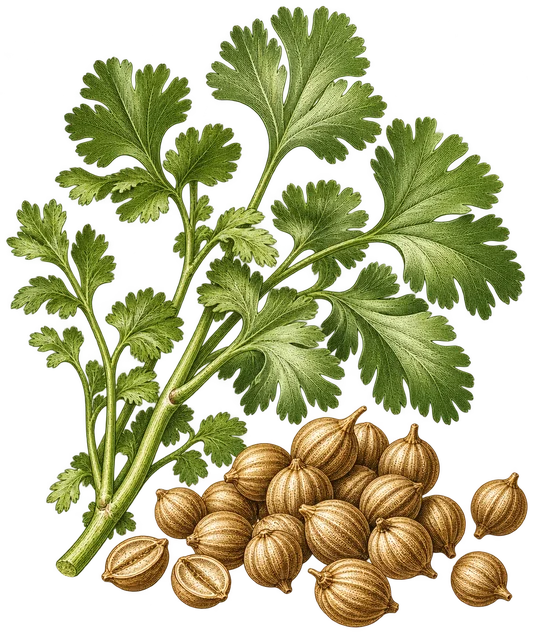
Coriandrum sativum L.; ripe dried fruits commonly called coriander seeds, and fresh leaves commonly called cilantro. They are two parts of the same plant with different flavor, chemistry and nutrient profiles.
Ingredient details, preparation and research
Source plant or material
Coriandrum sativum L.; ripe dried fruits (coriander seed) and fresh leaves/tender stems (cilantro).
Plant family / material: Apiaceae (carrot or parsley family).
Forms and route
Whole or ground dried coriander seed as a spice; fresh cilantro leaves and tender stems as a culinary herb. Seed infusions and labeled extracts/tinctures are separate preparations. Distilled essential oil and pressed seed fixed oil are not the same as either food form.
Vitamins and minerals
USDA reference amounts: 1 teaspoon coriander seed (1.8 g) supplies about 5 kcal, 0.75 g fiber, 13 mg calcium and 0.29 mg iron. Raw cilantro, 1/4 cup (4 g), supplies about 1 kcal, 12.4 micrograms vitamin K, 1.1 mg vitamin C and 13 micrograms vitamin A RAE. Seed portions make modest nutrient contributions; vitamin K is the standout leaf nutrient even in a small garnish. These figures describe eaten food, not strained tea or oil.
Absorption and preparation
Eating ground seed or cilantro includes plant solids; straining tea removes most fiber and does not reproduce the seed’s fixed-oil exposure. Ordinary meal fat helps absorption of leaf vitamin K. Crushing releases aroma but is not proven to improve a therapeutic absorbed dose, and no special herb combination is established.
Practical preparation
Use food-grade seed whole, lightly crushed or ground as a recipe requires. Wash fresh cilantro under running water and use the leaves and tender stems in food. Chopping and heating change its aroma. For medicinal products, follow the labeled plant part, strength and route; do not convert a trial syrup into a home seed-tea regimen.
Food notes
Coriandrum sativum flowers are also used as food, alongside cilantro leaves and coriander fruits. Use identified culinary-grown flowers as a fresh seasoning and keep them distinct from seed, leaf and essential-oil products. No seed-sized nutrient contribution or medicinal dose is assigned to a garnish.
Combination notes
Coriander can be combined with other culinary spices or herbs for flavor. A small IBS study tested a blend containing coriander, lemon balm and spearmint alongside usual symptom treatment; it cannot isolate coriander or establish synergy. No cilantro-plus-chlorella detox or absorption guarantee is supported.
Traditional and reported uses
- Whole or ground ripe fruits, commonly called seeds, are used in spice blends, breads and pickles; fresh cilantro is used in sauces, salads and garnishes.
- Recorded traditions include seed use for digestive discomfort and gas, and coriander fruit for headache in Persian medicine.
- Small human studies of seed powder, fruit syrup and multi-herb products report some benefits, but the findings are formulation-specific and need confirmation. They do not validate cilantro as treatment.
- Coriander flowers as a culinary seasoning, with seed and leaf uses kept distinct.
Contraindications and cautions
- Coriander allergy can be severe. Avoid known allergens; breathing difficulty or throat swelling after exposure needs urgent care.
- With warfarin or another vitamin-K antagonist, keep intake of cilantro and other vitamin-K-containing greens consistent rather than eliminating them automatically. Discuss large dietary changes.
- Review supplement-strength products with diabetes medicines because additive glucose lowering is plausible; a clinically quantified interaction is not established. Do not change prescribed treatment on the basis of a small herb trial.
- Pregnancy, breastfeeding, child-use and long-term concentrated-product safety are inadequately established. Ordinary food use does not prove extract safety.
- Do not swallow cosmetic essential oil or use coriander/cilantro instead of appropriate treatment for infection, persistent digestive symptoms or suspected metal poisoning.
Similar items and how they compare
- Sweet fennel
Both are Apiaceae aromatic fruits sold as seeds and used in digestive traditions.
Fennel emphasizes anethole and has distinct safety guidance; coriander seed often emphasizes linalool.
- Clary sage herb
Both are aromatic herbs, and their oils may contain linalool-related constituents.
Clary sage is Lamiaceae. Fresh cilantro has a different aldehyde-rich aroma, and neither leaf is equivalent to its distilled oil.
One plant, two distinct food materials
Coriandrum sativum L. belongs to Apiaceae. Coriander seed is the ripe dried fruit; cilantro is the fresh leafy herb, including tender stems. Commercial essential oil is a distillate, while pressed seed fixed oil is a fat. None is an equal-volume substitute for food, tea or extract.
Plant-part and preparation chemistry
Seed-oil analyses show linalool-rich profiles that vary markedly between accessions. Leaf research identifies a different group of volatile aldehydes and alcohols. In a primary extraction experiment, chopping before hot-water treatment changed their relative amounts, underscoring that a cooked leaf, raw garnish and distilled oil deliver different mixtures.
Attributed traditions
Jansen’s ethnobotanical account records longstanding seed spice use and digestive applications, with particular culinary examples from Ethiopia and other regions. Persian-medicine headache use of the fruit was the rationale for a modern syrup trial. Historical familiarity does not establish a medicinal dose or prove treatment efficacy.
Human metabolic evidence
A 2025 placebo-controlled trial studied 40 adults with type 2 diabetes for six weeks. Seed-powder capsules improved several glucose, insulin-resistance and lipid biomarkers; body measurements did not meaningfully change. The small, short study does not establish prevention of complications, long-term safety or effectiveness of cilantro or strained seed tea. It is not a replacement for diabetes care.
Migraine and digestive trials need careful interpretation
A one-month trial randomized 68 migraine patients; 66 were analyzed. Coriander-fruit syrup added to valproate improved attack measures compared with placebo syrup plus valproate. Separately, a 32-person IBS pilot tested coriander with lemon balm and spearmint plus symptom-directed treatment. Neither study establishes an effective home recipe or the independent benefit of coriander for IBS.
Laboratory activity and detox marketing
Laboratory antioxidant or antimicrobial results cannot establish treatment of infection or removal of toxic metals from a person. No reliable human chelation benefit for ordinary cilantro food or tea was established in the evidence reviewed. FDA warns against unapproved over-the-counter chelation claims; suspected poisoning requires appropriate testing and clinical care.
Food nutrients in realistic portions
The USDA seed reference lists 1 teaspoon as 1.8 g. It contains about 0.75 g fiber, with small calcium and iron amounts. USDA raw cilantro lists 1/4 cup as 4 g: about 12.4 micrograms vitamin K, but only 1.1 mg vitamin C. Large per-100-g nutrient numbers can exaggerate what a garnish supplies. Spoon and cup weights are database approximations.
Absorption and food preparation
Vitamin K is fat-soluble, and some fat in an ordinary meal supports its absorption from greens. That is a nutrient consideration, not proof of enhanced medicinal activity. Eating the seed or leaf includes solids that a strained infusion leaves behind; tea, essential oil and topical application cannot be assigned the whole-food nutrient figures. Wash fresh cilantro under running water; soap is not recommended.
Safety, allergy and medicines
Rare anaphylaxis is documented, including occupational sensitization. Warfarin users need consistent vitamin K intake, especially if a small garnish becomes a large daily serving. A possible additive glucose-lowering effect of concentrated seed products deserves review with diabetes treatment, but established clinical interaction data are limited. Pregnancy and pediatric supplement safety cannot be inferred from culinary use.
Similar ingredients and blends
Sweet fennel shares the fruit-as-spice and digestive-tradition pattern, but anethole-rich fennel is not interchangeable with linalool-rich coriander seed. Clary sage is another aromatic herb from a different family. Findings from Carmint or aromatic blends belong to the tested formulation, not every herb it contains.
Culinary flowers and exact edible part
Coriandrum sativum flowers are also used as food, alongside cilantro leaves and coriander fruits. Use identified culinary-grown flowers as a fresh seasoning and keep them distinct from seed, leaf and essential-oil products. No seed-sized nutrient contribution or medicinal dose is assigned to a garnish.
Entry sources
- NC State Extension: Coriander and cilantro identity, edible parts
- Jansen: Coriander culinary and recorded traditional uses
- Primary study: Comparison of coriander leaf and seed essential oils
- Primary study: Coriander seed oil chemistry
- Clinical case report: Coriander anaphylaxis
- NIH ODS: Vitamin K, food absorption and warfarin
- Poison Control: Essential oils, poisonous when misused
- USDA SR28: Herbs and spices food-composition tables
- USDA SR28: Vegetables tables, raw coriander leaves (cilantro)
- Nejad Ebrahimi et al. (2010): Essential-oil composition of coriander seed accessions
- Quynh, Iijima and Kubota (2010; online 2009): Extraction-dependent changes in coriander leaf volatiles
- Zamany et al. (2025): Six-week randomized coriander seed-powder trial in type 2 diabetes
- Delavar Kasmaei et al. (2016): Coriander fruit syrup added to valproate for migraine
- Vejdani et al. (2006): Carmint three-herb formulation in irritable bowel syndrome
- FDA: Questions and answers on unapproved chelation products
- EMA: Sweet fennel fruit, traditional digestive use and constituent comparison
- Kew: Salvia sclarea, accepted name and Lamiaceae family
- NCCIH: Using Dietary Supplements Wisely
- FDA: Selecting and serving produce safely
- Royal Horticultural Society: Growing and harvesting coriander, including edible flowers
- Singapore National Parks: Coriandrum sativum, Ethnobotanical Uses
Reference entry 95 · Recorded content review: 2026-10-07 · Review scope and dates