


Key cautions
- Avoid walnuts with a walnut allergy; tree-nut reactions can be severe, including in sauces, baked foods and mixed nuts.
- Remove every hard shell fragment. Whole kernels and thick nut butter need age-appropriate handling for children and people with swallowing difficulties.
What’s inside
Kernels are rich in polyunsaturated fats, chiefly linoleic acid and alpha-linolenic acid (ALA), with protein, fiber, magnesium, copper and manganese. The thin kernel skin contributes phenolics. Leaf or husk tannins and juglone-related chemistry should not be treated as the dose in a food portion.
Uses in brief

- Eat plain kernels or add chopped walnuts to oats, salads, grains and vegetable dishes.
- Use ground kernels for sauces, fillings or a walnut spread; they add fat, protein and texture.
Copper food reference
Copper in this food
Approximate reference values for the exact form and portion shown. The label Daily Value (DV) is 0.9 mg for adults and children age 4+, not an individual intake prescription. Portions differ, so this is not a per-gram ranking.
English walnuts
Kernels · 1 oz (28.35 g)
0.450 mg copper · 50% DV
English/Persian walnut; not black walnut hull tincture.
Compare copper food sources and read the mineral cautions
Food composition does not establish a deficiency or predict a treatment effect. Oils and extracts do not inherit these food values.
In the King James Bible
Walnuts (Persian / English) in the KJV
Probable botanical identification
Song of Solomon 6:11 says garden of nuts. Persian/English walnut, Juglans regia, is a strong conventional or probable botanical identification, not an explicit English KJV species name. This card does not identify those trees as North American black walnut, Juglans nigra, or infer a walnut-oil or hull preparation from the verse.
I went down into the garden of nuts to see the fruits of the valley, and to see whether the vine flourished and the pomegranates budded.
Song of Solomon 6:11 (KJV)
Scripture and identification sources
Words & their stories
WORDS & THEIR STORIES
The name behind the KJV
Biblical Hebrew · Song of Solomon 6:11 (KJV)
אֱגוֹזʾĕgōz
Nuts or nut trees, in the phrase “garden of nuts.”
Dictionary form: אֱגוֹז · ʾĕgōz
BDB treats the singular-looking noun as collective. This is its only biblical occurrence.
What the language reveals
Not the gift-list word
The nut-garden word ʾĕgōz differs from boṭnīm in Genesis 43:11, so the two KJV occurrences of “nuts” should not automatically be assigned the same plant.
Why Persian walnut is named
Musselman identifies the trees of this verse as Persian or English walnut, Juglans regia. That is a botanical interpretation of the ancient nut-garden reference.
Persian/English walnut is a strong conventional identification. The KJV does not explicitly say walnut, and the passage does not establish North American black walnut or walnut-oil and hull preparations.
Language and identification bibliography
History, folklore and reported uses
History, folklore and traditional uses
The familiar walnut has two common geographical names but one identity: Persian or English walnut, Juglans regia. Biblical botanist Lytton Musselman regards it as the tree behind the Song of Solomon’s garden of nuts, a valley setting alongside vines and pomegranates. That is an identification of the plant behind a generic KJV word. The large tree, its sheltered kernels and its place among orchard crops make the passage a natural starting point for the food’s story.
Its kitchen history is broader than a bowl of dried halves. Musselman describes candied green walnuts in parts of Syria, while World Agroforestry records mature kernels, ground meal, edible oil and vinegar-pickled immature fruit. A medieval English fish-day recipe in The Forme of Cury grinds walnuts with herbs for a sauce. These preparations use different stages or fractions of the fruit; neither a sweet preserve nor a spoonful of oil has the same composition as the plain mature kernel.
Outside the kitchen, walnut offered color, a fine working timber and a drying oil for useful finishes. Its husks and leaves entered dye traditions, while the wood served decorative joinery. European herbal practice also kept a separate external leaf tradition, now specifically described by EMA for minor skin complaints and excessive sweating. A food card can preserve that wider household history while clearly naming the material at every step.
Traditional, historical and reported uses
- Kernels, sauces and preserves
Food or household practiceWhy this label?
Kernels and immature fruit used in sauces and preserves.
Kernels and ground meal enrich food; traditional green-walnut preserves use immature fruit. The Forme of Cury records walnuts ground with herbs in a fish-day sauce.
- Husk and leaf dyes
Food or household practiceWhy this label?
Husks and leaves used for material dyes.
World Agroforestry records yellow and brown colors from different walnut parts, including mature husks and leaves. This is a material craft, not kernel nutrition.
- Fine furniture and joinery
Food or household practiceWhy this label?
Timber used in fine furniture and joinery.
The close-grained wood has been used for decorative furniture, veneers and inlay. Its usefulness belongs to the tree beyond its crop.
- Drying oil in paints and soaps
Food or household practiceWhy this label?
Seed oil used in paint and soap manufacture.
World Agroforestry records walnut seed oil in paint and soap manufacture. An industrial preparation should not be confused with bottled culinary oil.
- External leaf care and perspiration
Traditional accountWhy this label?
Traditional external medicinal leaf preparations.
EMA documents traditional dried-leaf preparations for minor inflammatory skin conditions and excessive sweating of hands and feet, distinct from oral kernel food.
Five distinct documented uses are presented with the plant part or product specified; historical practices are not preparation instructions.
Health topics: evidence and cautions
These notes describe a specific research context and preparation. A topic link is not a treatment recommendation.
Cardiovascular health · Risk reduction
Form and route: Plain whole or chopped walnuts · oral
Walnuts can be part of a heart-healthy nut choice.
Evidence: randomized_diet_pattern_evidence
Walnuts were included in PREDIMED’s mixed-nut Mediterranean diet.
Limits
Individual walnut effects cannot be separated from the nut mix and diet.
Cautions
- Avoid with walnut allergy.
Male fertility & sperm health · Support during care
Form and route: Whole shelled walnuts added to usual diet · oral food
Condition and setting: Semen quality in healthy young men eating a Western-style diet
Sperm vitality, motility and morphology improved in a dietary trial. This is not evidence of more pregnancies or live births.
Evidence: Limited dietary trial evidence
Randomized trial with masked outcome assessors; 117 men aged 21–35; 75 g/day for 12 weeks versus usual diet avoiding tree nuts.
Limits
Healthy men rather than an infertility-treatment population; whole nuts do not establish walnut-oil effects. Food trial could not blind participants.
Cautions
- Avoid with walnut allergy. Account for the substantial food energy and overall diet; the study portion is not a required fertility prescription.
Stress · Support during care
Form and route: Whole walnut food consumed daily during a university semester · oral
Condition and setting: Academic stress in university students
A small exploratory trial reported changes in some well-being measures, but it does not establish walnuts as a stress treatment; male-specific effects could not be determined.
Evidence: Limited exploratory food trial; male evidence unresolved
Students were randomized to daily walnut consumption or a control group across an examination period. Some mental-health and biomarker patterns favored walnuts; perceived-stress findings were not uniformly convincing.
Limits
Food intervention was not a blinded placebo comparison; multiple outcomes and too few male participants limit inference. Do not interpret lack of worsening within one group alone as proof of a between-group benefit.
Cautions
- Avoid if allergic to walnuts or tree nuts. Edible kernels are not walnut hull, leaf extracts or walnut oil.
Regional reading paths
These sourced notes describe cultivation, trade, food traditions or material history. A regional connection does not claim exclusive origin.
Asia
Native/cultivated: Kyrgyzstan walnut-fruit forests and regional food economies.
Kernels eaten as food or used in confectionery.
Europe
Cultivated and traditional processing: Périgord, France.
Edible kernels used in baking and other foods; distinct from walnut oil.
Identity & detailed reference
Identity
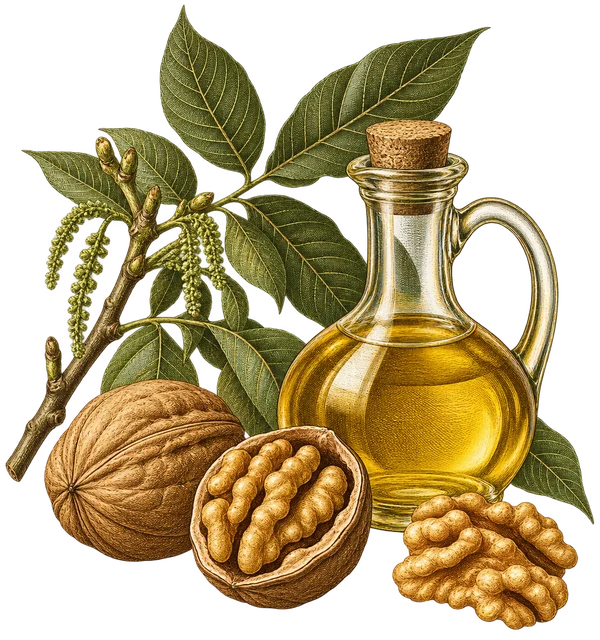
Juglans regia supplies the familiar light-colored walnut kernels. English and Persian refer to the same species, not two different nuts. North American black walnut, Juglans nigra, is a distinct species; black-walnut hull remedies are outside this card.
Ingredient details, preparation and research
Also known as: Persian walnut; English walnut; Common walnut
Source plant or material
Juglans regia L.; mature edible kernel inside a hard shell and green outer husk.
Plant family / material: Juglandaceae, the walnut family.
Forms and route
Shelled halves or pieces; plain or roasted; ground meal or walnut butter. Culinary walnut oil and traditionally prepared green-walnut preserves are separate foods; hull and leaf extracts are separate herbal materials.
Food sources
Mature plain J. regia kernels are the food basis. The papery brown skin is commonly eaten. Walnut oil has essentially no fiber or protein, while green-walnut preserves include a differently prepared immature fruit and often added sugar or salt.
Vitamins and minerals
For 28 g edible English/Persian walnut kernels, a small handful of about 14 halves (7 nuts): about 183 kcal, 4.3 g protein, 18.3 g fat, 3.8 g carbohydrate, 1.9 g fiber, 0.7 g sugars, 44 mg magnesium, 124 mg potassium, 27 mg calcium, 0.44 mg copper and 0.96 mg manganese. The serving supplies about 2.54 g ALA omega-3. Calculated from USDA SR28 food 12155; shells excluded. This is not a black-walnut or walnut-oil analysis.
Absorption and preparation
Walnut ALA is a plant omega-3, not the same fatty acid as marine EPA or DHA; the body converts only a limited amount. No special oil pairing is needed because walnuts already contain fat. As with other nuts, the intact kernel matrix influences energy release. Use normal meal or snack portions rather than a medicinal timing rule.
Practical preparation
Inspect shelled pieces for hard fragments. Chop or grind as needed, and keep opened kernels sealed in the refrigerator or freezer for longer keeping. Buy properly prepared green-walnut preserves instead of assuming an unripe whole fruit can be eaten untreated.
Combination context
Walnuts work with oats, lentils, greens, apples or cooked grains. They can replace part of a richer topping rather than always being added on top of it. Their ALA contribution does not make fish or algae omega-3 products compositionally identical.
Traditional and reported uses
- Eat plain kernels or add chopped walnuts to oats, salads, grains and vegetable dishes.
- Use ground kernels for sauces, fillings or a walnut spread; they add fat, protein and texture.
- The tree’s recorded heritage also includes dyeing, fine woodwork, drying oil and external leaf preparations, all separate from kernel nutrition.
Contraindications and cautions
- Avoid walnuts with a walnut allergy; tree-nut reactions can be severe, including in sauces, baked foods and mixed nuts.
- Remove every hard shell fragment. Whole kernels and thick nut butter need age-appropriate handling for children and people with swallowing difficulties.
- Store shelled nuts tightly closed and cool; refrigeration or freezing helps preserve their oil-rich flavor. Discard visibly moldy nuts and follow food recalls.
- Do not treat Persian walnut kernels as black-walnut hull medicine or copy medicinal leaf/husk preparations from this food card.
- Walnuts supply substantial energy in a small volume; use the intended portion, particularly when they are coated in sugar or mixed with added oils.
Preparation-specific cautions
- Walnut allergy can be severe; check sauces, pastries and mixed foods.
- Remove shell and use an age-appropriate texture.
- Keep nuts clean, dry, sealed and cool, and discard moldy food.
- Kernel food use does not establish an oral medicinal dose for other parts or species.
Similar items and how they compare
- Black walnut, Juglans nigra
A relative with edible kernels and separate herbal products.
North American species, different flavor and composition; it is not the conventional walnut of Song of Solomon 6:11.
- Walnut oil
Pressed from J. regia kernels.
Concentrated fat without the kernel’s fiber, protein and full mineral profile.
- Flax / linseed
Another plant source of ALA omega-3.
Different seed, serving size and food matrix; neither supplies the same forms of omega-3 as fish or algae.
Which walnut belongs here
Persian and English walnut both mean J. regia. The Song of Solomon’s nut garden is strongly associated with this species in biblical botany, though the KJV English remains nuts. J. nigra, the North American black walnut, is not the botanical identification of that garden.
ALA and the edible portion
A small handful provides ALA alongside other unsaturated fats, protein and fiber. ALA has its own dietary role; conversion to EPA and DHA is limited. Nutrient values apply to kernels, not husks, leaf tea, green preserves or the oil alone.
A whole-food dietary trial
In an eight-week crossover comparison analyzed in 194 adults, 43 g walnuts daily improved several blood-lipid measures relative to the nut-free phase. The effect did not depend significantly on meal versus snack timing. The trial was supported by the California Walnut Commission and assessed risk markers, not proof that walnuts alone prevent heart attacks.
Leaf traditions belong to a different preparation
EMA recognizes longstanding external use of specified walnut-leaf preparations for minor skin inflammation and excessive hand or foot sweating. That traditional-use assessment concerns dried leaf products, not eating walnuts or using black-walnut hulls.
Parts and materials used
Mature kernel for nutrition. Pressed oil, unripe whole fruit, green husk, leaves, bark and wood have separate uses and compositions.
Food forms and ingredient distinctions
Mature plain J. regia kernels are the food basis. The papery brown skin is commonly eaten. Walnut oil has essentially no fiber or protein, while green-walnut preserves include a differently prepared immature fruit and often added sugar or salt.
Practical preparation
Inspect shelled pieces for hard fragments. Chop or grind as needed, and keep opened kernels sealed in the refrigerator or freezer for longer keeping. Buy properly prepared green-walnut preserves instead of assuming an unripe whole fruit can be eaten untreated.
Meal ideas and combinations
Walnuts work with oats, lentils, greens, apples or cooked grains. They can replace part of a richer topping rather than always being added on top of it. Their ALA contribution does not make fish or algae omega-3 products compositionally identical.
Food reference portions
- Nuts, walnuts, english
small handful, approximately 14 halves (7 nuts) (28 g): about 183.12 kcal Energy. Calculated from the specified edible-portion reference; shells, oil and other forms excluded. Data: USDA SR28.
- Nuts, walnuts, english
small handful, approximately 14 halves (7 nuts) (28 g): about 4.264 g Protein. Calculated from the specified edible-portion reference; shells, oil and other forms excluded. Data: USDA SR28.
- Nuts, walnuts, english
small handful, approximately 14 halves (7 nuts) (28 g): about 18.259 g Total fat. Calculated from the specified edible-portion reference; shells, oil and other forms excluded. Data: USDA SR28.
Food composition reference
Nuts, walnuts, english · small handful, approximately 14 halves (7 nuts) (28 g). Approximate values, rounded to about three significant digits.
| Nutrient | Per 100 g | Per stated serving |
|---|---|---|
| Energy | 654 kcal | 183 kcal |
| Protein | 15.2 g | 4.26 g |
| Total fat | 65.2 g | 18.3 g |
| Carbohydrate | 13.7 g | 3.84 g |
| Fiber | 6.7 g | 1.88 g |
| Sugars | 2.61 g | 0.731 g |
| Calcium | 98 mg | 27.4 mg |
| Magnesium | 158 mg | 44.2 mg |
| Potassium | 441 mg | 123 mg |
| Copper | 1.59 mg | 0.444 mg |
| Manganese | 3.41 mg | 0.956 mg |
| ALA omega-3 | 9.08 g | 2.54 g |
USDA SR28 reference data, currently accessible; not newly collected 2026 measurements; USDA NDB 12155
per-100-g value × edible serving grams / 100; displayed prose rounded
Evidence limits
- The biblical identification is strong and conventional, but walnuts is not the English word in the quoted KJV verse.
- ALA is not equivalent to a matching gram amount of EPA or DHA.
- Non-kernel heritage uses are included for historical completeness and do not establish food-dose treatment effects.
Entry sources
- NC State Extension: Juglans regia, Persian/English walnut
- Lytton John Musselman, Old Dominion University: Walnut
- USDA SR28: Nuts and Seed Products; foods 12061 almonds, 12151 raw pistachios, 12155 English walnuts
- World Agroforestry: Juglans regia, products and recorded uses
- European Medicines Agency: Juglandis folium, walnut leaf traditional external use
- Bamberger et al.: Walnut-enriched diet and blood lipids, randomized controlled crossover trial
- NIH Office of Dietary Supplements: Omega-3 Fatty Acids, Consumer Fact Sheet
- FDA: Food Allergies, What You Need to Know
- University of California ANR: Nuts, Safe Methods for Consumers to Handle, Store, and Enjoy
- USDA ARS: Nuts for Calories!
- The Forme of Cury (c. 1390), Samuel Pegge edition, Project Gutenberg
- CDC: Choking Hazards in Infant and Toddler Nutrition
- Song of Solomon 6:11 (KJV)
Reference entry 156 · Recorded content review: 2026-10-06 · Review scope and dates