


Key cautions
- Avoid almonds with an almond allergy; tree-nut reactions can be severe, and mixed-nut products may introduce other allergens.
- Do not eat unknown bitter almonds or make home bitter-almond extracts: cyanogenic compounds can release cyanide. Buy food-grade sweet almonds.
What’s inside
Kernels provide mostly unsaturated fat, protein, fiber, alpha-tocopherol (vitamin E), magnesium, calcium and riboflavin. The skin contributes phenolic compounds. Amygdalin and related cyanogenic glycosides are especially relevant to bitter almonds; their presence is a safety issue, not a desirable vitamin.
Uses in brief

- Eat a small handful of unsalted sweet almonds or scatter chopped kernels over oats, vegetables or yogurt.
- Use ground almonds or almond butter for texture and richness in cooking; count the actual portion rather than treating all almond products alike.
Copper food reference
Copper in this food
Approximate reference values for the exact form and portion shown. The label Daily Value (DV) is 0.9 mg for adults and children age 4+, not an individual intake prescription. Portions differ, so this is not a per-gram ranking.
Almonds
Whole kernels, unroasted USDA entry · 1 oz (28.35 g)
0.292 mg copper · 32% DV
Compare copper food sources and read the mineral cautions
Food composition does not establish a deficiency or predict a treatment effect. Oils and extracts do not inherit these food values.
In the King James Bible
Almonds in the KJV
Named material
Almonds are explicitly named in Genesis 43:11 and Numbers 17:8. The conventional botanical identification is the cultivated almond, commonly called Prunus dulcis and now accepted by Kew as Prunus amygdalus. Neither verse distinguishes sweet from bitter cultivars or names almond oil. Modern food guidance here is for commercially edible sweet kernels.
And their father Israel said unto them, If it must be so now, do this; take of the best fruits in the land in your vessels, and carry down the man a present, a little balm, and a little honey, spices, and myrrh, nuts, and almonds:
Genesis 43:11 (KJV)
And it came to pass, that on the morrow Moses went into the tabernacle of witness; and, behold, the rod of Aaron for the house of Levi was budded, and brought forth buds, and bloomed blossoms, and yielded almonds.
Numbers 17:8 (KJV)
Scripture and identification sources
Words & their stories
WORDS & THEIR STORIES
The name behind the KJV
Biblical Hebrew · Genesis 43:11 (KJV)
וּשְׁקֵדִיםūšəqēdīm
“And almonds,” among the valued produce sent as a gift.
Dictionary form: שָׁקֵד · šāqēd
The verse has ū- (“and”) plus the plural šəqēdīm. The dictionary form is singular.
Biblical Hebrew · Numbers 17:8 (KJV); Numbers 17:23 in the Hebrew edition
שְׁקֵדִיםšəqēdīm
Almonds borne by Aaron’s rod after it buds and blossoms.
Dictionary form: שָׁקֵד · šāqēd
This is the same plural noun without “and.” The Hebrew and KJV chapter divisions give the event different verse numbers.
What the language reveals
A tree name and its fruit
The dictionary word šāqēd can name the almond tree or its nut. In both quoted passages, the plural identifies the almonds themselves.
An audible wordplay elsewhere
Jeremiah 1:11–12 pairs שָׁקֵד (šāqēd), “almond,” with שֹׁקֵד (šōqēd), “watching.” The similar sounds help connect the almond branch with God watching over his word. This is a literary wordplay, not a new definition of “almond.”
The conventional almond identification is strong. Neither quoted verse specifies sweet versus bitter almonds, a modern cultivar or almond oil.
Language and identification bibliography
- Hebrew text: Genesis 43:11 (Mechon-Mamre)
- Hebrew text: Numbers 17:23, corresponding to KJV 17:8 (Mechon-Mamre)
- Brown–Driver–Briggs: שָׁקֵד, almond / almond tree (H8247; Bible Hub transcription)
- Hebrew text: Jeremiah 1:11–12 (Mechon-Mamre)
- Brown–Driver–Briggs: שָׁקַד, watch / wake (H8245; Bible Hub transcription)
- Lytton John Musselman, Old Dominion University: Almond
History, folklore and reported uses
History, folklore and traditional uses
Almonds stand at the meeting point of orchard, kitchen and sacred imagery. Genesis places them among the valued goods sent from Canaan to Egypt, while Numbers describes Aaron’s staff bearing buds, flowers and nuts at once. In an ordinary orchard those stages unfold in sequence. The tree’s early blossoms also made it a vivid seasonal presence, and almond-shaped decoration appears in the tabernacle lampstand. The biblical name is clear, but the text does not label its almonds as modern sweet or bitter cultivars.
Centuries later, the medieval English recipe collection The Forme of Cury shows how much cooks could do with an almond. Its almond milk enters rice, leafy dishes and fish preparations; other recipes turn ground blanched almonds into cream or combine them with oats. This was a practical kitchen technique, not simply a modern beverage trend. The same kernel could be kept dry and then transformed into a pale, rich liquid or a thickening ingredient when needed.
Pressing opened a different branch of the story. Historical accounts describe almond oil in Chinese, Ayurvedic and Greco-Persian skin care, while pharmacognosy treats the fixed oil as a useful preparation in its own right. Modern farming finds value even in the outer hull, which can enter livestock feed. These histories explain the almond’s broad usefulness, but the bowl of sweet kernels, bottle of cosmetic oil and pile of hulls remain different materials.
Traditional, historical and reported uses
- Food, gifts and culinary richness
Food or household practiceWhy this label?
Culinary kernel use and food-gift tradition.
Sweet kernels have served as portable food and valued gifts; Genesis records almonds in Jacob’s offering, and later cookbooks use them in substantial dishes.
- Almond milk and thickened dishes
Food or household practiceWhy this label?
Historical cookbook records culinary almond-milk processing and dishes.
The Forme of Cury documents almond milk in rice, greens and fish dishes, as well as almond cream and gruel: a distinct processing tradition.
- Oil for dry-skin care
Traditional accountWhy this label?
Chinese, Ayurvedic and Greco-Persian topical oil-care traditions.
Ahmad’s historical account records almond oil in Chinese, Ayurvedic and Greco-Persian care for dry or irritated skin. This concerns topical fixed oil.
- Apothecary carrier and mild laxative tradition
Mixed/contextual sourcesWhy this label?
Pharmacognosy textbook describes pharmaceutical carrier and laxative context.
Trease and Evans describes fixed almond oil in pharmaceutical vehicles and a mild laxative role. This is preparation history, not a home medicinal dose.
- Hulls as livestock feed
Food or household practiceWhy this label?
Agricultural by-product use in livestock feed.
USDA describes almond hulls and shells as agricultural by-products, including hull use in livestock feeding. Human kernel nutrition does not describe these feed materials.
Five distinct documented uses are presented with the plant part or product specified; historical practices are not preparation instructions.
Health topics: evidence and cautions
These notes describe a specific research context and preparation. A topic link is not a treatment recommendation.
Cardiovascular health · Risk reduction
Form and route: Plain almonds · oral
Almonds fit a Mediterranean nut pattern.
Evidence: randomized_diet_pattern_evidence
Almonds were one component of PREDIMED’s mixed nuts.
Limits
That trial did not test almonds alone. Bitter almonds and almond oil are different.
Cautions
- Avoid with almond allergy.
Identity & detailed reference
Identity
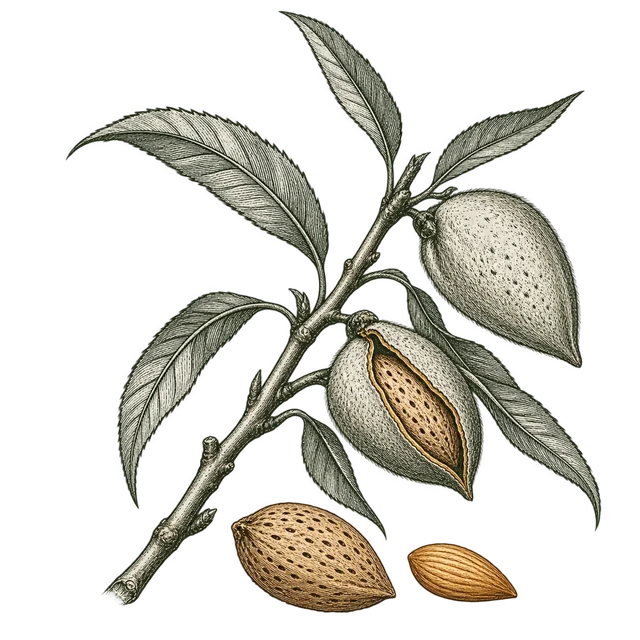
The almond is the edible seed within a stone-fruit shell. This food card concerns commercially edible sweet almonds. Kew currently accepts Prunus amygdalus Batsch; Prunus dulcis remains widespread in food science. Bitter almonds contain much more cyanogenic material and are not a home-food substitute.
Ingredient details, preparation and research
Also known as: Sweet almond; Prunus dulcis; Amygdalus communis
Source plant or material
Prunus amygdalus / Prunus dulcis; mature sweet seed kernels, with or without their thin brown skin.
Plant family / material: Rosaceae, the rose family; related to peach, plum and apricot.
Forms and route
Whole or sliced sweet kernels; raw-style or roasted; skin-on or blanched; meal/flour and almond butter. Almond beverages may be diluted and fortified. Sweet almond fixed oil and processed flavoring extracts have different compositions.
Food sources
Plain sweet almond kernels are the food basis. Blanching removes the skin; oil pressing removes most protein, fiber and minerals from the oil fraction. A fortified beverage may supply added calcium or vitamins, which are not the same as nutrients supplied by its almond content.
Vitamins and minerals
For 28.35 g edible plain almonds, 1 oz or a small handful: about 164 kcal, 6.0 g protein, 14.2 g fat, 6.1 g carbohydrate, 3.5 g fiber, 1.2 g sugars, 76 mg calcium, 77 mg magnesium, 208 mg potassium, 1.05 mg iron, 7.3 mg vitamin E and 0.32 mg riboflavin. Calculated from USDA SR28 food 12061 per 100 g; the shell is excluded. These are whole-kernel values, not almond-oil or beverage values.
Absorption and preparation
The kernel is a food matrix: chewing and grinding break cells and influence release of oil and other nutrients. Human mastication studies show that some fat remains inside intact cells after chewing; finely ground products are not identical to whole kernels. Eat in an ordinary meal or snack. No extra oil, fasting schedule or mandatory soaking is needed to obtain the food benefits.
Practical preparation
Choose unsalted sweet almonds if limiting salt. Weigh a handful once to learn the portion; slices and flour pack differently. Refrigerate homemade almond beverages promptly and follow their food-safety guidance. No bitter-almond detoxification method is offered.
Combination context
Add chopped almonds to oats, vegetables or a yogurt bowl for texture. If almond drink replaces dairy regularly, compare its protein and fortification label. Adding honey or sugar changes the finished food without increasing the amount of almond protein.
Traditional and reported uses
- Eat a small handful of unsalted sweet almonds or scatter chopped kernels over oats, vegetables or yogurt.
- Use ground almonds or almond butter for texture and richness in cooking; count the actual portion rather than treating all almond products alike.
- Historical uses include almond milk, soothing skin oils, apothecary oil preparations and agricultural use of hulls. These concern distinct preparations and parts.
Contraindications and cautions
- Avoid almonds with an almond allergy; tree-nut reactions can be severe, and mixed-nut products may introduce other allergens.
- Do not eat unknown bitter almonds or make home bitter-almond extracts: cyanogenic compounds can release cyanide. Buy food-grade sweet almonds.
- Whole nuts and thick spoonfuls of nut butter can present a choking risk for young children or people with swallowing difficulties; use an age-appropriate finely ground or thinned form.
- Use clean, dry handling and reputable suppliers. Keep kernels sealed and cool, refrigerating or freezing for longer storage; discard visibly moldy nuts.
- Almond beverages are not nutritionally identical to whole nuts. Check added sugar, protein and fortification; cosmetic almond oil is not automatically edible.
Preparation-specific cautions
- Almond allergy can cause a severe reaction. Check ingredients and cross-contact information.
- Cyanogenic glycosides in bitter almonds can release cyanide; use commercially edible sweet kernels rather than home detoxification.
- Serve in an age-appropriate texture to avoid choking.
- Keep clean, dry and cool; damaged or moldy nuts are unsuitable food.
Similar items and how they compare
- Sweet almond oil
Comes from the same edible kernel.
Oil supplies fat but essentially none of the whole nut’s fiber and protein; cosmetic and culinary grades differ.
- Pistachios
Another biblical-associated edible kernel.
Almond is explicitly named in the KJV; pistachio is a probable interpretation of a generic nut word, and the botanical families differ.
- Bitter almonds
Closely related almond material.
Cyanogenic glycosides create a serious poisoning hazard; they are not interchangeable with commercial sweet kernels.
Species name and sweet-kernel boundary
Taxonomic naming and food naming overlap: Kew now accepts Prunus amygdalus, while USDA and much research use Prunus dulcis. The nutritional discussion is limited to the sweet food kernel, not to seed extracts or a claim that every almond cultivar is edible.
What a handful contributes
A 1 oz portion supplies about 6 g protein and 3.5 g fiber along with vitamin E and magnesium. Meal and butter retain much of the kernel, whereas expressed oil separates a fat-rich fraction. Commercial almond drinks vary considerably in dilution and added nutrients.
Chewing, grinding and accessible nutrients
A randomized mastication study found that many almond cells survived chewing intact. A later trial in 31 adults found a modest increase in predicted lipid availability after commercial grinding. These are preparation-and-digestion findings; they do not require elaborate food combinations or prove that soaking is necessary.
The useful plant beyond its kernel
Historical pharmacognosy describes fixed almond oil as a pharmaceutical vehicle, while skin traditions use its softening qualities. Modern agriculture also uses hulls as livestock feed. Those uses belong to the wider plant story and do not convert the hull or cosmetic oil into an ordinary human food.
Parts and materials used
Mature sweet kernel for this food. Expressed fixed oil, hard shell, outer hull and bitter kernels are separate materials.
Food forms and ingredient distinctions
Plain sweet almond kernels are the food basis. Blanching removes the skin; oil pressing removes most protein, fiber and minerals from the oil fraction. A fortified beverage may supply added calcium or vitamins, which are not the same as nutrients supplied by its almond content.
- USDA SR28: Nuts and Seed Products; foods 12061 almonds, 12151 raw pistachios, 12155 English walnuts
- Grundy et al.: Mastication and lipid bioaccessibility of almonds in a randomized human study
- Creedon et al.: Almond processing and predicted lipid bioaccessibility, randomized mastication study
- Roncero et al.: Influence of Pressure Extraction Systems on Virgin Almond Oil and Defatted Flours
Practical preparation
Choose unsalted sweet almonds if limiting salt. Weigh a handful once to learn the portion; slices and flour pack differently. Refrigerate homemade almond beverages promptly and follow their food-safety guidance. No bitter-almond detoxification method is offered.
Meal ideas and combinations
Add chopped almonds to oats, vegetables or a yogurt bowl for texture. If almond drink replaces dairy regularly, compare its protein and fortification label. Adding honey or sugar changes the finished food without increasing the amount of almond protein.
Food reference portions
- Nuts, almonds
1 oz (a small handful) (28.35 g): about 164.147 kcal Energy. Calculated from the specified edible-portion reference; shells, oil and other forms excluded. Data: USDA SR28.
- Nuts, almonds
1 oz (a small handful) (28.35 g): about 5.996 g Protein. Calculated from the specified edible-portion reference; shells, oil and other forms excluded. Data: USDA SR28.
- Nuts, almonds
1 oz (a small handful) (28.35 g): about 14.155 g Total fat. Calculated from the specified edible-portion reference; shells, oil and other forms excluded. Data: USDA SR28.
Food composition reference
Nuts, almonds · 1 oz (a small handful) (28.35 g). Approximate values, rounded to about three significant digits.
| Nutrient | Per 100 g | Per stated serving |
|---|---|---|
| Energy | 579 kcal | 164 kcal |
| Protein | 21.1 g | 6 g |
| Total fat | 49.9 g | 14.2 g |
| Carbohydrate | 21.6 g | 6.11 g |
| Fiber | 12.5 g | 3.54 g |
| Sugars | 4.35 g | 1.23 g |
| Calcium | 269 mg | 76.3 mg |
| Magnesium | 270 mg | 76.5 mg |
| Potassium | 733 mg | 208 mg |
| Iron | 3.71 mg | 1.05 mg |
| Vitamin E, alpha-tocopherol | 25.6 mg | 7.27 mg |
| Riboflavin | 1.14 mg | 0.323 mg |
USDA SR28 reference data, currently accessible; not newly collected 2026 measurements; USDA NDB 12061
per-100-g value × edible serving grams / 100; displayed prose rounded
Evidence limits
- The Bible names almonds without specifying sweet/bitter cultivar or an oil preparation.
- USDA reference composition is not a test of the purchased batch; roasting, coating, blanching and beverage fortification change the product.
- Historical skin and pharmacy uses concern oil or prepared products, not treatment claims for eating kernels.
Entry sources
- Kew Plants of the World Online: Prunus amygdalus Batsch
- Lytton John Musselman, Old Dominion University: Almond
- USDA SR28: Nuts and Seed Products; foods 12061 almonds, 12151 raw pistachios, 12155 English walnuts
- EFSA: Health risks from cyanogenic glycosides in foods other than raw apricot kernels
- FDA: Food Allergies, What You Need to Know
- University of California ANR: Nuts, Safe Methods for Consumers to Handle, Store, and Enjoy
- Grundy et al.: Mastication and lipid bioaccessibility of almonds in a randomized human study
- Creedon et al.: Almond processing and predicted lipid bioaccessibility, randomized mastication study
- Roncero et al.: Influence of Pressure Extraction Systems on Virgin Almond Oil and Defatted Flours
- Ahmad: The uses and properties of almond oil
- Trease and Evans Pharmacognosy: Almond oil, quoted textbook chapter
- USDA ARS AgLab: Novel Uses for Discarded Almond Hulls
- The Forme of Cury (c. 1390), Samuel Pegge edition, Project Gutenberg
- CDC: Choking Hazards in Infant and Toddler Nutrition
- Genesis 43:11 (KJV)
- Numbers 17:8 (KJV)
Reference entry 140 · Recorded content review: 2026-10-06 · Review scope and dates