


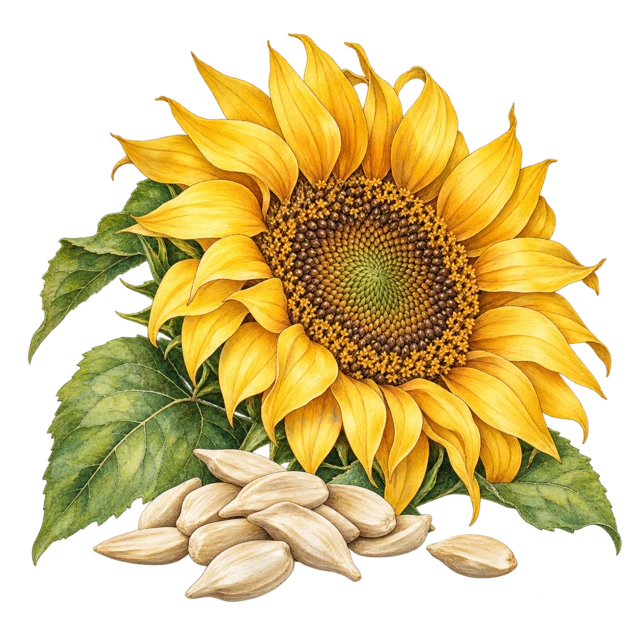
Key cautions
- Eat the kernel, not the tough hull; choose products sold for human food.
- Seed allergy is possible. A product made without tree nuts is not automatically safe for everyone with food allergy.
- Seed nutrition cannot be copied to sunflower oil; salt and flavor coatings also change the food.
What’s inside
Oil-bearing kernels containing protein and minerals, including copper; removing the hull does not turn the kernel into oil.
Uses in brief

- Toasted seed food
- Traditional ground seed meal
- Traditional oil use
Copper food reference
Copper in this food
Approximate reference values for the exact form and portion shown. The label Daily Value (DV) is 0.9 mg for adults and children age 4+, not an individual intake prescription. Portions differ, so this is not a per-gram ranking.
Sunflower kernels
Toasted · ¼ cup
0.615 mg copper · 68% DV
Compare copper food sources and read the mineral cautions
Food composition does not establish a deficiency or predict a treatment effect. Oils and extracts do not inherit these food values.
History, folklore and reported uses
History, folklore and traditional uses
The sunflower’s large head contains many small flowers, each capable of producing a seed-bearing fruit. Food kernels come from inside those familiar striped or dark hulls.
The National Park Service records Indigenous uses of sunflower seeds as snacks and ground meal, alongside seed-oil and dye uses. These are distinct preparations rather than one interchangeable sunflower remedy.
A closer look at its history
Food and color from the same crop
The National Park Service records sunflower seeds ground into bread meal, cracked for snacks and pressed for cooking oil in Indigenous North American traditions. It identifies Hopi seed-dye uses producing red, purple and blue, showing that seed selection served material as well as food purposes.
A living dye tradition
A 2014 National Park Service program specifically featured Nuvakuku Dawavendewa of lower Moenkopi as a specialist in natural dyes, including Hopi black sunflower. Naming the practitioner and occasion makes the dye tradition more concrete than treating it only as an anonymous custom of the past.
Additional history reviewed 2026-10-09
Traditional, historical and reported uses
- Toasted seed food
Food or household practiceWhy this label?
The claim documents toasted seed food as a culinary, craft, gardening, or practical material use; it reports neither a treatment outcome nor measured nutrient content.
Shelled, toasted kernels are an edible seed food; select unsalted or salted products according to the dish.
- Traditional ground seed meal
Food or household practiceWhy this label?
The claim documents traditional ground seed meal as a culinary, craft, gardening, or practical material use; it reports neither a treatment outcome nor measured nutrient content.
The National Park Service describes seeds being ground into meal for bread in Indigenous North American food traditions.
- Traditional oil use
Food or household practiceWhy this label?
The claim documents traditional oil use as a culinary, craft, gardening, or practical material use; it reports neither a treatment outcome nor measured nutrient content.
Pressed seed oil was used in cooking and grooming. Oil has a different composition from whole kernels.
- Hopi dye material
Food or household practiceWhy this label?
The claim documents hopi dye material as a culinary, craft, gardening, or practical material use; it reports neither a treatment outcome nor measured nutrient content.
The National Park Service records sunflower-seed dye use among the Hopi; this is a cultural material use, not a food or health claim.
Culinary, material and historical uses are distinguished from medical claims. The number of uses reflects the reviewed evidence, not a fixed quota.
Historical-use additions reviewed 2026-10-08
Growing notes
Helianthus annuus L.; edible-seed cultivars, distinguished from perennial sunflowers and cut-flower selections.
- Climate and planting
- Annual summer crop. Direct-sow after the last spring frost in a locally suitable season; allow the cultivar’s full seed-maturity period. Sow about one inch deep, thinning to the cultivar’s mature spacing. [1] [2]
- Cultivar and habit
- Choose an edible-seed cultivar. Dwarfs, branching plants and giants differ greatly; tall seed-head types may need 2–2½ feet between plants and staking in wind. [3] [2]
- Sun and soil
- Full sun and fertile, well-drained soil. Avoid sites where roots stay waterlogged. [2] [4]
- Water
- Water regularly through establishment. Although established plants tolerate drought, prevent serious water stress during flowering and seed filling for plump kernels. [2]
- Nutrition
- Use a soil test to establish nutrient needs. Add phosphorus and potassium only when indicated; excessive nitrogen favors foliage over flowering. [4] [2]
- Harvest
- Garden seed types often mature in 70–100 days, depending on cultivar. Look for drooping heads, yellowing backs, spent petals and filled seeds; finish drying with good airflow. [2]
Growing sources and regional guidance
- Oregon State University Extension: Sunflowers
- Iowa State University Extension: Growing Sunflowers and Their Varieties
- University of Florida IFAS: Warm Season Cut Flowers
- Utah State University Extension: Sunflower Cut Flower Production in Utah, March 2026
- NDSU Extension: Dakota Gardener, Grow a bouquet in 60 days
- National Park Service, Pipestone National Monument: Wildflowers
- National Park Service: Native American Artists to Demonstrate Traditional Spinning, Weaving, Natural Dyes, November 11, 2014
Growing notes reviewed 2026-10-09
Regional reading paths
These sourced notes describe cultivation, trade, food traditions or material history. A regional connection does not claim exclusive origin.
Europe
Introduced/cultivated: major eastern and southeastern European oilseed crop, including Ukraine, Romania and Bulgaria.
Food-grade kernels used as snacks and in baking; distinct from the extracted oil.
North America
Cultivated/traditional food: Mandan, Hidatsa and Arikara communities, United States.
Dried edible seeds for food.
Identity & detailed reference
Identity
Edible sunflower seed kernels, removed from their tough outer hulls. This card concerns food kernels, not planting seed, bird feed or extracted sunflower oil.
Ingredient details, preparation and research
Also known as: Sunflower kernels
Source plant or material
Helianthus annuus L.
Plant family / material: Asteraceae
Forms and route
Shelled kernels, plain or toasted; salted or flavored kernels; foods made with ground kernels. Extracted oil is a separate form.
Vitamins and minerals
Sunflower kernels supply fat, protein and copper. The comparison uses toasted edible kernels; the same value does not apply to sunflower oil.
Absorption and preparation
Copper figures measure content in the kernels. They do not establish a food-specific absorption percentage or a need to soak seeds.
Practical preparation
Use food-grade shelled kernels; keep dried seeds in airtight containers and follow product storage guidance.
Combination context
No special herbal pairing is required.
Combination notes
Use in an ordinary mixed diet; the food’s mineral content does not establish a medicinal combination or treatment.
Traditional and reported uses
- Toasted seed food
- Traditional ground seed meal
- Traditional oil use
- Hopi dye material
Contraindications and cautions
- Eat the kernel, not the tough hull; choose products sold for human food.
- Seed allergy is possible. A product made without tree nuts is not automatically safe for everyone with food allergy.
- Seed nutrition cannot be copied to sunflower oil; salt and flavor coatings also change the food.
Similar items and how they compare
- Sunflower oil
Produced from the same source plant.
Extracted fat lacks the kernel’s overall protein, fiber and mineral profile.
Preserving the food form
Drying, roasting and airtight storage are described by Oregon State Extension. This card gives no home medicinal preparation.
Evidence limits
Food composition varies by variety, preparation and product. A reference serving is a comparison, not a therapeutic dose.
Entry sources
- Kew POWO: Helianthus annuus
- National Park Service: Pipestone wildflowers, sunflower cultural uses
- Oregon State University Extension: Drying and roasting seeds
- NIH ODS: Copper, health-professional fact sheet, food table
- FDA: Food Allergies, What You Need to Know
Reference entry 241 · Recorded content review: 2026-10-08 · Review scope and dates