


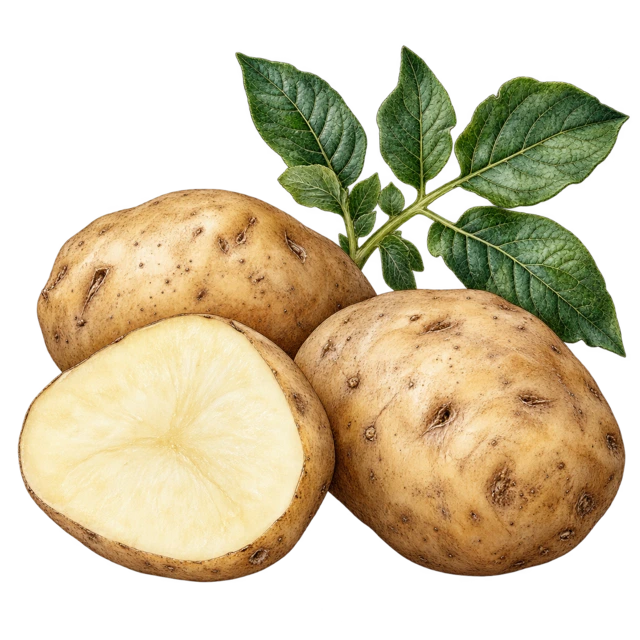
Key cautions
- Discard green, sprouting, shriveled, damaged or bitter potatoes. Cooking does not justify using suspect tubers.
- The copper figure includes skin, but skin should only be eaten on fresh, undamaged potatoes. Remove eyes from otherwise sound tubers; do not try to salvage green or sprouting potatoes for this comparison.
- Do not eat potato leaves, stems or berries. Sweet-potato leaves belong to a different plant and are not a guide to potato foliage.
What’s inside
Starch, fiber, potassium and vitamin C, with copper and other nutrients. Glycoalkaloids are safety-relevant constituents, particularly in green or sprouting material.
Uses in brief

- Cooked staple and mixed dishes
- Chuño food heritage
- Starch and flour ingredients
Copper food reference
Copper in this food
Approximate reference values for the exact form and portion shown. The label Daily Value (DV) is 0.9 mg for adults and children age 4+, not an individual intake prescription. Portions differ, so this is not a per-gram ranking.
Potato
Cooked, flesh and skin · 1 medium potato
0.675 mg copper · 75% DV
NIH does not specify a cultivar or more precise cooking method. Do not transfer to sweet potato (card 163).
Compare copper food sources and read the mineral cautions
Food composition does not establish a deficiency or predict a treatment effect. Oils and extracts do not inherit these food values.
History, folklore and reported uses
History, folklore and traditional uses
Potatoes originated as an Andean food crop and spread into European agriculture after the sixteenth century. Their storage tubers became a major staple.
The Andean preserved food chuño is an important part of that history. It is a culturally specific processed food, not an instruction to eat damaged or frost-spoiled household potatoes.
Traditional, historical and reported uses
- Cooked staple and mixed dishes
Food or household practiceWhy this label?
The claim documents cooked staple and mixed dishes as a culinary, craft, gardening, or practical material use; it reports neither a treatment outcome nor measured nutrient content.
Potatoes are boiled, baked or roasted and served as a staple food. Cooked potato can be mashed or used in soups, stews and pies.
- Chuño food heritage
Food or household practiceWhy this label?
The claim documents chuño food heritage as a culinary, craft, gardening, or practical material use; it reports neither a treatment outcome nor measured nutrient content.
Kew records chuño as a traditional preserved potato food of Aymara and Quechua communities.
- Starch and flour ingredients
Food or household practiceWhy this label?
The claim documents starch and flour ingredients as a culinary, craft, gardening, or practical material use; it reports neither a treatment outcome nor measured nutrient content.
Potatoes are processed into flour and starch for foods; these refined forms are distinct from whole cooked tubers.
Culinary, material and historical uses are distinguished from medical claims. The number of uses reflects the reviewed evidence, not a fixed quota.
Historical-use additions reviewed 2026-10-08
Regional reading paths
These sourced notes describe cultivation, trade, food traditions or material history. A regional connection does not claim exclusive origin.
Europe
Introduced/cultivated: European food crop, including UK and Germany; originally American.
Cooked tuber staple; discard strongly green or sprouting tubers rather than treating them as ordinary food.
South America
native domesticate; Peru, Bolivia
Cooked tubers.
Identity & detailed reference
Identity
The cultivated potato’s edible underground stem tuber. It is distinct from sweet potato, and the plant’s green foliage and berries are not table vegetables.
Ingredient details, preparation and research
Also known as: White potato; Irish potato; Papa
Source plant or material
Solanum tuberosum L.
Plant family / material: Solanaceae
Forms and route
Sound tubers cooked as boiled, baked, roasted or mashed potato; processed starches, fries and crisps have different compositions.
Vitamins and minerals
The copper comparison includes cooked flesh and skin of one medium potato. NIH does not specify the cultivar or a more precise cooking method; do not transfer the value to peeled mash or fries.
Absorption and preparation
Cooking and the final recipe change the food matrix. The copper number is a reference composition, not a guaranteed absorbed amount.
Practical preparation
Store sound tubers cool, dark and dry. Scrub and inspect before cooking; do not eat a finished dish that tastes bitter.
Combination context
No special herbal pairing is required.
Combination notes
Use in an ordinary mixed diet; the food’s mineral content does not establish a medicinal combination or treatment.
Traditional and reported uses
- Cooked staple and mixed dishes
- Chuño food heritage
- Starch and flour ingredients
Contraindications and cautions
- Discard green, sprouting, shriveled, damaged or bitter potatoes. Cooking does not justify using suspect tubers.
- The copper figure includes skin, but skin should only be eaten on fresh, undamaged potatoes. Remove eyes from otherwise sound tubers; do not try to salvage green or sprouting potatoes for this comparison.
- Do not eat potato leaves, stems or berries. Sweet-potato leaves belong to a different plant and are not a guide to potato foliage.
Similar items and how they compare
- Sweet potato
Both are starchy underground foods.
Sweet potato is an Ipomoea storage root in Convolvulaceae; potato is a Solanum stem tuber in Solanaceae.
Skin-inclusive nutrition and safety
A nutrient table cannot override food-safety advice. Green and sprouting tubers can accumulate glycoalkaloids; extra skin is not automatically beneficial.
Evidence limits
Food composition varies by variety, preparation and product. A reference serving is a comparison, not a therapeutic dose.
Entry sources
- Royal Botanic Gardens, Kew: Potato
- Kew: Taking root, potato season at Kew’s Kitchen Garden
- German Federal Institute for Risk Assessment: Green and strongly germinating potatoes
- NIH ODS: Copper, health-professional fact sheet, food table
Reference entry 244 · Recorded content review: 2026-10-08 · Review scope and dates