


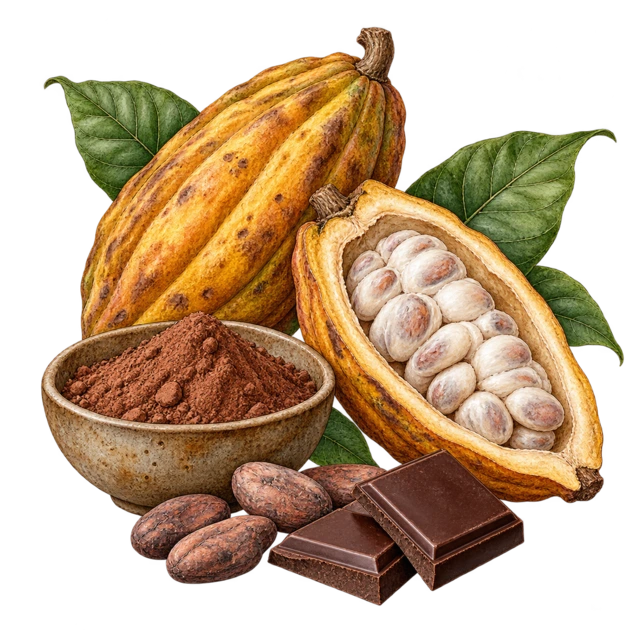
Key cautions
- Cocoa and chocolate contain caffeine and theobromine; sensitivity and serving size matter.
- Chocolate may contain milk, nuts, soy or other allergens; check the actual product.
- Do not treat chocolate as a heart-disease remedy or increase portions solely to chase copper. Sweetened products also contribute sugar and energy.
What’s inside
Cocoa solids contain minerals, fiber, flavanols and methylxanthines including theobromine and caffeine. Cocoa butter is the fat fraction; sugar and milk depend on the finished product.
Uses in brief

- Cacao-drink heritage
- Chocolate food ingredient
- Cocoa powder in desserts
Copper food reference
Copper in this food
Approximate reference values for the exact form and portion shown. The label Daily Value (DV) is 0.9 mg for adults and children age 4+, not an individual intake prescription. Portions differ, so this is not a per-gram ranking.
Unsweetened baking chocolate
Unsweetened baking chocolate · 1 oz
0.938 mg copper · 104% DV
Comparison portion, not a daily recommendation; differs from cocoa powder, sweetened chocolate and cacao nibs.
Dark chocolate
70–85% cacao solids · 1 oz
0.501 mg copper · 56% DV
Finished chocolate; do not substitute this value for cocoa powder or cacao nibs.
Cocoa powder
Unsweetened, not alkalized · 1 tbsp (5.4 g)
0.205 mg copper · 23% DV
Not sweetened cocoa drink mix; alkalized cocoa is a separate record.
Compare copper food sources and read the mineral cautions
Food composition does not establish a deficiency or predict a treatment effect. Oils and extracts do not inherit these food values.
History, folklore and reported uses
History, folklore and traditional uses
Cacao seeds have a long food and ceremonial history in the Americas. Kew records Maya and Aztec spiced cacao drinks and the use of valued beans as currency.
Fermentation, drying, roasting and grinding create the flavor and ingredients used in chocolate making. Separating cocoa solids and butter, then adding sugar or milk, produces foods with different uses and nutrient profiles.
A closer look at its history
A drink and a unit of value before a chocolate bar
Kew’s historical account describes Mesoamerican cacao drinks flavored with chilli and vanilla and beans used as currency by Maya and Aztec peoples. Empty shells filled with earth could even serve as counterfeits. Those uses place cacao in systems of exchange and ceremony as well as food; modern sweet chocolate is only one later form.
Processing changed what chocolate could become
European elite drinkers adopted cacao with different flavorings. Nineteenth-century pressing and manufacturing then helped move chocolate toward mass-market products. Kew’s archives preserve correspondence seeking manufacturers’ opinions on Sri Lankan beans, showing how botanical gardens also supported colonial crop transfer and commercial quality assessment.
Additional history reviewed 2026-10-10
Traditional, historical and reported uses
- Cacao-drink heritage
Food or household practiceWhy this label?
The claim documents cacao-drink heritage as a culinary, craft, gardening, or practical material use; it reports neither a treatment outcome nor measured nutrient content.
Ground cacao was consumed in spiced drinks in Central and South America; this historical beverage differs from a modern sweetened cocoa mix.
- Chocolate food ingredient
Food or household practiceWhy this label?
The claim documents chocolate food ingredient as a culinary, craft, gardening, or practical material use; it reports neither a treatment outcome nor measured nutrient content.
Processed seed material becomes baking chocolate and eating chocolate, with product-specific additions of sugar and milk.
- Cocoa powder in desserts
Food or household practiceWhy this label?
The claim documents cocoa powder in desserts as a culinary, craft, gardening, or practical material use; it reports neither a treatment outcome nor measured nutrient content.
Unsweetened powder adds cocoa flavor to mixed foods, including an avocado-based dessert documented by Illinois Extension.
- Cocoa-butter cosmetic use
Food or household practiceWhy this label?
The claim documents cocoa-butter cosmetic use as a culinary, craft, gardening, or practical material use; it reports neither a treatment outcome nor measured nutrient content.
The extracted fat is used in lip and skin products. Cosmetic use does not carry the mineral profile of cocoa solids.
- Ceremonial and exchange history
Traditional accountWhy this label?
The claim reports Maya/Aztec ceremonial and exchange practices from a botanical cultural-history account, without identifying a specific archival record.
Kew describes cacao in Maya and Aztec ceremonies and beans used as currency among the Aztecs.
Culinary, material and historical uses are distinguished from medical claims. The number of uses reflects the reviewed evidence, not a fixed quota.
Historical-use additions reviewed 2026-10-08
Story sources
- Royal Botanic Gardens, Kew: Cacao tree
- Kew POWO: Theobroma cacao, species profile
- University of Illinois Extension: Hidden Inside, An Avocado
- NIH ODS: Copper, health-professional fact sheet, food table
- USDA FoodData Central: Unsweetened cocoa powder, FDC 169593
- FDA: Qualified health claim for high-flavanol cocoa powder
- FDA: Cadmium in Food and Foodwares
- FDA: Food Allergies, What You Need to Know
Regional reading paths
These sourced notes describe cultivation, trade, food traditions or material history. A regional connection does not claim exclusive origin.
North America
Cultivated/traditional processing: Mexico/Mesoamerica and Caribbean.
Processed beans used for cocoa, chocolate and drinks.
South America
native and cultivated; tropical South America, Ecuador, Brazil
Processed cacao seeds and chocolate.
Australia & Oceania
introduced/traded and cultivated; Papua New Guinea
Cocoa and chocolate ingredient.
Identity & detailed reference
Identity
One source-plant card for cacao seeds and their food products. Cocoa powder, cocoa butter, nibs, unsweetened chocolate and sweetened bars are materially different.
Ingredient details, preparation and research
Also known as: Cocoa; Chocolate; Cacao nibs; Cocoa powder; Cocoa butter (separate fraction); Cocoa bean; Cocoa beans; Cacao bean; Cacao beans
Source plant or material
Theobroma cacao L.
Plant family / material: Malvaceae
Forms and route
Fermented and dried seeds, usually roasted; cacao nibs; unsweetened cocoa powder, including separately labeled alkalized forms; cocoa butter; baking and eating chocolate. Drink mixes include other ingredients.
Vitamins and minerals
Copper values differ substantially across unsweetened baking chocolate, 70–85% dark chocolate and unsweetened non-alkalized cocoa powder. Keep each stated portion with its own food form. The figures do not describe nibs, cocoa butter, drink mixes or white chocolate.
Absorption and preparation
A cocoa percentage is not a standardized flavanol amount. Processing and formulation vary, and mineral content alone does not establish a health effect.
Practical preparation
Choose the food form specified by the dish. Unsweetened powder and unsweetened baking chocolate are not weight-for-weight nutritional substitutes.
Combination context
No special herbal pairing is required.
Combination notes
Use in an ordinary mixed diet; the food’s mineral content does not establish a medicinal combination or treatment.
Traditional and reported uses
- Cacao-drink heritage
- Chocolate food ingredient
- Cocoa powder in desserts
- Cocoa-butter cosmetic use
- Ceremonial and exchange history
Contraindications and cautions
- Cocoa and chocolate contain caffeine and theobromine; sensitivity and serving size matter.
- Chocolate may contain milk, nuts, soy or other allergens; check the actual product.
- Do not treat chocolate as a heart-disease remedy or increase portions solely to chase copper. Sweetened products also contribute sugar and energy.
- Contaminant levels, including cadmium, vary by product and origin; a copper ranking is not a product safety certification.
Similar items and how they compare
- Carob
A different plant food sometimes used in chocolate-like foods.
Carob is not cacao and cannot inherit cacao’s composition.
What the qualified claim covers
FDA found only very limited credible evidence for a cardiovascular-risk claim restricted to qualifying high-flavanol cocoa powder. That is not a blanket claim for ordinary chocolate.
Powder calculation
The reviewed USDA record gives 3.788 mg copper per 100 g unsweetened cocoa powder. A 5.4 g tablespoon supplies about 0.205 mg. Alkalized powder and sweetened mixes require separate records.
Food composition reference
Cocoa, dry powder, unsweetened · 1 tbsp, unsweetened cocoa powder (5.4 g). Approximate values, rounded to about three significant digits.
| Nutrient | Per 100 g | Per stated serving |
|---|---|---|
| Energy | 228 kcal | 12.3 kcal |
| Protein | 19.6 g | 1.06 g |
| Total fat | 13.7 g | 0.74 g |
| Carbohydrate | 57.9 g | 3.13 g |
| Fiber | 37 g | 2 g |
| Calcium | 128 mg | 6.91 mg |
| Iron | 13.9 mg | 0.748 mg |
| Magnesium | 499 mg | 26.9 mg |
| Potassium | 1520 mg | 82.3 mg |
| Copper | 3.79 mg | 0.205 mg |
USDA FoodData Central SR Legacy reference data; not newly collected 2026 measurements
per-100-g value × edible serving grams / 100; prose rounded
Evidence limits
Food composition varies by variety, preparation and product. A reference serving is a comparison, not a therapeutic dose.
Entry sources
- Royal Botanic Gardens, Kew: Cacao tree
- Kew POWO: Theobroma cacao, species profile
- University of Illinois Extension: Hidden Inside, An Avocado
- NIH ODS: Copper, health-professional fact sheet, food table
- USDA FoodData Central: Unsweetened cocoa powder, FDC 169593
- FDA: Qualified health claim for high-flavanol cocoa powder
- FDA: Cadmium in Food and Foodwares
- FDA: Food Allergies, What You Need to Know
Reference entry 246 · Recorded content review: 2026-10-08 · Review scope and dates