


Key cautions
- Avoid lentils if you have a diagnosed lentil allergy. Allergy to one pulse does not by itself establish that all pulses are unsafe; use your allergy team’s advice.
- Sort, rinse and cook dried lentils until tender. They generally do not need soaking; follow the variety’s instructions.
What’s inside
Protein, starch, fiber, folate, iron and other minerals. Seed coat removal and cooking change texture and nutrient concentration.
Uses in brief

- Cooked lentils for soups, stews, salads, purees and pulse-based fillings.
- Lentil flour in appropriately cooked foods; split lentils for quicker-softening dishes.
Copper food reference
Copper in this food
Approximate reference values for the exact form and portion shown. The label Daily Value (DV) is 0.9 mg for adults and children age 4+, not an individual intake prescription. Portions differ, so this is not a per-gram ranking.
Lentils
Boiled, no added salt · ½ cup (99 g)
0.248 mg copper · 28% DV
Compare copper food sources and read the mineral cautions
Food composition does not establish a deficiency or predict a treatment effect. Oils and extracts do not inherit these food values.
In the King James Bible
In the King James Bible
Named material
The KJV spelling lentiles is retained exactly. Genesis 25:34 explicitly names lentil pottage; Ezekiel 4:9 includes lentils in the ration-bread mixture. These food references conventionally match the lentil crop but do not establish a modern cultivar, medicinal use or ideal fasting diet. Ezekiel’s context is siege and scarcity.
Then Jacob gave Esau bread and pottage of lentiles; and he did eat and drink, and rose up, and went his way: thus Esau despised his birthright.
Genesis 25:34 (KJV)
Take thou also unto thee wheat, and barley, and beans, and lentiles, and millet, and fitches, and put them in one vessel, and make thee bread thereof, according to the number of the days that thou shalt lie upon thy side, three hundred and ninety days shalt thou eat thereof.
Ezekiel 4:9 (KJV)
Scripture and identification sources
Words & their stories
WORDS & THEIR STORIES
The name behind the KJV
Biblical Hebrew · Genesis 25:34 (KJV)
עֲדָשִׁיםʿădāšīm
Lentils, specifying the pottage Jacob gives Esau.
Dictionary form: עֲדָשָׁה · ʿădāšāh
The verse uses the plural; the singular dictionary form is reconstructed in BDB.
Biblical Hebrew · Ezekiel 4:9 (KJV)
וַעֲדָשִׁיםwaʿădāšīm
“And lentils,” in the bread mixture.
Dictionary form: עֲדָשָׁה · ʿădāšāh
The conjunction has the vowel a before the following reduced a vowel.
What the language reveals
A stew and a loaf
The same food noun occurs in different preparations: pottage in Genesis and mixed bread in Ezekiel.
A plural throughout the biblical uses
BDB lists the biblical occurrences under the plural, including a growing lentil crop as well as food.
The lentil identification is conventional and strong. The passages do not specify a modern cultivar or prescribe a health or fasting diet.
Language and identification bibliography
History, folklore and reported uses
History, folklore and traditional uses
A pot of lentils carries unusual narrative weight in Genesis: Jacob gives Esau bread and pottage of lentiles after the bargain over the birthright. The crop itself is modest and practical. Lentils dry for storage, grow in small plots and become a meal after boiling. Musselman’s field account describes little patches among olive trees and on mountain ledges, bringing the biblical food back into the scale of household work rather than treating it as an abstract symbol.
Across later kitchens the small seed takes on many forms. It can thicken a curry, be mashed, fill dough or be milled into flour. In Italy, lentils also mark the turn of the year, their association with prosperity giving a common pantry food a ceremonial role. Those traditions are distinct from claims that lentils cure disease. Their modern value is easier to describe concretely: a cooked portion contributes meaningful protein, fiber and folate, with preparation and the rest of the meal shaping the result.
Traditional, historical and reported uses
- Pottage and everyday stew
Historical recordWhy this label?
Specific Genesis passage directly documents a boiled pulse meal.
Genesis 25:34 names lentil pottage with bread. It supplies a direct textual example of a boiled pulse meal without giving a full ingredient list or a modern recipe.
- Flour for breads and crisp foods
Food or household practiceWhy this label?
Lentil flour used in breads and crisp foods.
Kew documents lentils ground into flour for bread and foods such as papadum. Here the pulse becomes a flour ingredient rather than remaining a whole cooked seed.
- Fillings for dough-based dishes
Food or household practiceWhy this label?
Culinary lentil fillings for dough-based dishes.
Kew records lentil fillings in puri and parathas in the Indian subcontinent. A filled preparation has a separate culinary role from lentils served as soup.
- Mashed lentils and flour pastes
Food or household practiceWhy this label?
Regional mashed-pulse and flour-paste preparations.
Kew describes Ethiopian azifa as cooked, mashed lentils and elbet as a lentil-flour paste. The examples show deliberate texture-making with the pulse, not merely another name for pottage.
- New Year prosperity food
Food or household practiceWhy this label?
Ceremonial New Year food associated with prosperity.
Italy’s national tourism account records lentils at New Year as an auspicious food associated with prosperity.
Health topics: evidence and cautions
These notes describe a specific research context and preparation. A topic link is not a treatment recommendation.
Injury and recovery · Support during care
Form and route: cooked lentils · oral food
Lentils add nutrients to a varied recovery diet.
Evidence: clinical nutrition guidance
NHS wound guidance includes lentils among iron-rich foods.
Limits
No claim that lentils alone accelerate healing.
Cautions
- Cook before eating; adjust portions to tolerance and prescribed diets.
Diabetes and prediabetes · Support during care
Form and route: Cooked lentils · oral
Lentils can help build a high-fiber, lower-glycemic meal.
Evidence: randomized_diet_pattern_evidence
A three-month trial in 121 adults with type 2 diabetes found a small HbA1c advantage for a legume-rich low-GI diet over a high-wheat-fiber diet.
Limits
Beans, chickpeas and lentils were used together; no lentil-only effect was established.
Cautions
- Count carbohydrate and introduce fiber gradually.
Colon and bowel health · Symptom support
Form and route: Cooked lentils · oral
A fiber-containing food for a bowel-friendly eating pattern.
Evidence: Agency dietary guidance
NIDDK lists this food among useful fiber sources.
Limits
No proof that this single food prevents or treats colorectal cancer.
Cautions
- Increase fiber gradually and drink suitable fluids.
Muscle mass · Support during care
Form and route: Oral cooked lentils in meals; no clinical hypertrophy dose established. · oral
Condition and setting: Food-first protein adequacy during resistance training
Cooked lentils contribute protein to a varied diet that supports resistance training. They are a food option, not a proven standalone muscle-growth treatment.
Evidence: Food-first protein support only
USDA lists lentils among vegetarian protein foods. This is dietary guidance rather than an isolated-food intervention. Supports a protein-source role only.
Limits
Do not imply an individual lentil trial demonstrated hypertrophy or convert food-group ounce equivalents into grams of protein.
Cautions
- Respect any known legume allergy and individual digestive tolerance.
Regional reading paths
These sourced notes describe cultivation, trade, food traditions or material history. A regional connection does not claim exclusive origin.
Asia
Cultivated and traditional food: India and Bangladesh, with wider West Asian use.
Cooked whole or split pulses in dal and soups.
Europe
Cultivated and traditional processing: Le Puy, France, and Italian food traditions.
Cooked pulses used in soups, salads and regional dishes.
Identity & detailed reference
Identity
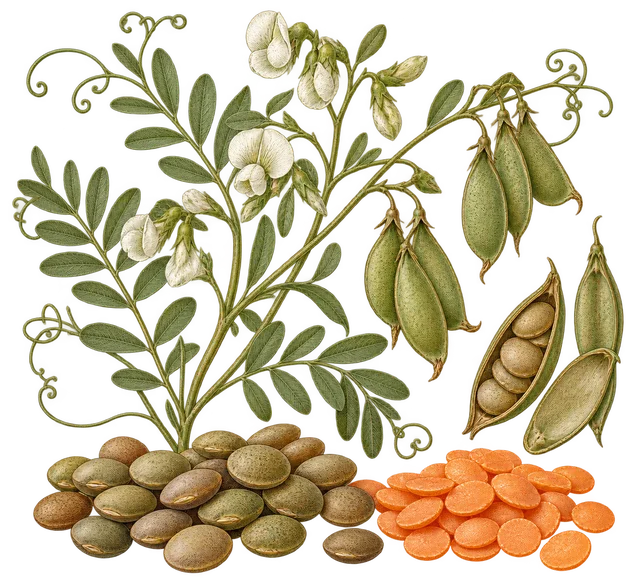
The lens-shaped edible seeds of the lentil crop. Whole seed-coat-on lentils and split dehulled red lentils differ in cooking behavior; dal can also mean other pulses and does not always identify lentils.
Ingredient details, preparation and research
Also known as: Lentiles (KJV spelling); Red, green and brown lentils (modern food forms)
Source plant or material
Lens culinaris Medik. (also treated within Vicia as Vicia lens); The lens-shaped edible seeds of the lentil crop. Whole seed-coat-on lentils and split dehulled red lentils differ in cooking behavior; dal can also mean other pulses and does not always identify lentils.
Plant family / material: Fabaceae (pea and bean family)
Forms and route
Dried whole or split lentils; cooked lentils; canned cooked lentils; lentil flour. The food portion below is mature lentils boiled without salt, not dry lentils or a prepared curry.
Vitamins and minerals
Modern food reference: 1/2 US cup mature lentils, boiled without salt, about 99 g, supplies approximately 115 kcal, 8.9 g protein, 19.9 g carbohydrate, 7.8 g fiber, 179 micrograms folate and 3.3 mg iron. Calculated from USDA SR28 NDB 16070 (1 cup = 198 g; pages 353–355). Dry lentils weigh less before absorbing water; do not apply these values to the same weight of dry seed or to a recipe containing oil, meat or coconut milk.
Absorption and preparation
Serve with a vitamin-C-rich ingredient such as peppers or citrus to help absorb the lentils’ nonheme iron. A varied diet containing cereals and pulses supplies complementary amino acids without requiring a precisely timed food pairing. Split lentils soften readily; whole lentils hold shape better. Cooking and draining choices change the finished dish, and the iron figure is content rather than an amount guaranteed to be absorbed.
Traditional and reported uses
- Cooked lentils for soups, stews, salads, purees and pulse-based fillings.
- Lentil flour in appropriately cooked foods; split lentils for quicker-softening dishes.
Contraindications and cautions
- Avoid lentils if you have a diagnosed lentil allergy. Allergy to one pulse does not by itself establish that all pulses are unsafe; use your allergy team’s advice.
- Sort, rinse and cook dried lentils until tender. They generally do not need soaking; follow the variety’s instructions.
- Large sudden increases in pulse or fiber intake can cause gas. Start with a comfortable food portion; severe or persistent digestive symptoms need assessment.
Similar items and how they compare
- Beans (fava / broad beans)
Both are biblical pulses used for substantial meals.
Lentils are smaller, usually need no soaking and do not share the fava-specific favism warning.
- Wheat
Bread and lentils appear together in Genesis 25:34.
The passage names a meal and a moral choice; it does not prescribe a calculated protein ratio.
Identity and variety
The edible lentil is conventionally Lens culinaris; newer classifications also place it in Vicia. Whole brown or green seeds and dehulled red splits are food forms of lentil, while other pulses sold as dal must be identified separately.
Practical cooking
Unlike many larger dried beans, lentils normally do not need soaking. Sort and rinse them, then simmer until tender. Split forms can disintegrate into a puree; whole forms can retain their shape.
What the nutritional evidence means
USDA values quantify nutrients in plain cooked lentils. They do not validate fasting regimens, anemia treatment or a curative role for the pottage in Genesis. Allergy and individual tolerance still matter.
Food portion and nutrition
Modern food reference: 1/2 US cup mature lentils, boiled without salt, about 99 g, supplies approximately 115 kcal, 8.9 g protein, 19.9 g carbohydrate, 7.8 g fiber, 179 micrograms folate and 3.3 mg iron. Calculated from USDA SR28 NDB 16070 (1 cup = 198 g; pages 353–355). Dry lentils weigh less before absorbing water; do not apply these values to the same weight of dry seed or to a recipe containing oil, meat or coconut milk.
Preparation and meal pairing
Serve with a vitamin-C-rich ingredient such as peppers or citrus to help absorb the lentils’ nonheme iron. A varied diet containing cereals and pulses supplies complementary amino acids without requiring a precisely timed food pairing. Split lentils soften readily; whole lentils hold shape better. Cooking and draining choices change the finished dish, and the iron figure is content rather than an amount guaranteed to be absorbed.
Evidence limits
- Modern lentil colors and varieties are not fixed by the verses.
- Kew’s broad use account includes some common-name groupings wider than true lentils; this card does not treat mung bean or horse gram as lentil species.
Entry sources
- Royal Botanic Gardens, Kew: Lentil
- Lytton John Musselman, Old Dominion University: Lentils
- Italia.it, Italian National Tourism Board: New Year traditions in Italy
- North West Allergy Network: Allergy to Legumes & Pulses
- MedlinePlus: Healthy food trends, beans and legumes
- USDA Standard Reference 28 (2015): legumes and legume products, food group 16
- NIH Office of Dietary Supplements: Iron, Health Professional Fact Sheet
- FAO: Nature’s nutritious seeds, 10 reasons why you should opt for pulses
- King James Bible: Project Gutenberg eBook 10
Reference entry 149 · Recorded content review: 2026-10-06 · Review scope and dates