


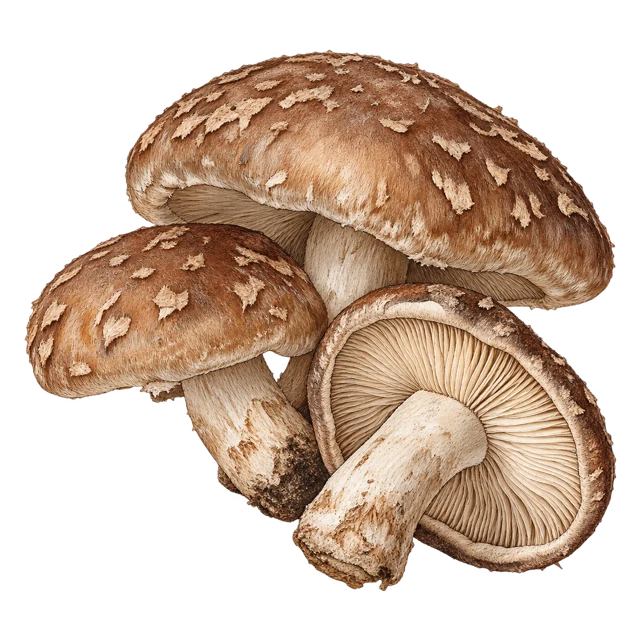
Key cautions
- Raw or inadequately cooked shiitake can cause a striking itchy, streaked rash. Cook food mushrooms thoroughly; cooking is not a guarantee for someone with a prior allergy.
- Check concentrated supplements with the care team during cancer treatment; AHCC has product-specific potential medicine interactions.
What’s inside
Polysaccharides include lentinan, a beta-glucan; eritadenine is another studied constituent. Amounts in a meal do not equal an isolated research preparation.
Uses in brief

- Culinary mushroom
- Restorative tonic
- Cold and circulation remedies
Copper food reference
Copper in this food
Approximate reference values for the exact form and portion shown. The label Daily Value (DV) is 0.9 mg for adults and children age 4+, not an individual intake prescription. Portions differ, so this is not a per-gram ranking.
Shiitake
Cooked, chopped · ½ cup
0.650 mg copper · 72% DV
Compare copper food sources and read the mineral cautions
Food composition does not establish a deficiency or predict a treatment effect. Oils and extracts do not inherit these food values.
History, folklore and reported uses
History, folklore and traditional uses
Shiitake belongs as much to the kitchen and woodland as to the apothecary. East Asian growers have long raised it on hardwood logs; more recent sawdust cultivation makes use of processed wood materials. Fresh and dried mushrooms carry this cultivation history into everyday cooking, where texture and savory flavor remain central.
A historical account reproduced in an FAO forestry paper attributes restorative and cold-remedy uses to the Ming-period physician Wu Rui. These belong to the record of medical belief and practice. Today, studies of purified lentinan and proprietary mycelial preparations form a separate chapter: a cooked mushroom, an isolated injected compound and a branded supplement are different materials.
A closer look at its history
A name rooted in woodland cultivation
Shiitake’s Japanese name points to the shii/chinquapin tree. Modern woodland cultivation retains that relationship with hardwood, while sawdust-block culture compresses the production cycle. These are different cultivation systems for the same named food species.
Tree waste as a substrate
An Indian experiment presented through FAO used mixed hardwood sawdust in synthetic logs and obtained fruiting bodies. This is a specific agricultural reuse of selected lignocellulosic material, not evidence that contaminated wood or arbitrary waste is suitable for food production.
Additional history reviewed 2026-10-09
Traditional, historical and reported uses
- Culinary mushroom
Food or household practiceWhy this label?
The claim documents culinary mushroom as a culinary, craft, gardening, or practical material use; it reports neither a treatment outcome nor measured nutrient content.
Fresh and dried fruiting bodies are used in East Asian cooking, with dried mushrooms especially useful for savory flavor.
- Restorative tonic
Traditional accountWhy this label?
Historical Chinese tonic beliefs are reported, but the claim does not identify a specific archival text or establish increased stamina.
Historical Chinese accounts attributed increased stamina to shiitake.
- Cold and circulation remedies
Historical recordWhy this label?
The source explicitly attributes cold and circulation remedies to Wu Rui writings, making this a historical written-record claim.
FAO’s historical summary records use for colds and circulation-related complaints in writings attributed to Wu Rui.
- Characterized extracts in medical research
Mixed/contextual sourcesWhy this label?
The attached MSK pages cover both preclinical and human investigations of distinct extracts; the general research claim is not limited to one study setting or to edible shiitake.
Purified lentinan and mycelial preparations have been studied separately from the food; AHCC is a proprietary preparation, not a synonym for shiitake.
- Wood-residue cultivation
Food or household practiceWhy this label?
The claim documents wood-residue cultivation as a culinary, craft, gardening, or practical material use; it reports neither a treatment outcome nor measured nutrient content.
Growers cultivate shiitake on hardwood logs and supplemented sawdust. Research on tree waste shows a practical agricultural use of the fungus as a wood-decomposing food crop, separate from medicinal claims.
Features and lookalikes to study
Lentinula edodes (Berk.) Pegler; Lentinus edodes is a familiar older name.
Common names vary between regions and suppliers; the scientific scope above governs this card.
Morphology described in sources
- Brown-capped, pale-gilled mushrooms on hardwood are only a starting description, not a diagnosis. Known inoculated logs provide provenance, but other fungi can fruit on the same logs.
- Habitat and substrate
- See the source-linked morphology and comparison notes below; a separate habitat summary has not been verified for this card.
- Geographic scope
- A complete regional range is not established here. Broad common names and commercial labels can span different species.
- Season in the cited region
- No region-specific fruiting season has been verified for this card. Do not infer a local season from trade availability.
Galerina marginata (potentially lethal)
Galerina on decaying wood can be mistaken for small brown cultivated-log mushrooms. Its mature spore deposit is rusty brown and a ring may be visible; a shiitake deposit is pale.
Ring remnants may disappear and immature material is especially misleading. Do not use spore colour alone or assume every mushroom on an inoculated log is shiitake.
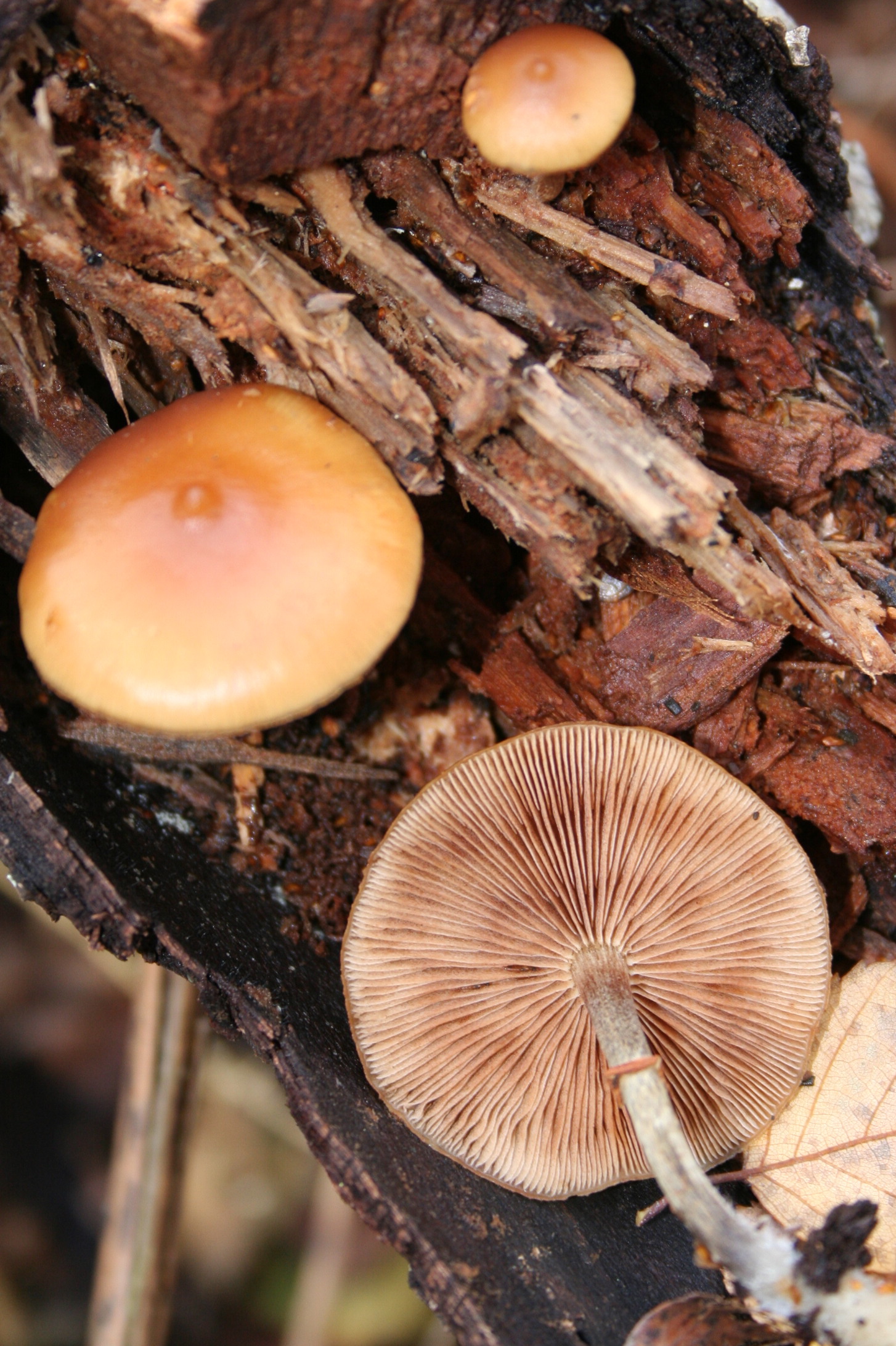
Source-labeled Galerina marginata, woodland near Paris, 6 November 2005. Photograph by Strobilomyces, CC BY-SA 3.0. Wood substrate or a familiar cap shape does not authenticate shiitake or enoki.
This photograph shows brown caps, an exposed gilled underside and decaying wood. Microscopic characters and a spore deposit are not shown; cap or gill colour alone cannot establish identity.
Photograph source and attribution · CC BY-SA 3.0. Original image, unmodified. Species attribution comes from the source; no independent specimen authentication is claimed.

This limited photo pilot is not a complete atlas or an edibility decision aid. Do not eat a wild mushroom based on this photograph.
Limits and regional differences
- Confirm the cultivated strain and examine each fruiting body; unfamiliar growth needs expert identification. Log ownership and inoculation do not authenticate an individual mushroom.
- Educational comparison only. Neither this card, an illustration, a photograph, a spore-print colour nor a checklist establishes that a wild collection is safe to eat. A qualified local mycologist must assess uncertain material; do not taste an unknown fungus. Cooking does not reliably eliminate mushroom toxins.
Regional reading paths
These sourced notes describe cultivation, trade, food traditions or material history. A regional connection does not claim exclusive origin.
Asia
Cultivated/traditional use: China and Japan.
Cooked fresh or dried mushroom in savoury dishes.
Identity & detailed reference
Identity
Lentinula edodes (Berk.) Pegler; Lentinus edodes is a familiar older name.
Ingredient details, preparation and research
Also known as: shiitake; xiang gu; Chinese black mushroom
Source plant or material
Lentinula edodes (Berk.) Pegler; Fruiting bodies, fresh or dried; cultured mycelium and isolated polysaccharides are separately processed materials.
Fungal family: Omphalotaceae
Forms and route
Fresh or dried fruiting bodies used as cooked food. Mushroom powder, cultured mycelium, proprietary AHCC and purified lentinan are different preparations.
Vitamins and minerals
A culinary food rather than a standardized nutrient supplement. Fresh and dried weights are not interchangeable; this card does not assign a vitamin, mineral or protein dose.
Absorption and preparation
Cook fresh mushrooms thoroughly and rehydrate dried food hygienically before cooking. Purified lentinan trials, often involving injection, cannot establish the absorption or effects of a mushroom meal.
Traditional and reported uses
- Fresh and dried fruiting bodies are used in East Asian cooking, with dried mushrooms especially useful for savory flavor.
- Historical Chinese accounts attributed increased stamina to shiitake.
- FAO’s historical summary records use for colds and circulation-related complaints in writings attributed to Wu Rui.
- Purified lentinan and mycelial preparations have been studied separately from the food; AHCC is a proprietary preparation, not a synonym for shiitake.
- Growers cultivate shiitake on hardwood logs and supplemented sawdust. Research on tree waste shows a practical agricultural use of the fungus as a wood-decomposing food crop, separate from medicinal claims.
Contraindications and cautions
- Raw or inadequately cooked shiitake can cause a striking itchy, streaked rash. Cook food mushrooms thoroughly; cooking is not a guarantee for someone with a prior allergy.
- Check concentrated supplements with the care team during cancer treatment; AHCC has product-specific potential medicine interactions.
- This card is not a foraging identification guide. Unknown wild mushrooms should not be eaten.
Similar items and how they compare
- Maitake
Both are cultivated culinary mushrooms with polysaccharide-extract research.
Shiitake is Lentinula edodes; maitake is Grifola frondosa. Their foods and named extracts are not interchangeable.
Identity, fungal material and preparation
Lentinula edodes (Berk.) Pegler; Lentinus edodes is a familiar older name. Fruiting bodies, fresh or dried; cultured mycelium and isolated polysaccharides are separately processed materials. Cook fresh mushrooms thoroughly and rehydrate dried food hygienically before cooking. Purified lentinan trials, often involving injection, cannot establish the absorption or effects of a mushroom meal.
Constituents and food context
Polysaccharides include lentinan, a beta-glucan; eritadenine is another studied constituent. Amounts in a meal do not equal an isolated research preparation. A culinary food rather than a standardized nutrient supplement. Fresh and dried weights are not interchangeable; this card does not assign a vitamin, mineral or protein dose.
Traditional uses and evidence boundaries
Evidence is preparation-specific. A cooked food cannot reproduce an injected or purified lentinan trial, and shiitake is not an established cancer treatment.
Safety and product distinctions
Raw or inadequately cooked shiitake can cause a striking itchy, streaked rash. Cook food mushrooms thoroughly; cooking is not a guarantee for someone with a prior allergy. Check concentrated supplements with the care team during cancer treatment; AHCC has product-specific potential medicine interactions.
Entry sources
- FAO: Production of Shiitake Mushroom on Tree Waste
- MSK: Shiitake mushroom
- French Poison Control Centre case series, 2022
- MSK: AHCC
- Food Standards Australia New Zealand: Lentinula edodes taxonomic information
Reference entry 207 · Recorded content review: 2026-10-08 · Review scope and dates