


Key cautions
- For celiac disease, choose a product labeled gluten-free and check shared processing and added ingredients. A mixed Ezekiel-style bread contains wheat and barley even when millet itself is included.
- Do not transfer one millet’s nutrient profile to all millets or to sorghum; check the actual food and preparation.
What’s inside
Modern millet foods mainly supply starch, with protein, fiber and minerals varying considerably by species and processing. Finger millet’s calcium profile, for example, should not be applied to all millets.
Uses in brief

- Modern edible millet as cooked kernels, porridge, flatbread flour or other properly cooked grain foods.
- A carefully labeled comparison to a biblical grain name whose precise botanical identity remains open.
Copper food reference
Copper in this food
Approximate reference values for the exact form and portion shown. The label Daily Value (DV) is 0.9 mg for adults and children age 4+, not an individual intake prescription. Portions differ, so this is not a per-gram ranking.
Millet
Cooked · 1 cup
0.280 mg copper · 31% DV
Generic cooked millet nutrient record; not species-specific historical grain evidence.
Compare copper food sources and read the mineral cautions
Food composition does not establish a deficiency or predict a treatment effect. Oils and extracts do not inherit these food values.
In the King James Bible
In the King James Bible
Probable botanical identification
Millet is explicitly named in Ezekiel 4:9, but the precise cereal behind the Hebrew term is debated; both millet and sorghum identifications occur in scholarship. The following modern food information is comparative. The bread belongs to Ezekiel’s siege-ration sign-act and is not a medical diet prescription.
Take thou also unto thee wheat, and barley, and beans, and lentiles, and millet, and fitches, and put them in one vessel, and make thee bread thereof, according to the number of the days that thou shalt lie upon thy side, three hundred and ninety days shalt thou eat thereof.
Ezekiel 4:9 (KJV)
Words & their stories
WORDS & THEIR STORIES
The name behind the KJV
Biblical Hebrew · Ezekiel 4:9 (KJV)
וְדֹחַןwədōḥan
“And millet,” one ingredient of the mixed bread.
Dictionary form: דֹּחַן · dōḥan
Wə- means “and.” This is the only biblical occurrence listed by BDB.
What the language reveals
One occurrence limits comparison
Because dōḥan occurs here alone, other biblical contexts cannot independently narrow its cereal identity.
Botanical interpretations differ
BDB gives millet; Musselman discusses the verse under sorghum and notes a related Arabic name used for pearl millet. The identification deserves a visible caution.
The KJV names millet, but the exact ancient cereal is debated. No particular modern millet species or sorghum variety is proved, and the siege ration is not a prescribed modern diet.
History, folklore and reported uses
History, folklore and traditional uses
Ezekiel’s millet comes to us as one ingredient in an enacted ration, not as a surviving seed sample with a modern label. The Hebrew grain name has been interpreted in different ways, and Musselman connects it with sorghum while other traditions favor millet. Keeping that uncertainty visible is part of telling the food’s story honestly. It allows the biblical passage to remain itself without making every packet of modern millet a direct archaeological match.
The wider millet world is richly specific. Pearl millet, finger millet, proso millet and other small-grained cereals have fed communities across dry regions of Africa and Asia. Cooks boil grains, steam coarse particles, griddle dough, pop seeds and ferment drinks. These are related forms of cereal ingenuity, yet their ingredients and nutrient profiles differ. The examples below are identified modern or historical food traditions, not claims that all were practiced with Ezekiel’s grain.
Traditional, historical and reported uses
- Boiled kernels in rice-like meals
Food or household practiceWhy this label?
Named millet kernels cooked as rice-like meals.
FAO records proso and foxtail millet kernels cooked as annam in India. This concerns named modern millet traditions rather than a definitive identification of the biblical ingredient.
- Flatbreads from millet flour
Food or household practiceWhy this label?
Millet flour used for griddle-cooked flatbreads.
Pearl-millet roti is a traditional use documented by FAO. Flour and water form a griddle-cooked food, with handling different from elastic wheat dough.
- Steamed coarse-grain foods
Food or household practiceWhy this label?
Traditional steamed-grit food processing.
West African traditions steam pearl-millet grits for couscous-type foods, sometimes drying the result for later reconstitution. This is distinct from simply boiling kernels.
- Popped snacks
Food or household practiceWhy this label?
Popped-grain snack preparation.
FAO records popping pearl millet and finger millet in Indian villages, with variety affecting how well grains expand. Popping is a separate snack-making transformation.
- Fermented beverages
Food or household practiceWhy this label?
Regional fermented beverage preparation.
Millet and sorghum appear in regional fermented drink traditions. Some are alcoholic and others are not; a cooked-grain nutrition panel cannot be assigned to the drink.
Regional reading paths
These sourced notes describe cultivation, trade, food traditions or material history. A regional connection does not claim exclusive origin.
Asia
Cultivated: India and Himalayan Asia; some species were introduced from Africa.
Cooked grains or flour for regional staple foods.
Identity & detailed reference
Identity
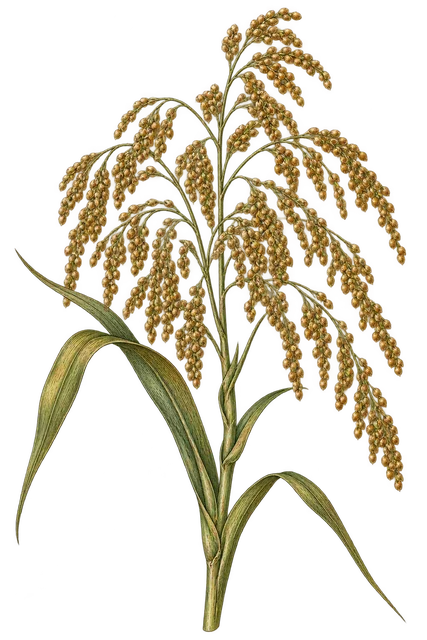
The grain called millet in Ezekiel 4:9. Historical identification is disputed; proso millet and sorghum are among proposals. Modern millets are a group of different cereals, not one plant proven by the verse.
Ingredient details, preparation and research
Also known as: KJV millet; Dochan; Modern millet (comparison category)
Source plant or material
Biblical species uncertain: Panicum miliaceum L. and Sorghum bicolor (L.) Moench are among proposed identifications; The grain called millet in Ezekiel 4:9. Historical identification is disputed; proso millet and sorghum are among proposals. Modern millets are a group of different cereals, not one plant proven by the verse.
Plant family / material: Poaceae (grass family)
Forms and route
Modern edible millet kernels, cooked grain, flour, porridge and regional fermented foods. The numeric comparison uses USDA’s food labeled Millet, cooked; it is not assigned as the securely identified ancient grain.
Vitamins and minerals
Comparison only: 1/2 US cup of the modern USDA food Millet, cooked, about 87 g, supplies approximately 104 kcal, 3.1 g protein, 20.6 g carbohydrate, 1.1 g fiber, 0.55 mg iron and 38 mg magnesium. Calculated from USDA SR28 NDB 20032 (1 cup = 174 g; pages 127–129). The record is a generic cooked-millet food reference, not a nutrient analysis of Ezekiel’s uncertain cereal, sorghum, finger millet or millet flour. No ancient species is inferred from these numbers.
Absorption and preparation
Cook the specific millet according to its label and desired texture; water content greatly changes the weight and nutrient density of porridge. Include pulses, eggs or another suitable protein food and vegetables as part of a balanced meal. Vitamin-C-rich foods can help nonheme-iron absorption. Fermentation or malting can change phytate and food texture, but the effect depends on the species and process; no universal absorption multiplier is assigned.
Traditional and reported uses
- Modern edible millet as cooked kernels, porridge, flatbread flour or other properly cooked grain foods.
- A carefully labeled comparison to a biblical grain name whose precise botanical identity remains open.
Contraindications and cautions
- For celiac disease, choose a product labeled gluten-free and check shared processing and added ingredients. A mixed Ezekiel-style bread contains wheat and barley even when millet itself is included.
- Do not transfer one millet’s nutrient profile to all millets or to sorghum; check the actual food and preparation.
- Cook grain and flour appropriately. An ancient-grain label does not make raw flour or uncooked dough microbiologically safe.
Similar items and how they compare
- Wheat
Both can be used in cereal meals and flour preparations.
Wheat contains gluten; pure modern millet is a different food, but mixed breads may contain both.
- Ancient hulled wheat (KJV rye and grain fitches)
Both require care over ancient crop identification.
The uncertain biblical words represent different grains and should not be collapsed into a single ancient-grain formula.
Name and species uncertainty
The KJV word millet is explicit. The botanical assignment is not: ODU’s Bible-plant account discusses sorghum, while the older lexicon tradition gives millet. Modern millet diversity should remain visible instead of assigning all references to proso millet.
A food group with varied composition
Millet species and milling differ markedly. FAO reports variation in mineral content and the removal of nutrient-rich layers during processing. A finger-millet calcium claim is not a generic millet claim.
Gluten and mixed recipes
A pure millet product and a mixed grain bread are different. The mixture explicitly listed in Ezekiel includes wheat and barley and cannot be presented as a gluten-free recipe.
Food portion and nutrition
Comparison only: 1/2 US cup of the modern USDA food Millet, cooked, about 87 g, supplies approximately 104 kcal, 3.1 g protein, 20.6 g carbohydrate, 1.1 g fiber, 0.55 mg iron and 38 mg magnesium. Calculated from USDA SR28 NDB 20032 (1 cup = 174 g; pages 127–129). The record is a generic cooked-millet food reference, not a nutrient analysis of Ezekiel’s uncertain cereal, sorghum, finger millet or millet flour. No ancient species is inferred from these numbers.
Preparation and meal pairing
Cook the specific millet according to its label and desired texture; water content greatly changes the weight and nutrient density of porridge. Include pulses, eggs or another suitable protein food and vegetables as part of a balanced meal. Vitamin-C-rich foods can help nonheme-iron absorption. Fermentation or malting can change phytate and food texture, but the effect depends on the species and process; no universal absorption multiplier is assigned.
Evidence limits
- No single modern millet species, and no separate sorghum identity, is proved by Ezekiel 4:9.
- USDA’s generic cooked-millet record is used only as a labeled modern food comparison.
Entry sources
- Michael Zohary: Plants of the Bible
- Lytton John Musselman, Old Dominion University: Sorghum (KJV millet)
- Brown-Driver-Briggs / Strong’s lexicon: Hebrew 1764, dochan
- FAO: Sorghum and millets in human nutrition, Millet utilization
- FAO: Sorghum and millets in human nutrition, Culinary preparations
- FAO: Sorghum and millets in human nutrition, breads and traditional beverages
- FAO: Sorghum and millets in human nutrition, Mineral composition and availability
- NIDDK: Eating, Diet, & Nutrition for Celiac Disease
- FDA: Handling Flour Safely, What You Need to Know
- USDA Standard Reference 28 (2015): cereal grains and pasta, food group 20
- NIH Office of Dietary Supplements: Iron, Health Professional Fact Sheet
- King James Bible: Project Gutenberg eBook 10
Reference entry 151 · Recorded content review: 2026-10-06 · Review scope and dates