


Key cautions
- Do not swallow undiluted essential oil or substitute it for culinary stalks/tea.
- Seek advice before prolonged concentrated tea or extract use, especially with kidney disease, pregnancy, breastfeeding or medicines.
- Keep essential-oil evidence separate from culinary leaf use. Do not use an untested leaf infusion or homemade oil blend as dependable bite protection.
- Lemongrass essential oil can cause contact allergy. Culinary stalks and concentrated oil are not interchangeable.
What’s inside
Citral (geranial and neral) is prominent in the volatile oil; oil composition varies with source and extraction.
Uses in brief

- Lemony seasoning in Southeast Asian soups, curries and other dishes.
- Traditional digestive tea; clinical evidence for treating disease is limited.
- Mosquito-related use of a separate preparation: distilled Cymbopogon citratus oil has been investigated in topical mosquito repellents, including human forearm testing. Culinary stalks, tea and a potted lemongrass plant have not thereby been shown to provide the same protection.
- A small, short study tested a formulated Cymbopogon flexuosus essential-oil tonic for dandruff. That is a different species and preparation from culinary Cymbopogon citratus stalks or tea.
History, folklore and reported uses
Stalks in Southeast Asian kitchens
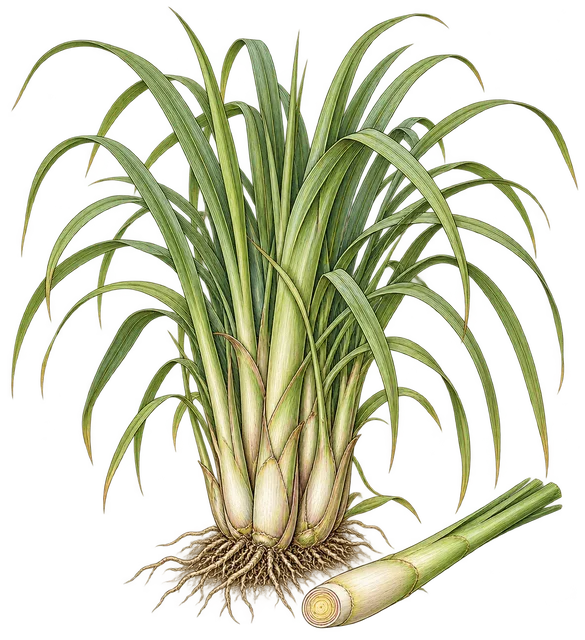
NParks records crushed stalks in tom yam, curries, seafood and poultry. UF/IFAS adds marinades and teas and describes the tender inner stalk beneath tough outer layers. The stalk is formed from compressed, overlapping leaf sheaths.
NParks: Cymbopogon citratus · UF/IFAS: Herb Stories, All About that Lemongrass
Leaf tea and Brazilian abafado
Lemongrass leaves entered household digestive drinks and Brazilian abafado tea traditions. An early human study investigated the dried-leaf tea used in Brazilian folk practice; the clinical findings are covered separately in this card.
Scented washes and perfumery
PROSEA records fresh C. citratus leaves in Indian scented hair washes and lightly perfumed water. It also describes the oil as an industrial citral source for making violet-smelling ionones used in perfumery. Fresh-leaf washes, distilled oil and finished perfumes are different preparations.
A beekeeping sideline
UF/IFAS records lemongrass oil as a beekeeping lure that imitates a bee-attracting scent. The same account speculates about mosquito repellency through a relationship to citronella; that is not a field demonstration that a living clump prevents bites. Food, tea, bee lures and tested personal repellents remain distinct.
Growing notes
Cymbopogon citratus culinary lemongrass; not a generic guide for citronella grasses or bottled lemongrass oil.
- Climate and lifecycle
- A tender perennial that can be grown as a summer annual. In cold climates plant divisions after the last spring frost, then bring a small potted division into bright warmth before autumn frost. Summer heat drives the fastest growth. [1]
- Sun, soil and spacing
- Give full sun and moist, rich, well-drained loam. USU suggests about 3 feet between divisions. Florida landscape plants may reach 6 feet tall and 4 feet wide, so keep paths and nearby low crops clear. [1] [2]
- Water and feeding
- Water regularly during active growth, especially in containers; avoid waterlogging. Base bed fertility on a soil test and use the product’s container directions. A dry Utah garden and humid Florida site should not share an automatic watering calendar. [1]
- Harvest and propagation
- Established stalks can be cut at ground level once about half an inch thick, often by late summer in a cool-climate planting. Divide healthy clumps for the next season; a stalk harvest does not require flowers or pollination. [1] [2]
- Pests and care
- Hand-weed young plants. Indoor plants may develop spider mites; leaf blight is another possible problem. Remove damaged foliage and obtain a diagnosis before choosing treatment. No companion-plant pest protection is promised here. [1]
Growing sources and regional guidance
Growing notes reviewed 2026-10-12
Regional reading paths
These sourced notes describe cultivation, trade, food traditions or material history. A regional connection does not claim exclusive origin.
Asia
Cultivated/traditional use: Southeast Asia, including Singapore; precise wild origin is uncertain.
Leaf sheaths and leaves flavour soups and cooked dishes.
Identity & detailed reference
Identity
Culinary West Indian lemongrass leaves and swollen leaf sheaths. Other Cymbopogon species, including citronella grasses, are not interchangeable.
Ingredient details, preparation and research
Also known as: Serai; Fever grass; West Indian lemongrass
Source plant or material
Culinary West Indian lemongrass leaves and swollen leaf sheaths. Other Cymbopogon species, including citronella grasses, are not interchangeable.
Plant family / material: Poaceae
Forms and route
Fresh culinary stalk bases, dried leaf infusions and extracts. Distilled essential oil is a concentrated separate product.
Vitamins and minerals
A stalk used to flavor broth and then removed is not equivalent to eating the whole plant. No generic vitamin/mineral serving is assigned to strained tea.
Absorption and preparation
Bruising releases aroma for cooking; that is a flavor technique, not a proven medicinal absorption strategy. Distilled oil differs from a water infusion.
Traditional and reported uses
- Lemony seasoning in Southeast Asian soups, curries and other dishes.
- Traditional digestive tea; clinical evidence for treating disease is limited.
- Mosquito-related use of a separate preparation: distilled Cymbopogon citratus oil has been investigated in topical mosquito repellents, including human forearm testing. Culinary stalks, tea and a potted lemongrass plant have not thereby been shown to provide the same protection.
- Scalp research concerns a formulated lemongrass essential-oil tonic, not culinary stalks or tea; circulation and regrowth benefits are unestablished.
Contraindications and cautions
- Do not swallow undiluted essential oil or substitute it for culinary stalks/tea.
- Seek advice before prolonged concentrated tea or extract use, especially with kidney disease, pregnancy, breastfeeding or medicines.
- Keep essential-oil evidence separate from culinary leaf use. Do not use an untested leaf infusion or homemade oil blend as dependable bite protection.
- Lemongrass essential oil can cause contact allergy. Culinary stalks and concentrated oil are not interchangeable.
Similar items and how they compare
- Lemon balm
Both have a lemon-like aroma and tea traditions.
Lemon balm is a mint-family leaf; lemongrass is a grass with different constituents.
Food identity
C. citratus is a clumping grass; the culinary stalk is formed from overlapping leaf sheaths. Citronella products should not be assumed to be culinary lemongrass.
Human evidence and limits
A small 1986 study did not show sleep benefit. A later study reported dose/time-related adverse changes in kidney-function indices during repeated tea use. These small studies neither prove broad benefit nor establish unlimited tea safety.
Oil versus infusion
Analytical work shows extraction-dependent oil composition, including cis- and trans-citral. Results for isolated oil cannot be directly assigned to soup or strained tea.
Mosquito repellency in research
A 2015 study tested repellency on human forearms; performance varied by mosquito species and carrier. A 2002 formulation experiment used bird skin. These oil findings do not establish repellency from standing plants, food or tea.
Hair care: cosmetic role and evidence limits
Form distinction and limited human evidence: a small, short study of a formulated Cymbopogon flexuosus lemongrass essential-oil tonic found reduced dandruff over two weeks. It did not show improved scalp circulation or hair regrowth. Its result cannot be assigned to culinary Cymbopogon citratus stalks, tea, a homemade rinse or every lemongrass product. Essential-oil species and finished formulations matter. Contact-allergy surveillance found lemongrass-oil reactions in selected dermatology patients, not a general-population risk estimate. Use only a properly formulated topical product as directed and stop for irritation; persistent dandruff or inflamed scalp deserves assessment.
Evidence limits
- No medicinal tea dose supplied.
- Evidence is insufficient for a universal safe long-term medicinal regimen.
Entry sources
- NParks: Cymbopogon citratus
- Human lemongrass tea study
- Lemongrass tea and renal-function indices
- Lemongrass oil GC-MS extraction study
- PROSEA Essential-oil plants: Cymbopogon citratus
- Soonwera & Phasomkusolsil (2015): Efficacy of Thai herbal essential oils as green repellent against mosquito vectors
- Author-institution repository: Soonwera & Phasomkusolsil (2015), full abstract
- Oyedele et al. (2002): Formulation of a mosquito-repellent topical product from lemongrass oil
- Chaisripipat et al. (2015): Formulated lemongrass tonic and dandruff
- Geier et al. (2022): Essential-oil contact allergy in selected dermatology patients
Reference entry 201 · Recorded content review: 2026-10-07 · Review scope and dates