


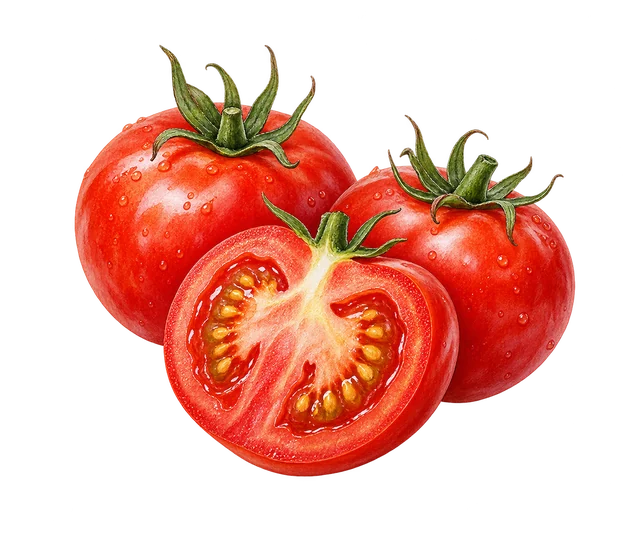
Key cautions
- Wash fruit and refrigerate cut tomato or prepared dishes promptly.
- For home canning, follow a tested recipe with its required acidification; tomato taste does not prove safe acidity.
- Use fruit for food, not leaf or stem extracts; avoid a product if allergic.
What’s inside
Water, organic acids, vitamin C, potassium and carotenoids; lycopene is characteristic of many red cultivars but color and cultivar matter.
Uses in brief

- Fresh culinary fruit
- Cooked salsa and preserves
History, folklore and reported uses
History, folklore and traditional uses
CONABIO places tomato within Mexican domestication and cuisine. DLR also documents tomatoes in the controlled EDEN ISS Antarctic greenhouse: a research-station crop, not a plant native to Antarctica.
Traditional, historical and reported uses
- Fresh culinary fruit
Food or household practiceWhy this label?
Label describes the stated practice or evidence, not an efficacy grade. Exact form and cautions remain attached.
Tomato is a foundational ingredient in Mexican food documentation and many contemporary dishes. Different cultivars suit different textures and uses.
- Cooked salsa and preserves
Food or household practiceWhy this label?
Label describes the stated practice or evidence, not an efficacy grade. Exact form and cautions remain attached.
NCHFP’s tested salsa illustrates cooked tomato preservation with controlled proportions and acidification. A fresh salsa recipe cannot automatically be canned safely.
2 supported uses; records describe the named form and are not treatment recommendations.
Historical-use additions reviewed 2026-10-09
Health topics: evidence and cautions
These notes describe a specific research context and preparation. A topic link is not a treatment recommendation.
Prostate health · Safety reference
Form and route: Tomato foods, including cooked products; not isolated lycopene · oral
Tomatoes can be part of meals, but are not an established prostate cancer treatment.
Evidence: Clinical biomarker evidence is limited
NCI reviews small tomato and lycopene studies. Changes in PSA or tissue markers do not establish longer survival or cancer control.
Limits
Different foods and supplements were studied. A food association is not proof of prevention.
Cautions
- Continue recommended screening discussions and cancer care.
- Do not treat falling PSA after a diet change as proof that cancer is controlled.
Skin cancer · UV-protection research
Form and route: Tomato paste consumed with olive oil in the trial · oral food
A small trial found changes in UV-related redness and photodamage markers after tomato paste.
Evidence: Small randomized human trial; surrogate outcomes
Twenty healthy women consumed tomato paste with olive oil or olive oil alone for 12 weeks. Some instrument-measured redness and skin-damage markers improved; the visually assessed minimal erythema dose was not significantly different.
Limits
This did not test skin-cancer incidence. Findings do not establish a sunscreen effect or benefits from every tomato food or isolated lycopene supplement.
Cautions
- Food is an adjunct to normal sun protection, not a substitute. Do not apply tomato paste to a suspicious lesion.
Regional reading paths
These sourced notes describe cultivation, trade, food traditions or material history. A regional connection does not claim exclusive origin.
North America
Domesticated/cultivated: Mexico and Mesoamerica; now widely cultivated.
Ripe fruit used fresh and cooked.
Antarctica
Controlled Antarctic greenhouse research.
Cultivated food crop; not native Antarctic flora.
Identity & detailed reference
Identity
Edible fruit of Solanum lycopersicum. Tomatillo (Physalis) and leaves or stems of the tomato plant are different materials.
Ingredient details, preparation and research
Also known as: Jitomate
Source plant or material
Solanum lycopersicum
Plant family / material: Solanaceae
Forms and route
Fresh ripe fruit, cooked tomatoes, puree, paste and properly preserved foods. Concentrated lycopene supplements are not whole tomatoes.
Vitamins and minerals
Paste concentrates solids by removing water; canned sauces may contain added salt or sugar. Equal weights of fresh tomato and paste are not equivalent servings.
Absorption and preparation
A human absorption study found lycopene more available from paste than fresh tomato under the tested meal conditions. This is not proof that cooked tomato is superior for every nutrient.
Practical preparation
Rinse under potable running water, trim damaged portions and use fresh or cook as the recipe requires. Follow a complete tested preservation method rather than improvising shelf-stable salsa.
Traditional and reported uses
- Fresh culinary fruit
- Cooked salsa and preserves
Contraindications and cautions
- Wash fruit and refrigerate cut tomato or prepared dishes promptly.
- For home canning, follow a tested recipe with its required acidification; tomato taste does not prove safe acidity.
- Use fruit for food, not leaf or stem extracts; avoid a product if allergic.
Absorption is a narrower claim than prevention
Gärtner and colleagues measured post-meal lycopene responses from fresh tomato and paste eaten with oil. The findings concern the tested carotenoid and food matrix, not cancer prevention or a required oil dose.
Antarctic cultivation is technological
The EDEN ISS account describes controlled-environment crop production. Its geographical connection should not be represented as traditional Antarctic food heritage.
Evidence limits
Regional history and food/material practice do not establish treatment efficacy. Composition depends on the named species, part and preparation; no medicinal dose or universal nutrient ranking is inferred.
Entry sources
- CONABIO: La cocina tradicional mexicana
- NCHFP / University of Georgia: Choice Salsa
- Gärtner et al. (1997): Lycopene bioavailability from tomato paste versus fresh tomato
- DLR: The EDEN ISS greenhouse
Reference entry 411 · Recorded content review: 2026-10-09 · Review scope and dates