


Key cautions
- Some plants release cyanide when tissue is damaged; appearance does not establish cyanogenic status.
- Avoid unverified lawn material, concentrated preparations and routine home consumption.
What’s inside
Cyanogenic plants contain the components needed to release hydrogen cyanide after tissue damage; the trait varies genetically.
Uses in brief

- Reference for recorded leaf and flower uses, rather than a home preparation guide.
History, folklore and reported uses
History, folklore and traditional uses
Missouri’s Department of Conservation describes a plant better known for pasture, honey and fortunate four-leaf finds than for dinner. It records cooked leaves and flower-head drinks, but also regards the greens as survival food. Washington University’s work adds an important qualification to that familiar story: white clover varies genetically in its capacity to release cyanide. A remembered use therefore cannot certify a handful picked from a lawn.
Traditional, historical and reported uses
- Cooked greens
Food or household practiceWhy this label?
The claim documents cooked greens as a culinary, craft, gardening, or practical material use; it reports neither a treatment outcome nor measured nutrient content.
MDC records thoroughly boiled leaves as a survival food. This is documentation, not a validated detoxification method.
- Flower-head drinks
Food or household practiceWhy this label?
The claim documents flower-head drinks as a culinary, craft, gardening, or practical material use; it reports neither a treatment outcome nor measured nutrient content.
MDC notes occasional tea made with flower heads; no routine-use safety conclusion follows.
- Naga deworming tradition
Traditional accountWhy this label?
The exact use is a Naga deworming tradition recorded in the study; its rat experiment is a qualification and does not turn the heritage claim into human research.
Tangpu, Temjenmongla and Yadav report white clover (Trifolium repens) as a deworming remedy in Naga folk medicine in India. Their investigation examined aerial-shoot extract in rats; that animal research does not establish safe or effective human treatment.
Only specifically supported uses are included; historical or culinary use is not clinical proof.
Historical-use additions reviewed 2026-10-08
Identity & detailed reference
Identity
White clover is a true clover. This card documents food history and safety limits; it does not recommend eating lawn clover.
Ingredient details, preparation and research
Source plant or material
Trifolium repens L.; White clover is a true clover. This card documents food history and safety limits; it does not recommend eating lawn clover.
Plant family / material: Fabaceae
Forms and route
Flower heads and cooked leaves appear in food histories; raw greens, infusions and extracts are not equivalent.
Vitamins and minerals
No dependable household serving or nutrient claim is assigned to this safety-limited material.
Absorption and preparation
No absorption-enhancing pairing or validated household detoxification protocol is established in this review.
Practical preparation
No recipe is supplied. Reports of boiling leaves are historical food descriptions, not a guarantee that unknown material is safe.
Traditional and reported uses
- Reference for recorded leaf and flower uses, rather than a home preparation guide.
Contraindications and cautions
- Some plants release cyanide when tissue is damaged; appearance does not establish cyanogenic status.
- Avoid unverified lawn material, concentrated preparations and routine home consumption.
Similar items and how they compare
- Wood sorrel
Both can have three-part leaves.
Oxalis is a different genus and family; its key concern is oxalate.
- Red clover
Both are Trifolium.
T. pratense research or supplement instructions do not establish white-clover safety.
Why the caution overrides a simple edible label
Washington University explains cyanogenic and non-cyanogenic white clover. This variation is not a field identification shortcut and the research does not establish a safe human portion.
Species scope
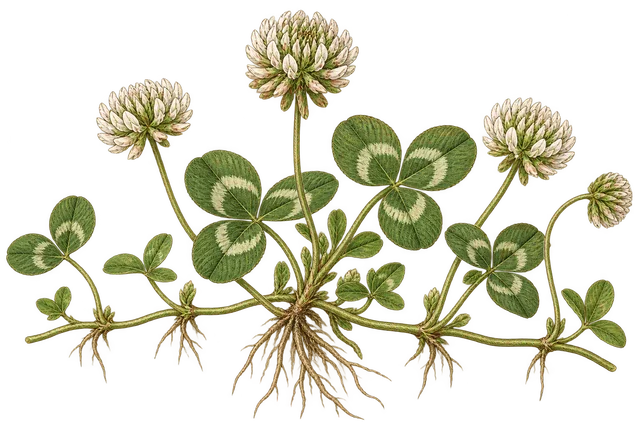
The mat-forming clover is T. repens. A white flower color alone is insufficient: other clovers also flower white.
Entry sources
- Missouri Department of Conservation: White clover
- NC State Extension: Trifolium repens
- Washington University: Genetic differences in clover make one type toxic
- Tangpu, Temjenmongla and Yadav: Anticestodal Activity of Trifolium repens Extract, author-uploaded abstract
Reference entry 176 · Recorded content review: 2026-10-07 · Review scope and dates