


Before you bake
- Use commercially canned, fully cooked navy beans and lentils, rinsed and well drained, weighed after draining. Do not substitute raw dried beans, soaked-only beans, raw bean flour or home-sprouted legumes. Bread baking is not the preparation step for raw beans.
- Use food-grade grain flours intended for baking. Flour and dough remain raw until thoroughly cooked: do not taste raw dough. Wash hands, tools and work surfaces after flour handling.
- Contains wheat, spelt (a wheat), barley and gluten; unsuitable for coeliac disease or wheat allergy. Beans and lentils can also cause allergic reactions. Check every ingredient label for personal allergens.
- Cool baked bread fully on a rack, then freeze portions you will not eat promptly. Keep unused canned legumes refrigerated and follow their storage label.
GATHER
Ingredients

- 300 g strong white wheat bread flour, plus up to 10 g for handling if needed
- 50 g wholemeal spelt flour
- 25 g barley flour
- 25 g millet flour
- 25 g canned navy beans, rinsed and well drained
- 25 g canned lentils, rinsed and well drained
- 240 g lukewarm water, plus up to 20 g more if needed
- 30 g olive oil, plus a little to grease the bowl and tin
- 20 g granulated sugar
- 8 g fine salt
- 7 g instant yeast
MAKE
Method
Mash or blend the drained beans and lentils smooth with the 240 g water. Stir in the oil and sugar. Combine the four flours, yeast and salt in a separate bowl, then mix in the wet ingredients.
Rest for 10 minutes, then knead for 8–10 minutes. Add reserved water 5 g at a time only if the dough feels stiff. It should be soft and slightly tacky, holding a mound rather than flowing. Use extra flour sparingly.
Cover in a greased bowl until visibly expanded, about 45–75 minutes. Shape into a log and place seam-side down in the greased loaf tin. Cover again until puffy, about 30–45 minutes; the dough need not double. Meanwhile heat a conventional oven to 180°C / 350°F.
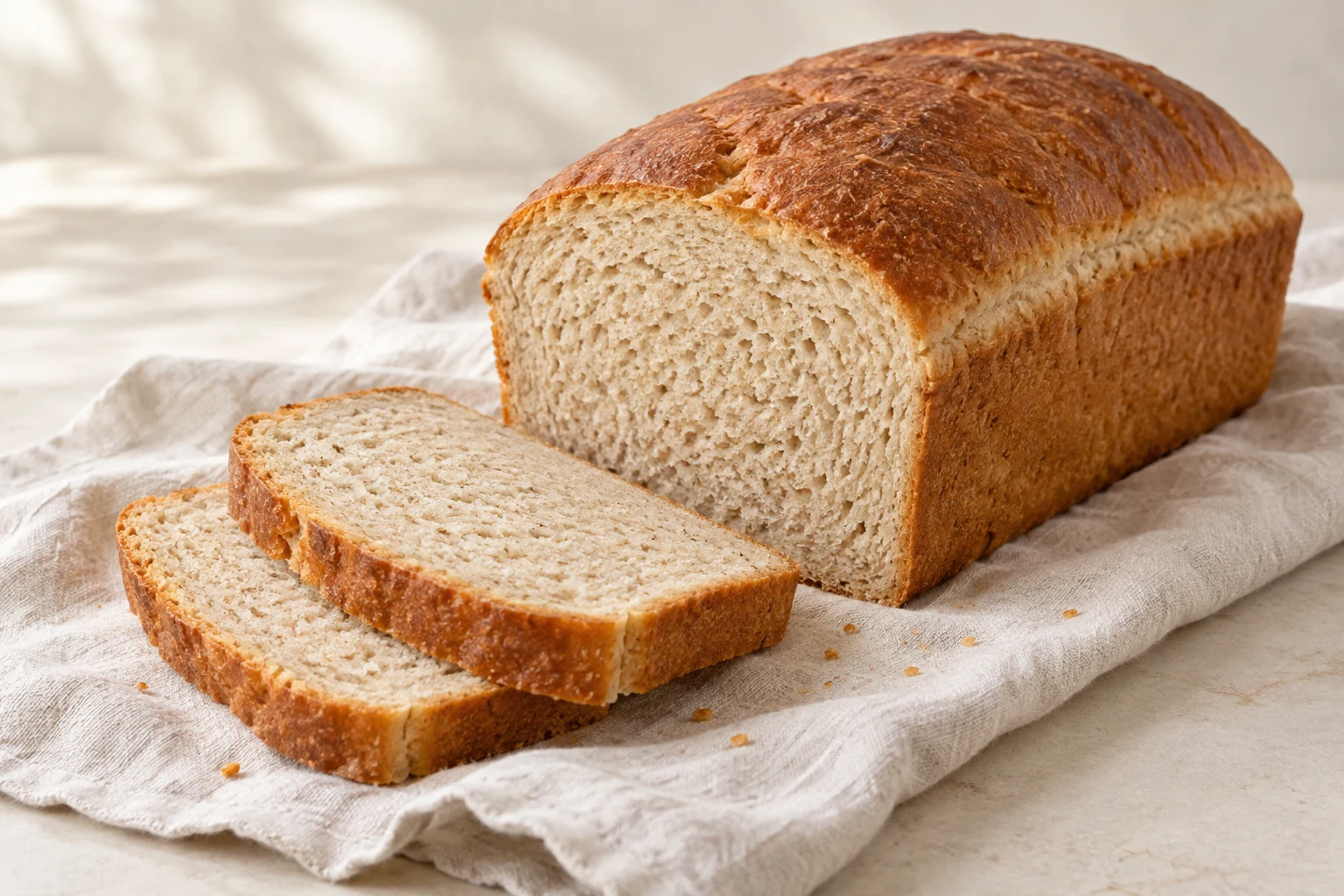
Bake about 40–50 minutes, loosely shielding the top with foil if it darkens too quickly. The loaf should be well browned with firm sides. A centre reading around 93°C / 200°F adds a doneness cue; it does not validate this untested formula or replace the full bake.
After 10 minutes, turn out onto a rack. Cool completely, at least 2 hours, before slicing. Do not serve a wet or raw dough centre. Freeze portions you will not eat promptly.
Kitchen notes
Expect a close-textured table loaf. Keep the strong wheat flour: it supplies most of the structure. Do not substitute raw bean flour, increase the legumes, or replace the wheat with gluten-free flour without developing a different recipe.
Kitchen-untested adaptation: suggested bake times and texture need a trial bake
READ THE CONTEXT
Inspired by Scripture
Ezekiel 4:9 lists grains and legumes for bread within a sign of siege, scarcity and measured rations. The chapter gives no proportions for the six ingredients and no modern mixing, proofing or oven schedule.
This is a modern kitchen interpretation, not an exact ancient recipe or a copy of a branded sprouted loaf. Wheat, barley, millet, spelt, beans and lentils provide the inspiration. Spelt is a modern choice for the debated grain name fitches, and canned navy beans are a practical modern substitution, not a claim about the biblical bean species.
This adaptation has not been kitchen-tested. It takes a published multigrain pan loaf as its structural starting point, with a new grain blend and a small quantity of cooked legumes. It makes ordinary food, with no healing, complete-nutrition or special absorption claim.
Take thou also unto thee wheat, and barley, and beans, and lentiles, and millet, and fitches, and put them in one vessel, and make thee bread thereof, according to the number of the days that thou shalt lie upon thy side, three hundred and ninety days shalt thou eat thereof.
Ezekiel 4:9 (KJV)
Sources & adaptation
Adapted in structure and method from the King Arthur Test Kitchen’s Harvest Grains Bread, with a different grain blend, fully cooked legumes and adjusted liquid, oil and sugar. These changes have not been tested by The Herb Notebook or endorsed by the source.
The King Arthur recipe supplies the pan-loaf starting point; the listed changes are an original, untested adaptation. Lentils.org is a separate published example of canned lentils puréed into bread and is not the source for this formula or short proofing schedule. Scripture supports the ingredient list and scarcity context. Food-safety sources support the handling cautions. No source has tested this exact bread.
- King Arthur Test Kitchen: Harvest Grains Bread
- Lentils.org: No-Knead Bread with Lentils
- Ezekiel 4:9–17, King James Version
- FDA: Handling Flour Safely: What You Need to Know
- FDA: Natural Toxins in Food, bean lectins
- King Arthur Baking: Using a thermometer with yeast bread, original baking comparison
- King Arthur Baking: How to tell if bread is done baking