


Key cautions
- Portions are compact: about one-quarter cup contains nearly 29 g carbohydrate. Count the actual amount within a carbohydrate plan when relevant.
- Check labels for sulfites if sensitive, particularly with golden raisins or mixed dried fruit.
What’s inside
Drying concentrates naturally occurring glucose and fructose, carbohydrate and minerals in a small volume. Raisins retain some dietary fiber and polyphenols, but processing, cultivar and storage alter the profile. Sulfur dioxide may be used in some light-colored products; read the label.
Uses in brief

- Use a measured portion as a compact food, or add raisins to bread, cereal and cooked dishes.
- The biblical record documents dried-fruit provisions and gifts.
In the King James Bible
In the King James Bible
Named material
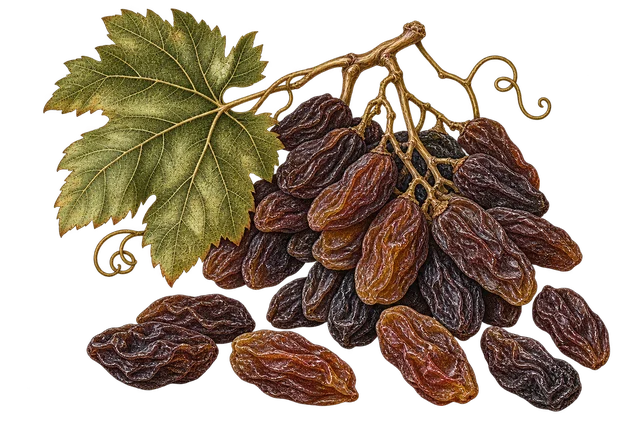
The KJV names raisins and distinguishes moist grapes from dried grapes. Raisins are dried fruit of the grapevine; the nutrient panel uses a modern seedless reference product. The verses do not specify a modern cultivar or drying method.
And they gave him a piece of a cake of figs, and two clusters of raisins: and when he had eaten, his spirit came again to him: for he had eaten no bread, nor drunk any water, three days and three nights.
1 Samuel 30:12 (KJV)
He shall separate himself from wine and strong drink, and shall drink no vinegar of wine, or vinegar of strong drink, neither shall he drink any liquor of grapes, nor eat moist grapes, or dried.
Numbers 6:3 (KJV)
Scripture and identification sources
Words & their stories
WORDS & THEIR STORIES
The name behind the KJV
Biblical Hebrew · 1 Samuel 30:12 (KJV)
צִמֻּקִיםṣimmuqīm
Clusters or bunches of raisins, two of which are given as food.
Dictionary form: צִמּוּק · ṣimmūq
The plural is written without the vowel-letter waw used in the dictionary form.
Biblical Hebrew · Numbers 6:3 (KJV)
וִיבֵשִׁיםwībēšīm
“Or dried,” describing grapes excluded during the Nazirite vow.
Dictionary form: יָבֵשׁ · yābēš
The conjunction joins fresh and dried grapes. Yābēš is an adjective meaning dry, not a separate fruit species.
What the language reveals
A food noun and a descriptive adjective
Samuel uses a word for raisin bunches; Numbers describes grapes by contrasting fresh and dried.
Different kinds of passage
One text narrates feeding a hungry person. The other defines abstention during a particular religious vow.
These are dried grapes; neither verse specifies seedless grapes, a modern cultivar or an industrial drying method.
History, folklore and reported uses
History, folklore and traditional uses
Raisins enter the biblical food record as a practical preparation. In 1 Samuel, dried grapes and a cake of figs are given to a man who has gone without food and water; elsewhere Abigail includes raisin clusters among provisions taken to David. The texts place dried fruit within travel, household stores and the careful work of offering food to others.
Drying makes grapes portable and extends their use beyond harvest, but it also changes the scale of a serving. Modern raisin-growing separates varieties and drying methods according to the desired product. University of California records describe tray drying, mechanical dehydration and drying on the vine, while USDA breeding work produced cultivars suited to earlier harvest or vine drying. The modern seedless raisin should not be silently projected into every ancient cluster.
Raisins became familiar ingredients in breads, puddings and confections, and a commercial crop with its own grading and storage practices. Their compact carbohydrate has also made them useful in modern exercise studies. This later sports-food role is not what the Bible claims; it illustrates how an old preservation technique can serve a new practical purpose.
Traditional, historical and reported uses
- Portable food after deprivation
Historical recordWhy this label?
Specific Samuel passage documents food provision after deprivation.
First Samuel 30:12 records a piece of fig cake and raisin clusters given to an exhausted man. The immediate context is nourishment after a long absence of food and water.
- A household gift in diplomacy
Historical recordWhy this label?
Specific Samuel passage documents a diplomatic food gift.
Abigail’s provisions in 1 Samuel 25:18 include raisins, showing dried fruit as part of a substantial food gift. This is a social use distinct from a recipe or remedy.
- Preservation and a marketable grape crop
Food or household practiceWhy this label?
Grape preservation and agricultural drying processes.
Drying reduced dependence on the short fresh-grape season. University of California documents the development of raisin processing and crop handling, including tray, dehydrator and vine-dried forms.
- Breads, puddings and confections
Food or household practiceWhy this label?
Raisins used in baked foods and confections.
USDA describes raisins in foods such as oatmeal cookies, bread pudding and cinnamon rolls. The dried fruit contributes concentrated sweetness and texture within a recipe.
- A modern food-based exercise carbohydrate
Human researchWhy this label?
Explicit randomized human running study of food-based carbohydrate supplementation.
A small randomized running study compared raisins with commercial chews and water. This reported use is for exercise fueling, separate from the fruit’s ancient cultural history.
Story sources
- 1 Samuel 30:12 (King James Version)
- 1 Samuel 25:18 (King James Version)
- University of California: California leads in raisin production, history of drying and processing research
- University of California: Crop Profile for Grapes (Raisin) in California
- USDA ARS (1996): Helping Raisins Make the Grade
- Too et al. (2012): Natural versus commercial carbohydrate supplementation and endurance running performance
Identity & detailed reference
Identity
Raisins are a dried preparation of grapes, not a new botanical species. The KJV names raisins and also distinguishes moist grapes from dried grapes. This card therefore complements the fresh-grape card rather than duplicating it.
Ingredient details, preparation and research
Also known as: raisins; grapes; dried
Source plant or material
Vitis vinifera L., dried fruit; Dried grape fruit, with the modern seedless form used for nutrition; distinct from fresh grapes, wine, juice and seed extracts.
Plant family / material: Vitaceae (grape family)
Forms and route
Plain sun-dried or mechanically dried grapes; dark seedless raisins, golden raisins, sultanas and small Black Corinth/Zante currants. Seeded raisins, raisin paste, juice concentrate and sweetened coatings are separate forms. Zante currants are dried grapes, not Ribes currants.
Vitamins and minerals
About one-quarter cup loosely filled plain seedless raisins (36 g; USDA lists 145 g per unpacked cup) provides approximately 108 kcal, 28.5 g carbohydrate, 21.3 g sugars, 1.3 g fiber, 1.1 g protein, 270 mg potassium, 18 mg calcium, 12 mg magnesium and 0.68 mg iron. Vitamin C is under 1 mg. Calculated from USDA SR28 food 09298. This is a rounded household portion; packed cups and larger boxes can weigh more.
Absorption and preparation
Raisins need no soaking to make their minerals available, although soaking can soften them. Their iron is nonheme and the amount per small serving is modest; vitamin-C-rich food can support absorption in a mixed meal. Raisins should not be promoted as an anemia treatment. Drying removes water rather than removing sugar, and raisin water is not nutritionally equivalent to eating the fruit.
Traditional and reported uses
- Use a measured portion as a compact food, or add raisins to bread, cereal and cooked dishes.
- The biblical record documents dried-fruit provisions and gifts.
- Raisins have been studied as a food-based carbohydrate source during endurance exercise; this is separate from a medicinal or detoxification claim.
Contraindications and cautions
- Portions are compact: about one-quarter cup contains nearly 29 g carbohydrate. Count the actual amount within a carbohydrate plan when relevant.
- Check labels for sulfites if sensitive, particularly with golden raisins or mixed dried fruit.
- Small sticky dried fruit can be difficult to chew; prepare the form for the eater and use appropriate feeding guidance.
- Discard spoiled or moldy product and store as directed. Added coatings or concentrates have different composition.
Similar items and how they compare
- Fresh grapes
The same source fruit before drying.
Much more water and a larger volume for the same carbohydrate; use the separate fresh-grape serving.
- Dates
Another compact naturally sweet food.
Fruit of a palm rather than a grapevine, with different size and nutrient concentration.
- Black Corinth or Zante currants
A small dried-grape form.
Not the fresh black or red currants of the genus Ribes.
Dried grapes, not a new species
The KJV explicitly distinguishes moist from dried grapes in Numbers 6:3. Raisin varieties and drying processes may differ, but the botanical connection remains to grapes.
Small exercise trials
In a randomized crossover study of 11 male runners, raisins and sports chews were compared with water during prolonged exercise and a subsequent timed run. Findings support raisins as one practical carbohydrate option in that setting, not superiority for everyone or a treatment for fatigue.
Concentration, additives and serving size
The USDA values use plain seedless raisins. Golden-color processing may involve sulfiting, so susceptible people should check labels. An unpacked quarter-cup is a smaller amount than a generous packed scoop.
Evidence limits
- Explicit KJV dried-fruit preparation
- The food is dried grapes; modern seedless varieties and drying methods are not specified by the verses.
Entry sources
- Kew Plants of the World Online: Vitis vinifera in Vitaceae
- Lytton John Musselman, Old Dominion University: Grape
- University of California: Crop Profile for Grapes (Raisin) in California
- University of California: California leads in raisin production, history of drying and processing research
- USDA ARS (1996): Helping Raisins Make the Grade
- USDA ARS (2003): Yummy Raisins Developed by California Team
- Too et al. (2012): Natural versus commercial carbohydrate supplementation and endurance running performance
- FDA: Food Allergies, sulfites and labeling
- USDA SR28: Raisins, seedless, food 09298, PDF page 831
- NIH Office of Dietary Supplements: Vitamin C, Health Professional Fact Sheet
- 1 Samuel 30:12 (King James Version)
- 1 Samuel 25:18 (King James Version)
- Numbers 6:3 (King James Version)
Reference entry 155 · Recorded content review: 2026-10-06 · Review scope and dates