


Key cautions
- Use food-grade produce and wash before cutting unless the package gives appropriate ready-to-eat directions.
- Do not transfer this root card’s safety assumptions to raw radish sprouts, which have a different production context.
What’s inside
Water, fibre, vitamin C and glucosinolate-derived pungent compounds. Cultivar, maturity and growing conditions influence size, texture and peppery flavour.
Uses in brief

- Crisp raw vegetable
- Cooked radish dishes
History, folklore and reported uses
History, folklore and traditional uses
DLR documented this crop in the controlled EDEN ISS greenhouse near Neumayer III during its Antarctic research programme. The greenhouse returned to Germany in 2023; this association is neither a native-range claim nor a record of an indigenous Antarctic food tradition.
Traditional, historical and reported uses
- Crisp raw vegetable
Food or household practiceWhy this label?
The linked sources document this material-specific use; no treatment outcome or universal safety is inferred.
USU describes the familiar red radish’s crunch and pungency. Sliced roots function as an ordinary vegetable ingredient; freshness and variety affect the eating quality.
- Cooked radish dishes
Food or household practiceWhy this label?
The linked sources document this material-specific use; no treatment outcome or universal safety is inferred.
Purdue FoodLink documents cooking radishes. Heat produces a softer vegetable with a different flavour from the raw root, without turning it into a medicinal preparation.
2 supported material-specific uses; practices are not proof of treatment efficacy.
Historical-use additions reviewed 2026-10-09
Regional reading paths
These sourced notes describe cultivation, trade, food traditions or material history. A regional connection does not claim exclusive origin.
Antarctica
Controlled Antarctic greenhouse research.
Cultivated food crop; not native Antarctic flora.
Identity & detailed reference
Identity
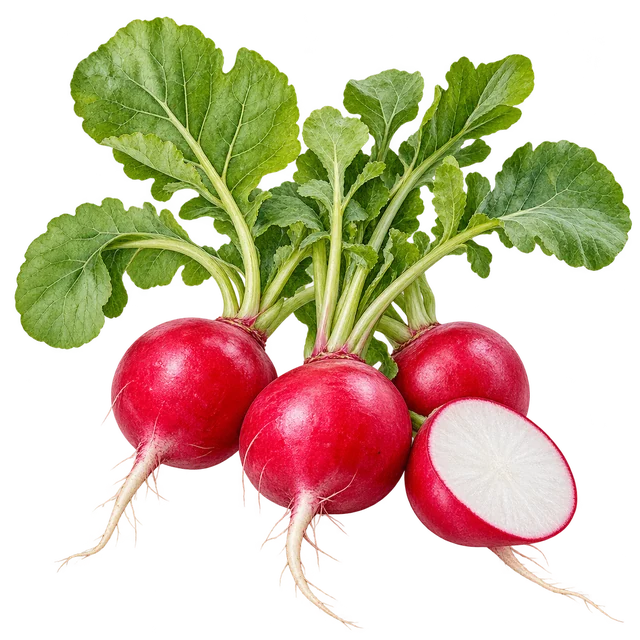
Radish is the edible swollen root and lower stem of cultivated Raphanus sativus varieties. Red globe radishes and daikon are crop forms; sprouts and leafy tops are separate food portions.
Ingredient details, preparation and research
Also known as: Garden radish; Daikon crop forms
Source plant or material
Raphanus sativus
Plant family / material: Brassicaceae
Forms and route
Fresh washed roots, sliced salad vegetables and cooked roots. Fermented radishes, raw sprouts and leaf preparations require their own processing and safety context.
Vitamins and minerals
Roots contribute modest amounts of fibre and micronutrients in a food portion. Large daikon roots and a small salad garnish represent different quantities; no numeric serving value is assumed.
Absorption and preparation
Cooking softens texture and changes pungency. These food effects do not establish a detoxification action or a special nutrient-absorption pairing.
Practical preparation
Trim damaged material, rinse roots with safe running water, refrigerate and prepare with clean utensils. Follow a recipe for cooked radishes and refrigerate leftovers promptly.
Combination notes
Use raw or cooked as a vegetable component; choose the cultivar and cut size for the recipe rather than assuming every radish behaves identically.
Traditional and reported uses
- Crisp raw vegetable
- Cooked radish dishes
Contraindications and cautions
- Use food-grade produce and wash before cutting unless the package gives appropriate ready-to-eat directions.
- Do not transfer this root card’s safety assumptions to raw radish sprouts, which have a different production context.
- A greenhouse label does not remove the need for hygienic food handling.
Similar items and how they compare
- Horseradish
Both are pungent Brassicaceae crops.
Radish roots and Armoracia condiments are different plants and food uses.
Controlled Antarctic cultivation
DLR lists radishes among EDEN ISS crops. The facility supplied a space-analogue research programme near Neumayer III, rather than demonstrating an indigenous Antarctic food tradition.
Historical experiment, not a current native crop
DLR reports the greenhouse’s return to Germany in 2023. That bounded history should remain attached to the Antarctic association instead of implying the same installation is still producing there.
Evidence limits
No Antarctic origin, special polar nutrient advantage or medicinal benefit is claimed. Ordinary crop and food-safety evidence remain separate from the greenhouse experiment.
Entry sources
- DLR: The EDEN ISS greenhouse
- Utah State University Extension: Radishes in the garden
- FDA: Selecting and serving produce safely
- Purdue Extension FoodLink: Radish food preparation
- DLR: EDEN ISS returned from Antarctica in 2023
Reference entry 517 · Recorded content review: 2026-10-09 · Review scope and dates