


Key cautions
- Whole grapes are a choking hazard for young children; remove seeds and quarter lengthways and adapt the texture to the child’s eating skills.
- Grape-seed extract is a supplement with separate medicine-interaction and pregnancy considerations.
- The usual advice to retain washed grape skins is not a rule for babies or children with swallowing difficulty. NHS advises adapting texture and considering skin removal to make fruit easier to swallow; choking prevention takes priority over retaining the whole-fruit composition.
What’s inside
The flesh, skin and seeds are different tissues. Read nutrient values as estimates for the specified edible fruit, and distinguish food composition from concentrated extracts and medicinal leaves.
UC Davis Waterhouse Lab: Grape proanthocyanidins in seeds and skins · USDA Standard Reference 2018: Raw red/green European-type grapes (including Thompson seedless), original report 09132 · NCCIH: Grape seed extract, evidence and safety (2025) · EMA: Grapevine leaf, well-established and traditional medicinal uses
Nutrients in a defined fresh-fruit portion
Reference portion: 3/4 cup (126 g) edible grapes. FDA rounds this to about 90 kcal, 23 g carbohydrate, 20 g sugars, 1 g fiber and 240 mg potassium. For comparison, the USDA 2018 European-type grape record, which explicitly includes Thompson seedless, gives about 18 micrograms vitamin K and 4 mg vitamin C at the same weight, with under 1 g protein. USDA SR28 reports about 0.16 mg copper at this weight for the same reference food. These are general grape reference estimates, not seeded-cultivar measurements or a promise that the seeds are consumed. Grapes are not a high-protein food or a particularly rich vitamin C source.
USDA Standard Reference 2018: Raw red/green European-type grapes (including Thompson seedless), original report 09132 · FDA: Raw fruits nutrition poster, grapes portion and nutrients · NIH Office of Dietary Supplements: Vitamin K absorption and warfarin guidance · USDA SR28: Raw red/green European-type grapes (including Thompson seedless), food 09132, PDF pages 425–427
Seeds, skins and the supplement distinction
UC Davis describes differences between seed and skin tannins and how location and vineyard conditions affect them. That chemistry does not by itself rank seeded fruit above seedless fruit. NCCIH’s supplement evidence concerns extracts: possible changes in selected blood-lipid or blood-pressure measures remain uncertain because studies and formulations differ.
UC Davis Waterhouse Lab: Grape proanthocyanidins in seeds and skins · NCCIH: Grape seed extract, evidence and safety (2025)
Understanding the tannins
Proanthocyanidins are chains of flavan-3-ol compounds; the larger structures are condensed tannins. They can bind proteins in saliva, helping explain the drying sensation called astringency. UC Davis reports that skin tannins tend to have longer chains than seed tannins.
UC Davis Waterhouse Lab: Grape proanthocyanidins in seeds and skins
Uses in brief

- Eat as whole fruit or add to meals; keep the skin for the normal whole-fruit composition.
- Choose seeded or seedless for taste and convenience. Neither has a proven general health advantage solely from its seed status.
In the King James Bible
Grapes in the KJV
Named material
The scouts bring back a large cluster of grapes from Eshcol as part of the land’s fruit. Numbers also names the vine’s kernels and husk in the Nazirite instructions, giving a direct connection to grapes and their seeds without specifying a modern cultivar.
And they came unto the brook of Eshcol, and cut down from thence a branch with one cluster of grapes, and they bare it between two upon a staff; and they brought of the pomegranates, and of the figs.
Numbers 13:23 (KJV)
All the days of his separation shall he eat nothing that is made of the vine tree, from the kernels even to the husk.
Numbers 6:4 (KJV)
Scripture and identification sources
Words & their stories
WORDS & THEIR STORIES
The name behind the KJV
Biblical Hebrew · Numbers 13:23 (KJV)
עֲנָבִיםʿănābīm
Grapes, in the cluster carried back by the scouts.
Dictionary form: עֵנָב · ʿēnāb
This is the plural of the grape noun; the passage also names the cluster, ʾeškōl.
Biblical Hebrew · Numbers 6:4 (KJV)
מֵחַרְצַנִּיםmēḥarṣannīm
“From the kernels,” in the KJV prohibition on vine products during a Nazirite vow.
Dictionary form: חַרְצַנִּים · ḥarṣannīm
The opening mē- means “from.” Brown–Driver–Briggs lists the noun in its attested plural; the exact vine part has been disputed.
What the language reveals
A place named for a cluster
The following verse connects Eshcol’s name with the cluster taken there. The Hebrew noun ʾeškōl means a cluster in this narrative.
What “seeded” can claim
Numbers 6:4 has the KJV’s kernels-and-husk phrase, although the exact ancient terms are disputed. Neither passage identifies a modern grape variety.
The fruit is grape, but cultivar, seed number and modern seed-extract benefits are not specified.
Language and identification bibliography
- Hebrew text: Numbers 13:23–24 (Mechon-Mamre)
- Brown–Driver–Briggs: עֵנָב, grape (H6025; Bible Hub transcription)
- Brown–Driver–Briggs: אֶשְׁכּוֹל, cluster (H811; Bible Hub transcription)
- Hebrew text: Numbers 6:4 (Mechon-Mamre)
- Brown–Driver–Briggs: חַרְצַנִּים, grape kernels or another vine product (H2785; Bible Hub transcription)
History, folklore and reported uses
What seeded means
A seed-bearing grape is a fruit type, not a health-product standard. European table grapes, American grapes and hybrids differ in flesh, skin and seed characteristics. Muscadines, native to the southeastern United States, are a useful example of why one generic grape table cannot describe every variety precisely.
Kew Plants of the World Online: Vitis vinifera, accepted name and native range · University of Georgia Viticulture: Muscadine grapes
Muscadines are a separate comparison
The muscadine name commonly refers to Vitis rotundifolia. Its thick-skinned fruits range from bronze to deep purple and are used fresh or in juices and jams. The vines are adapted to the heat and humidity of the southeastern United States, giving this regional crop a different growing context from many European-type table grapes.
Fresh fruit, juice, raisins and oil
Drying removes water, so raisins concentrate carbohydrate into a smaller volume. Strained juice supplies little fiber compared with the whole fruit. Seed oil is principally a fat ingredient, while seed extracts concentrate other compounds. Compare the actual label and serving rather than treating every grape product as equivalent.
USDA MyPlate: Fruit group, portions and whole-fruit fiber · Royal Botanic Gardens, Kew: Grape vine, uses and plant identity
Early cultivation and the evidence from Georgia
Grapes have a long history before the modern distinction between a seeded snack and a seedless supermarket bunch. Kew places Vitis vinifera’s native range from southern central and southeastern Europe into Central Asia and northern Iran. In Georgia, a research team found chemical and botanical evidence consistent with grape wine in pottery dated about 6000–5800 BCE. The authors explicitly cautioned that this did not establish which neighboring region first developed the tradition.
Kew Plants of the World Online: Vitis vinifera, accepted name and native range · McGovern et al. (2017): Early Neolithic wine of Georgia, original archaeological study
Religious symbolism and everyday food
The vine became more than a fruit crop. Kew describes its place among the biblical Seven Species, its symbolism in Greek and Roman religion, and wine’s place in Christian communion. But the vine also fed everyday kitchens as fresh fruit, raisins and vinegar, and supplied leaves for wrapped dishes. Azerbaijan’s culinary communities describe preserving grape leaves and sharing dolma at ordinary meals and gatherings; UNESCO recognized that living food tradition in 2017.
Royal Botanic Gardens, Kew: Grape vine, uses and plant identity · UNESCO: Dolma making and sharing tradition in Azerbaijan · Azerbaijan culinary community statement to UNESCO: Grapevine dolma and preserving leaves
Winter sweets from the vine harvest
Preserving the harvest created foods beyond wine and raisins. Türkiye’s tourism authority describes Tunceli pestil, dried fruit pulp kept for winter, and orcik, strings of nuts or raisins dipped in grape or mulberry molasses and dried. These uses connect grape growing with household winter preparation and the pleasure of sharing a concentrated sweet food.
A long history of seedless breeding
Seedless grapes belong to a long horticultural story of their own. Cornell records a seedless-grape breeding project begun with the New York Botanical Garden in 1919; the cross that produced Bronx Seedless was made in 1925 and the variety was named in 1937. Today the seeds left from pressing fruit also become oil or concentrated extracts. That is a useful modern byproduct story, while the simple choice between seeded and seedless fruit remains a matter of variety and preference.
Cornell Fruit Resources: The Bronx Seedless grape breeding history · Royal Botanic Gardens, Kew: Grape vine, uses and plant identity · NCCIH: Grape seed extract, evidence and safety (2025)
Reading the medicinal traditions
The practices below are attributed historical uses. Demulcent means soothing to irritated surfaces; expectorant refers to helping bring up respiratory mucus. These descriptions do not establish clinical effectiveness of fresh grapes, and the historical compound recipes are not instructions to recreate them.
Raisins as a bowel remedy
Dutt’s historical account of Indian materia medica describes dried grapes, Draksha, as a laxative; CCRAS also lists constipation among the traditional indications. The remedy belongs to dried-fruit preparations rather than to chewing grape seeds.
Udoy Chand Dutt: The Materia Medica of the Hindus, Vitis vinifera/Draksha; historical text transcription · CCRAS Dravya: Vitis vinifera/Drākṣā, Ayurvedic actions and therapeutic uses
Soothing cough and throat preparations
The same Indian text records raisins in demulcent and expectorant compound medicines for cough and hoarseness. Those sweet medicinal preparations, sometimes fermented or combined with other ingredients, are distinct from fresh seeded grapes.
Grapevine leaves for venous complaints
EMA documents specified grapevine-leaf preparations for heavy, uncomfortable legs and, on a traditional-use basis, hemorrhoid symptoms and capillary fragility. This belongs to the leaves’ separate herbal history, not to the berries or their seeds.
EMA: Grapevine leaf, well-established and traditional medicinal uses
Leaf preparations need their own assessment
EMA distinguishes evidence-supported use of specified leaf medicines for chronic venous insufficiency from traditional-use indications. The latter include hemorrhoid symptoms only after a doctor has excluded serious conditions. These adult medicinal preparations have their own product instructions; food grapes or culinary leaf dishes are not substitutes.
EMA: Grapevine leaf, well-established and traditional medicinal uses
Wine as a medicinal carrier
Kew records ancient Egyptian medicinal wine, and McGovern’s archaeochemical study identifies wine carrying herbal and tree-resin additives. This is a history of compound medicines and extraction, not evidence that drinking wine benefits health.
Royal Botanic Gardens, Kew: Grape vine, uses and plant identity · McGovern, Mirzoian and Hall (2009): Ancient Egyptian herbal wines, archaeochemical study
Keeping and sharing the vine harvest
Tunceli’s grape-pulp pestil and molasses-coated orcik preserved concentrated sweetness for later use. Grape leaves also belong to the dolma hospitality tradition recorded by Kew and UNESCO, connecting the vine harvest with storage, sharing and celebration.
Go Türkiye: Tunceli food traditions, grape pestil and orcik · Royal Botanic Gardens, Kew: Grape vine, uses and plant identity · UNESCO: Dolma making and sharing tradition in Azerbaijan
Identity & detailed reference
Identity
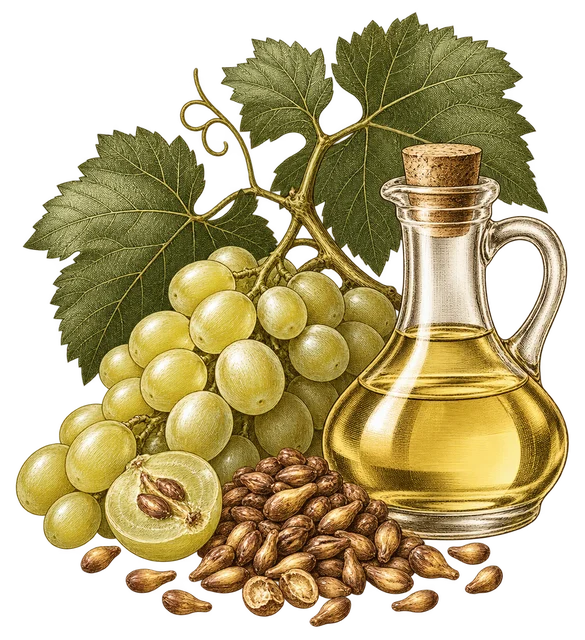
Seeded grapes are grape berries with developed seeds, not a separate botanical species or a standardized supplement. This card mainly describes ordinary table grapes, commonly Vitis vinifera and related hybrids; muscadines are a distinct grape group with different skins, seeds and nutrient profiles.
Ingredient details, preparation and research
Source plant or material
Grape vines, chiefly Vitis vinifera for European-type table grapes; American species and hybrids also supply edible grapes. The usual food is the flesh and skin. Seeds, leaves, pressed seed oil and extracts are separate ingredients.
Plant family / material: Vitaceae (grape family).
Forms and route
Fresh whole fruit; frozen grapes; raisins; juice; grape-seed flour or extract; and grapeseed oil. Whole fruit, juice, raisins, oil and concentrated seed extract are not nutritionally or clinically interchangeable. This card is about the food, with comparisons to the other forms.
Food sources
Fresh red, black/purple or green seeded table grapes. These can be eaten alone or with yogurt, oats, nuts or a meal. Raisins are dried grapes with less water; strained grape juice has little fiber. Muscadines are not represented precisely by European-type table-grape nutrient values.
Absorption and preparation
Eating the washed skin retains the whole-fruit food matrix. Polyphenols are metabolized during digestion and by gut microbes; a small human grape-pomace study found markedly different metabolite profiles between people. An antioxidant measurement in a seed does not say how much reaches human tissues. A normal meal with some fat supports absorption of fat-soluble vitamin K; no special oil dose, fasting schedule or grape-seed stack is established. Yogurt or nuts can add protein and fat to a snack, rather than acting as a proven grape-polyphenol absorption enhancer.
Traditional and reported uses
- Food: grapes contribute to fruit variety and provide carbohydrate and fluid; their fiber content is modest rather than exceptionally high.
- Polyphenols: skins and seeds supply plant compounds studied in nutrition research. Laboratory antioxidant activity is not proof that chewing seeds prevents disease.
- Grape-seed extract: NCCIH describes small, variable studies of blood lipids and blood pressure. These do not establish a treatment effect for whole seeded grapes or replace prescribed care.
Contraindications and cautions
- For infants and young children, remove seeds and quarter grapes lengthways, further adapting size and texture to eating skills; supervise eating. The intact round fruit is a choking hazard.
- Rinse grapes under running water before eating. Do not use soap, bleach or household disinfectants on fruit.
- Portion counts matter when managing carbohydrate intake. Juice and raisins are easy to consume in larger carbohydrate amounts than an ordinary fresh-fruit portion.
- Seeds can be hard and bitter. There is no established nutritional need to deliberately chew or swallow them; remove them if uncomfortable or if swallowing is difficult.
- With warfarin or a related vitamin K antagonist, keep overall vitamin K intake consistent and follow the prescriber’s plan. This does not require avoiding grapes.
- Before taking concentrated grape-seed extract, review medicines with a pharmacist or clinician. Safety during pregnancy and breastfeeding is not well established; ordinary food portions are a different exposure.
- The usual advice to retain washed grape skins is not a rule for babies or children with swallowing difficulty. NHS advises adapting texture and considering skin removal to make fruit easier to swallow; choking prevention takes priority over retaining the whole-fruit composition.
Similar items and how they compare
- Seedless grapes
The same food category, often with small undeveloped seed traces.
Seedlessness is a horticultural trait, not evidence of poor nutritional quality. Cultivar, portion and how the fruit is eaten matter more than a blanket seed-based ranking.
- Grape-seed extract
Concentrates compounds from grape seeds, particularly proanthocyanidins.
Supplement studies use defined preparations and doses. Eating a few seeds cannot be assumed equivalent.
- Grapeseed oil
Pressed or extracted from grape seeds; already a separate Barn entry.
An oil provides fat and calories without whole-fruit fiber and carbohydrate. It is not a dose-equivalent substitute for a polyphenol-rich seed extract.
- Tart cherries
Another colored fruit containing polyphenols.
A different plant family and nutrient profile; cherry-juice sleep trials do not apply to grapes.
Food value at a realistic portion
A small bowl, approximately 3/4 cup or 126 g, supplies about 90 kcal and 23 g carbohydrate using the FDA poster. Most is naturally occurring sugar, while fiber is about 1 g. The USDA comparison record includes Thompson seedless and cannot precisely describe each seeded cultivar; it adds modest vitamin K and potassium. In practice, choosing grapes for enjoyment and fruit variety is more realistic than treating them as a vitamin megadose.
Digestion and sensible combinations
A ten-person study of a grape-pomace beverage measured numerous metabolites, with large person-to-person differences. It does not validate a specific trick for absorbing compounds from whole seeds. Enjoying grapes with yogurt, nuts or a mixed meal broadens the meal’s nutrients; vitamin K uses the normal fat-absorption pathway.
Practical safety
Prepare grapes carefully for young children, with seeds removed and fruit quartered lengthways; further adapt size and texture to eating skills and supervise eating. Wash under running water rather than with cleaning chemicals. People taking warfarin should maintain consistent vitamin K intake; concentrated seed supplements need their own medicine and pregnancy review.
- CDC: Preparing fruit safely for young children
- FoodSafety.gov: Safe ways to handle and clean produce
- NIH Office of Dietary Supplements: Vitamin K absorption and warfarin guidance
- NCCIH: Grape seed extract, evidence and safety (2025)
- NHS: Preparing fruit safely for babies and young children
- Kingswinford Medical Practice (NHS): Cut round fruit lengthways into quarters
Entry sources
- Royal Botanic Gardens, Kew: Grape vine, uses and plant identity
- NCCIH: Grape seed extract, evidence and safety (2025)
- FDA: Raw fruits nutrition poster, grapes portion and nutrients
- Kew Plants of the World Online: Vitis vinifera, accepted name and native range
- UC Davis Waterhouse Lab: Grape proanthocyanidins in seeds and skins
- Castello et al. (2018): Human grape-pomace phenolic bioavailability study
- NIH Office of Dietary Supplements: Vitamin K absorption and warfarin guidance
- CDC: Preparing fruit safely for young children
- FoodSafety.gov: Safe ways to handle and clean produce
- USDA MyPlate: Fruit group, portions and whole-fruit fiber
- University of Georgia Viticulture: Muscadine grapes
- NHS: Preparing fruit safely for babies and young children
- Kingswinford Medical Practice (NHS): Cut round fruit lengthways into quarters
- USDA Standard Reference 2018: Raw red/green European-type grapes (including Thompson seedless), original report 09132
- USDA SR28: Raw red/green European-type grapes (including Thompson seedless), food 09132, PDF pages 425–427
- McGovern et al. (2017): Early Neolithic wine of Georgia, original archaeological study
- UNESCO: Dolma making and sharing tradition in Azerbaijan
- Azerbaijan culinary community statement to UNESCO: Grapevine dolma and preserving leaves
- Go Türkiye: Tunceli food traditions, grape pestil and orcik
- Cornell Fruit Resources: The Bronx Seedless grape breeding history
Reference entry 111 · Recorded content review: 2026-10-06 · Review scope and dates