


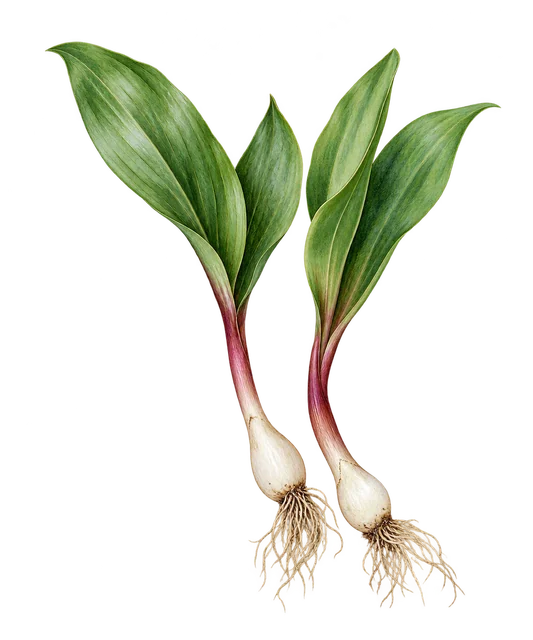
Key cautions
- Do not identify ramps from this card: poisonous lookalikes exist, and a common name or photograph is insufficient.
- Favor cultivated, traceable supplies; destructive wild harvest can deplete slow-growing populations.
- Refrigerate fresh or cooked material
What’s inside
Water, plant fiber and sulfur-containing aroma compounds characteristic of Allium foods. Reliable serving-specific nutrient values are not supplied here.
Uses in brief

- Seasonal cooked vegetable
- Leaf seasoning
History, folklore and reported uses
History, folklore and traditional uses
Forest Service research documents ramp management in eastern North America. Collaborative research with Eastern Band of Cherokee Indians partners addresses wasdi and cultural continuity; it should be attributed to that community rather than generalized to every Indigenous people.
Traditional, historical and reported uses
- Seasonal cooked vegetable
Food or household practiceWhy this label?
Label describes the stated practice or evidence, not an efficacy grade. Exact form and cautions remain attached.
Forest-farming guidance records bulbs and leaves as foods. Their concentrated allium flavor allows use in savory dishes without equating them with a medicinal garlic extract.
- Leaf seasoning
Food or household practiceWhy this label?
Label describes the stated practice or evidence, not an efficacy grade. Exact form and cautions remain attached.
NC State documents edible leaves as well as bulbs. Culinary leaf use is distinct from permission to harvest a wild patch without considering land access and ecological impact.
2 supported uses; records describe the named form and are not treatment recommendations.
Historical-use additions reviewed 2026-10-09
Regional reading paths
These sourced notes describe cultivation, trade, food traditions or material history. A regional connection does not claim exclusive origin.
North America
Native: eastern United States and Canada; Cherokee wasdi specifically documented.
Pungent edible leaves and bulbs; prefer cultivated, sustainably sourced material.
Identity & detailed reference
Identity
Allium tricoccum, commonly called ramps or wild leek. Allium ursinum, the European ramson, is a different species and existing entry.
Ingredient details, preparation and research
Also known as: Wild leek; Wasdi
Source plant or material
Allium tricoccum
Plant family / material: Amaryllidaceae
Forms and route
Food-grade cultivated or responsibly sourced leaves and bulbs. This card does not identify wild plants or establish a safe harvesting method.
Vitamins and minerals
Usually a seasonal vegetable or seasoning, not a standardized supplement. Pickled, salted and butter-rich preparations differ from plain cooked leaves or bulbs.
Absorption and preparation
Cooking changes aroma and texture. No special mineral-absorption advantage or clinical effect is established for ramps compared with other vegetables.
Practical preparation
Use verified culinary material, clean it thoroughly and prepare with a trusted recipe. Cook bulbs or use clean leaves as an aromatic as the dish requires. Seek validated guidance for any preservation rather than improvising sealed jars.
Traditional and reported uses
- Seasonal cooked vegetable
- Leaf seasoning
Contraindications and cautions
- Do not identify ramps from this card: poisonous lookalikes exist, and a common name or photograph is insufficient.
- Favor cultivated, traceable supplies; destructive wild harvest can deplete slow-growing populations.
- Refrigerate fresh or cooked material. Do not store improvised fresh-herb oil mixtures at room temperature.
Conservation and community-led research
The Forest Service study emphasizes doing research together with Cherokee partners. Its value concerns harvesting knowledge, sustainability and community relationships, not clinical evidence for health claims.
Evidence limits
Regional history and food/material practice do not establish treatment efficacy. Composition depends on the named species, part and preparation; no medicinal dose or universal nutrient ranking is inferred.
Entry sources
- USDA: Forest Farming Ramps
- USDA research: Wasdi plants guide collaborations in Cherokee landscapes
- NC State Extension: Allium tricoccum
Reference entry 419 · Recorded content review: 2026-10-09 · Review scope and dates