


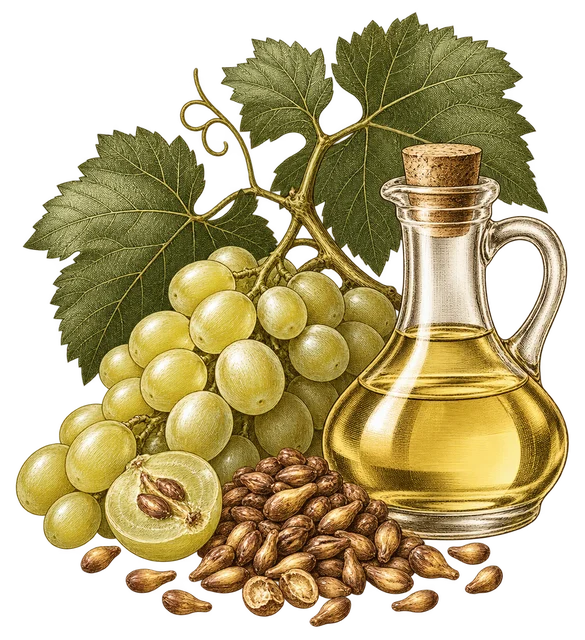
Key cautions
- Keep oil separate from grape-seed extract supplements
- Food and cosmetic labels determine the route; avoid a known grape-seed reaction
- NOW advises keeping its oil out of eyes and off broken or irritated skin. Follow the instructions for the particular product and intended body area.
What’s inside
Most of the bottle is triglyceride fat: fatty acids attached to glycerol. Linoleic acid, an omega-6 fat, predominates, alongside oleic acid and smaller amounts of saturated fatty acids. Minor constituents depend on the grape and processing method.
Botanical material and extraction
Grape-seed fixed oil is obtained from the seed fraction, often recovered after winemaking. Kew places Vitis vinifera in Vitaceae. A 2024 primary processing study used Graševina grape pomace: pulsed-electric-field pretreatment increased oil recovery and several minor constituents, while the fatty-acid profile changed little. These are manufacturing/composition results, not clinical evidence that the resulting oil treats inflammation or is absorbed better.
Kew Plants of the World Online: Vitis vinifera and Vitaceae · Ćurko et al. (2024): Pulsed-electric-field pretreatment and constituents of cold-pressed grape-seed oil
A measured cold-pressed oil
Graševina is a white-wine grape variety. In the 2024 experiment, its untreated cold-pressed seed oil contained 67.09% linoleic and 20.30% oleic acid, measured as shares of total fatty acids. The electrical pretreatment used short pulses to make seed cells more permeable before pressing. These sample measurements are distinct from the USDA food-record values below.
What the constituents do and do not imply
The oil is primarily triglyceride fat, usually linoleic-rich. Tocopherols, tocotrienols and sterols vary with seed source and processing; a laboratory antioxidant result is not a human health endpoint. The NCCIH material concerns grape-seed extract supplements. That distinct product cannot provide the clinical evidence, standardized polyphenol dose or interaction profile of food oil.
Ćurko et al. (2024): Pulsed-electric-field pretreatment and constituents of cold-pressed grape-seed oil · NCCIH: Grape seed extract, supplement evidence and safety
Nutrition per documented portion
The USDA record gives a 13.6 g tablespoon. Its 28.8 mg alpha-tocopherol per 100 g calculates to 3.9168 mg in that portion; 884 kcal/100 g calculates to about 120 kcal. The separated oil does not retain the protein, fiber and minerals of the seed as meaningful dietary amounts. Do not add tocotrienols or gamma-tocopherol to the alpha-tocopherol Daily Value calculation.
USDA FoodData Central SR Legacy: nutrient data and household portions; FDC 171028, 171026, 171027 · NIH Office of Dietary Supplements: Vitamin E, alpha-tocopherol, absorption and Daily Values
Uses in brief

- Food-grade cooking/dressing oil
- Skin softening and massage/hair-conditioning carrier
- Hair lengths: grapeseed oil is a cosmetic carrier for shine and smoother feel; regrowth is unproven.
In the King James Bible
Source-plant connection: grapevine
Source plant or material; different preparation
Numbers names the grapevine’s kernels and husk in the instructions for a Nazirite’s separation. The connection is to grapes and their seeds, the source material for grapeseed oil; the extracted oil itself is not named.
All the days of his separation shall he eat nothing that is made of the vine tree, from the kernels even to the husk.
Numbers 6:4 (KJV)
Scripture and identification sources
Words & their stories
WORDS & THEIR STORIES
The name behind the KJV
Biblical Hebrew · Numbers 6:4 (KJV)
מֵחַרְצַנִּיםmēḥarṣannīm
“From the kernels,” in the KJV prohibition on vine products during a Nazirite vow.
Dictionary form: חַרְצַנִּים · ḥarṣannīm
The opening mē- means “from.” Brown–Driver–Briggs lists the noun in its attested plural; the exact vine part has been disputed.
What the language reveals
The whole range of vine products
The phrase runs from ḥarṣannīm to zāg, rendered “kernels” to “husk” by the KJV. Older interpretations differ over the precise parts; the prohibition’s comprehensive scope is clear.
A source-plant connection
The verse names no extracted oil. Its relevance to this card is the grapevine and the KJV’s reference to kernels.
Grapes are secure in context; the exact mapping of these two ancient terms to seed and skin is less certain. This is not evidence for biblical grapeseed-oil use.
Language and identification bibliography
History, folklore and reported uses
Recovering value from the harvest
Grapeseed oil has a compelling history of making use of what a harvest leaves behind. In 1921, USDA researchers Frank Rabak and J. H. Shrader published a report on grape-juice industry waste, examining how skins, stems and seeds could yield jelly, cream of tartar, oil and other products. Its oil chapter belongs to the practical world of processors, machinery and the economics of recovering useful materials. It is direct evidence of a modern industrial story, rather than proof that the oil was a familiar medicine wherever ancient people made wine.
A modern culinary and body-care oil
Later food-science accounts describe commercial grapeseed-oil manufacture in Germany, France and Italy by the 1930s. The oil’s culinary life sits beside the much older histories of grapes, raisins and wine, while modern body-care practice adds another destination for the extracted fat. Grapeseed oil and concentrated grapeseed extracts are different products: the reputation of a tannin-rich extract, or the symbolism of wine, cannot simply be poured into the oil bottle.
Garavaglia et al. (2016): Grape Seed Oil Compounds, production history and distinction from extracts
A light massage carrier
AromaWeb describes grapeseed as an all-purpose carrier used widely in aromatherapy massage. Its relatively fluid texture gives it a practical role in spreading a body-care blend.
Softening and moisturizing skin
NOW’s single-ingredient grapeseed oil is presented as a light skin moisturizer and a base for lotions. This is a modern natural-cosmetic application of the seed’s fixed oil.
NOW Foods: Grapeseed Oil, skin moisturizer and hair conditioner
Cleansing and oily-skin care
Aroma-Zone records a cleansing reputation for grapeseed oil and uses it in care for oily and combination skin. This purpose is separate from the moisturizing role of a leave-on lotion.
Aroma-Zone: Grape seed oil, modern natural-beauty applications
Conditioning fine or dry hair
NOW lists the oil as a hair conditioner, while Aroma-Zone includes it in masks and balms for fine, dry or damaged hair. These uses concern coating and conditioning the hair fibre.
NOW Foods: Grapeseed Oil, skin moisturizer and hair conditioner · Aroma-Zone: Grape seed oil, modern natural-beauty applications
Seasoning and cooking
Aroma-Zone also records grapeseed oil as an edible oil for seasoning and frying. Its culinary role belongs to the extracted seed fat; grape-seed extract, grape juice and wine are different preparations.
Aroma-Zone: Grape seed oil, modern natural-beauty applications
Regional reading paths
These sourced notes describe cultivation, trade, food traditions or material history. A regional connection does not claim exclusive origin.
Europe
Cultivated and processed: European wine-growing regions; Croatian primary study examines pressed grape-seed oil.
Fixed seed oil used in cooking and cosmetic formulations; not grape-seed extract.
Identity & detailed reference
Identity
Vitis vinifera L.; fixed triglyceride oil extracted from grape seeds, often a winemaking by-product. It differs from polyphenol-rich grape-seed extracts, grape juice, wine, whole grapes and essential oils.
Ingredient details, preparation and research
Source plant or material
Vitis vinifera L.; seeds separated from grape pomace, rather than the flesh, skin, juice or fermented wine.
Plant family / material: Vitaceae (grape family).
Forms and route
Food-grade cold-pressed or refined culinary oil; cosmetic carrier, massage oil and skin/hair formulations. Polyphenol-rich seed-extract capsules, tinctures and standardized proanthocyanidin products are separate preparations.
Food sources
Food-grade grapeseed oil is the relevant food. Whole grapes, juice, wine, defatted seed material and grape-seed extract have different nutrient and phytochemical profiles; their vitamin, fiber or extract findings are not oil-serving values.
Vitamins and minerals
USDA SR Legacy FDC 171028 specifies 1 tablespoon = 13.6 g: approximately 120 kcal, 13.6 g fat, 1.31 g saturated fat and 9.47 g linoleic acid. Alpha-tocopherol is 3.92 mg, about 26% of the 15 mg vitamin E Daily Value. It supplies essentially no protein, fiber or listed major minerals. Values vary by product; total tocotrienols/tocopherols are not automatically equivalent to alpha-tocopherol for vitamin E requirements.
Absorption and preparation
Food-grade oil is digested as dietary fat and supports absorption of fat-soluble nutrients in the meal. A light skin feel is not a measured systemic bioavailability or a guarantee of deep penetration. Extraction technologies change composition; they do not themselves establish superior human absorption or health outcomes.
Practical preparation
Measure it into food rather than adding unneeded supplemental oil. Follow the label’s cooking guidance, avoid smoking/reusing cooking oil, and store closed in a cool dark place. Choose a topical product made for the intended body area; keep ordinary cosmetics out of eyes and do not improvise treatment of infected skin.
Combination notes
Grapeseed and jojoba were the carrier mixture in both arms of a published scalp trial, so the trial cannot demonstrate either carrier alone, their synergy, or a general hair-growth effect. In foods, no special oil combination is required; choose according to flavor, intended cooking and the overall diet.
Traditional and reported uses
- Contemporary culinary use in dressings, sauces and cooking; the useful dietary comparison is replacement of another fat.
- COSMILE identifies it as a skin-conditioning emollient; it also provides slip in massage and hair products.
- One small oral trial examined inflammation/metabolic markers during weight loss. Scalp and pregnancy-massage studies used grapeseed as one component and do not isolate a plain-oil medicinal effect.
- Hair lengths: grapeseed oil is a cosmetic carrier for shine and smoother feel; regrowth is unproven.
Contraindications and cautions
- Use only food-labeled oil orally. An edible oil does not make a fragranced cosmetic blend safe to swallow.
- Avoid a known reaction to grapes/seeds or the product, and stop a cosmetic that causes irritation. Added fragrance or other ingredients may be responsible.
- Interaction and pregnancy warnings for grape-seed extract supplements should be checked separately; they cannot simply be copied to culinary oil, nor dismissed for a product that actually contains extract.
- Do not replace prescribed metabolic treatment or evaluation of hair loss with oil. No comprehensive medicinal-dose interaction profile is established by the studies here.
- Sudden swelling during pregnancy needs prompt maternity assessment; a massage-oil study is not a reason to self-treat a potentially serious cause.
- NOW advises keeping its oil out of eyes and off broken or irritated skin. Follow the instructions for the particular product and intended body area.
Similar items and how they compare
- High-linoleic safflower oil
Another linoleic-rich food and cosmetic carrier oil.
Safflower also has high-oleic cultivars; vitamin E and minor compounds are not identical.
- Rosehip oil
Both are seed-lipid oils used in cosmetic conditioning.
Rosehip often contains more alpha-linolenic acid and is commonly sold solely for topical use.
- Grape-seed extract
Shares the plant part and is frequently confused with the oil.
Extract supplements concentrate a different, largely polyphenolic fraction and have their own evidence, dose and interaction questions.
An eight-week oral trial
In a randomized study of 44 overweight or obese women, grapeseed oil or sunflower oil provided 15% of energy within a weight-loss diet for eight weeks. Several markers improved within the grapeseed group; the abstract specifically reports a between-group advantage for high-sensitivity C-reactive protein. It does not establish a between-group benefit for every endpoint, weight loss from extra oil, or fewer cardiovascular events. Percent of energy is retained as reported, not converted into an invented daily spoon dose.
Scalp evidence: a carrier in both groups
The 1998 alopecia-areata trial compared a thyme/rosemary/lavender/cedarwood essential-oil blend in jojoba and grapeseed with the same carriers alone. Improvement was reported in 19/43 versus 6/41 participants after seven months. This comparison cannot isolate grapeseed oil and does not apply automatically to androgenetic hair loss. A carrier is a vehicle, not proof of a regrowth medicine. The authors’ 1999 reply describes alternating allocation, a predictable method that weakens the original claim of randomization.
Pregnancy massage is a combined intervention
A 2020 trial described 90 women assigned to grapeseed-oil foot massage, sweet-almond-oil massage or usual care. Massage lasted 20 minutes daily for five days. Both massage groups improved circumference outcomes, without a difference between oils; there was no massage-only comparator. Thus it does not identify a specific oil effect. New or sudden pregnancy swelling belongs with maternity assessment rather than an oil experiment.
Cosmetic use, absorption and interactions
COSMILE supports skin-conditioning/emollient roles, not disease treatment. Oral oil is digested as fat, whereas topical conditioning does not establish nutritional uptake. The reviewed trials do not comprehensively test medicine interactions. Keep the complete ingredient list in view, especially when a product combines seed oil, seed extract, essential oils or fragrance.
Food handling and related oils
AHA includes grapeseed among unsaturated culinary-oil choices. Use it for a role that fits its label and flavor, avoid overheating or reusing cooking oil, and protect stored oil from deterioration. High-linoleic safflower is a closer fatty-acid comparison than high-oleic safflower; neither comparison proves identical vitamin content, shelf life or clinical outcomes.
Hair care: cosmetic role and evidence limits
Preliminary hair-fiber evidence: a small laboratory study examined grape-seed-oil treatment of damaged hair. This does not establish new growth or guaranteed detangling in everyday use. Results from fermented or chemically modified grape oils cannot be assigned to the ordinary fixed oil. In the alopecia-areata essential-oil mixture study, grapeseed was also present in the carrier-only group. Cosmetic conditioning can improve the feel or appearance of existing lengths; it is not evidence of new hair growth. Oils do not add water to hair: laboratory moisture studies address changes in water movement, not a universal “hydration” effect. Use a small amount of a tolerated hair product on lengths or ends according to its label, alongside conditioner and gentle detangling. Stop for irritation; persistent scalp itching, redness or loss needs assessment.
Entry sources
- Kew Plants of the World Online: Vitis vinifera and Vitaceae
- COSMILE Europe: Vitis vinifera seed oil, cosmetic ingredient roles
- Ćurko et al. (2024): Pulsed-electric-field pretreatment and constituents of cold-pressed grape-seed oil
- Irandoost et al. (2013): Grape-seed versus sunflower oil in 44 overweight/obese women
- NCCIH: Grape seed extract, supplement evidence and safety
- Hay et al. (1998): Aromatherapy mixture versus jojoba/grapeseed carriers in alopecia areata
- Navaee and Rakhshkhorshid (2020): Grape-seed/almond oil foot massage trial in pregnancy
- NHS: Swollen ankles, feet and fingers in pregnancy; warning signs requiring urgent assessment
- Anaphylaxis UK: Plant-based oils, refining and food-allergy cautions
- American Academy of Dermatology: How to test skin-care products
- American Heart Association: Healthy cooking oils, food substitution and storage guidance
- NIDDK: Your digestive system and how it works
- USDA FoodData Central SR Legacy: nutrient data and household portions; FDC 171028, 171026, 171027
- NIH Office of Dietary Supplements: Vitamin E, alpha-tocopherol, absorption and Daily Values
- Hay and Ormerod (1999): Author reply clarifies alternating allocation in the 1998 alopecia trial
- Kim (2020): Effect of Grape seed Oil on Chemically Damaged Hair Improvement
- Keis et al. (2007): Effect of oil films on moisture vapor absorption on human hair
- AAD: How to stop damaging your hair
Reference entry 69 · Recorded content review: 2026-10-05 · Review scope and dates