


Key cautions
- Do not give honey to a child younger than 12 months because of infant botulism risk. Do not add it to infant food, water, formula or pacifiers.
- Do not put kitchen honey on an open wound. Food honey is not a substitute for sterile medical-grade dressings; problematic wounds need professional assessment.
What’s inside
Predominantly fructose and glucose with water, smaller amounts of other sugars and organic acids; variable enzymes, aroma compounds and phenolics. Mineral and vitamin amounts are small at a spoonful. Honey is not nutritionally equivalent to bee pollen or royal jelly.
Uses in brief

- Use a little as a sweetener in food or drinks; a teaspoon is often enough to change flavor.
- For people aged at least 1 year, honey is a familiar soothing option for a short-lived cough; pediatric guidance supports this limited use.
In the King James Bible
Honey in the KJV
Named material
Honey is explicitly named. Judges 14:8 directly links it to bees, and Proverbs 24:13 names honeycomb, so bee honey is firmly supported in these passages. Some other biblical uses of the underlying honey term may include plant syrups; no claim is made that all biblical honey was bee honey, all was date syrup, or any verse specifies today’s floral variety.
My son, eat thou honey, because it is good; and the honeycomb, which is sweet to thy taste:
Proverbs 24:13 (KJV)
And after a time he returned to take her, and he turned aside to see the carcase of the lion: and, behold, there was a swarm of bees and honey in the carcase of the lion.
Judges 14:8 (KJV)
Scripture and identification sources
Words & their stories
WORDS & THEIR STORIES
The name behind the KJV
Biblical Hebrew · Proverbs 24:13 (KJV)
דְבַשׁdəbaš
Honey, praised for its pleasing taste.
Dictionary form: דְּבַשׁ · dəbaš
The verse’s vowel pattern is retained; the dictionary also shows the pausal form dəbāš.
Biblical Hebrew · Proverbs 24:13 (KJV)
וְנֹפֶתwənōpet
“And honeycomb,” in the KJV; flowing honey or honey from the comb.
Dictionary form: נֹפֶת · nōpet
Wə- means “and.” The lexical focus is honey flowing from a comb, not a modern processed honey product.
Biblical Hebrew · Judges 14:8 (KJV)
וּדְבָשׁūdəbāš
“And honey,” found with a swarm of bees.
Dictionary form: דְּבַשׁ · dəbaš
Ū- means “and”; the longer ā vowel occurs in this pausal form.
What the language reveals
Context identifies bee honey
The bees in Judges make the material clear. That does not require every occurrence of dəbaš elsewhere to mean bee honey rather than a sweet syrup.
Sweetness becomes a comparison
The next verse in Proverbs turns from honey to wisdom. Its literary comparison should not be read as a medical regimen.
Bee honey is supported in these contexts. The Hebrew does not specify a floral variety, processing method or therapeutic effect, and it does not make all biblical honey date syrup.
History, folklore and reported uses
History, folklore and traditional uses
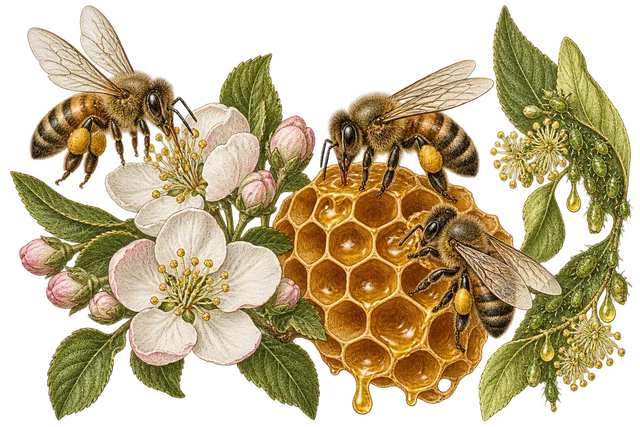
Honey’s story joins the labor of insects with human skill in gathering, keeping and transforming food. Bees concentrate a dilute plant resource into something sweet and storable, and beekeepers learned to harvest it without losing its distinctive character. The Bible preserves more than an abstract image of abundance: Judges describes bees and honey together, and Proverbs recalls the sweetness of the comb. These details matter when modern readers distinguish bee honey from fruit syrups.
The kitchen was only one destination. FAO’s account traces honey into fermented drinks, herbal preparations and cosmetics. In brewing, its sugars become the basis of mead; in a cream, its water-attracting character serves a different purpose; in traditional herbal mixtures, sweetness helps carry other ingredients. Each craft changes the same material’s role. A spoonful eaten for flavor is therefore only one small part of honey’s social history.
Household care gives the history an especially familiar voice. Honey in a soothing drink remains common, and contemporary pediatric advice permits honey for cough comfort after the first birthday. Wound treatment has a much older association too, but its present-day form is a sterile, controlled medical dressing. Keeping these contexts clear allows the story to remain generous without treating an ordinary food jar as a medical kit.
The raw-honey label highlights a processing choice within the older honey tradition. Purdue’s food guide distinguishes raw, filtered, comb and deliberately crystallized forms; FAO’s handling account explains why beekeepers try to preserve delicate aroma while making honey practical to bottle. These distinctions concern the food’s handling and sensory character, rather than a new medicinal identity.
Traditional, historical and reported uses
- Sweetening and food craft
Food or household practiceWhy this label?
Culinary sweetening and food preparation.
Honey flavors and sweetens baked goods, drinks and preserved preparations. Its taste varies with the plants visited by bees.
- Mead and fermented drinks
Food or household practiceWhy this label?
Fermentation into honey wines and other drinks.
FAO documents honey wine and related fermentation traditions, where honey supplies fermentable sugars rather than merely a finishing drizzle.
- Throat and cough comfort
Mixed/contextual sourcesWhy this label?
Combines household soothing practice with current pediatric care guidance.
Honey is a longstanding household soothing food; current pediatric guidance permits its use for cough after age 1, never in younger infants.
- Historical wound care
Mixed/contextual sourcesWhy this label?
Combines historical external-care context with modern sterile medical products.
Honey has a long external-care history. Modern practice uses appropriate sterile dressings, a different product standard from culinary honey.
- Cosmetics and medicinal carriers
Food or household practiceWhy this label?
Cosmetic and herbal-carrier formulation uses.
Honey has been incorporated into moisturizing cosmetics and used to carry herbal preparations, two documented formulation roles distinct from eating it plain.
Five distinct documented uses are presented with the plant part or product specified; historical practices are not preparation instructions.
Story sources
- FAO: Value-added products from beekeeping, Honey, sections 2.1–2.5
- FAO: Honey wines, cosmetics and handling, continuation of Chapter 2
- American Academy of Pediatrics: Cough, home care and honey age restriction
- Oxford Health NHS Foundation Trust: Medical honey simplified, patient leaflet
- Purdue Extension FoodLink: Honey, raw and processed forms
- FAO: Value-added products from beekeeping, heating and storage
- CDC: Foods and Drinks to Avoid or Limit, honey before 12 months
Health topics: evidence and cautions
These notes describe a specific research context and preparation. A topic link is not a treatment recommendation.
Respiratory health · Symptom support
Form and route: food honey · oral
Honey may reduce night cough in children older than one.
Evidence: limited clinical evidence
Small studies summarized by NCCIH support short-term symptom relief.
Limits
Evidence here is mainly pediatric and does not establish treatment of the infection.
Cautions
- Never give honey under age one; consider sugar intake and allergy.
Cancer by type · Support during care
Form and route: Protocol-selected honey applied in the mouth and swallowed · oral mucosal and oral
Honey may help prevent mouth sores during head-and-neck radiation treatment.
Evidence: Clinical guideline suggestion
MASCC/ISOO makes a suggestion for radiation with or without chemotherapy.
Limits
Trials used different honeys and small mixed groups. No separate tumor-control benefit is established for oral, throat or laryngeal cancer.
Cautions
- Use only with the oncology/dental team’s approval, considering swallowing and blood-sugar needs.
Regional reading paths
These sourced notes describe cultivation, trade, food traditions or material history. A regional connection does not claim exclusive origin.
Australia & Oceania
New Zealand mānuka honey is produced by bees visiting mānuka flowers and has a documented national production and authentication system.
Culinary sweetener; ordinary honey is not medical-grade wound honey. Do not give honey to infants under 12 months.
Identity & detailed reference
Identity
Honey is concentrated nectar or honeydew collected and transformed by bees. The floral or honeydew source, bee species and handling affect color, flavor and composition. Date syrup and carob syrup are plant products even where called honey in ordinary speech.
Ingredient details, preparation and research
Also known as: Bee honey; Comb honey; Honeycomb; raw honey; unheated honey
Source plant or material
No single source plant. Bees collect nectar from flowers or honeydew associated with plants, then process and store it in the comb.
Plant family / material: Not a plant: honey-producing bees belong to Apidae. The nectar-producing plants belong to many families.
Forms and route
Liquid, naturally crystallized or creamed honey; honey in comb; filtered or heated food honey. Sterile medical-grade wound dressings are separate manufactured products. Floral labels do not by themselves make food honey medical-grade. Raw honey is another food form. Purdue describes it as honey not highly heated or finely filtered; ask the producer about handling rather than treating the word raw as a medical grade.
Food sources
Plain food-grade honey is the nutritional basis. A small drizzle sweetens yogurt, porridge or dressing. Honeycomb also includes wax, while prepared syrups, lozenges and honey blends may add other sugars or ingredients.
Vitamins and minerals
For 21 g honey, 1 tablespoon: about 64 kcal, 17.3 g carbohydrate, 17.2 g sugars, 0.06 g protein, negligible fat and fiber, 11 mg potassium and about 1 mg calcium. A 7 g teaspoon is one-third of that amount: about 21 kcal and 5.7 g sugars. USDA SR28 food 19296 is the basis. A spoonful is not a meaningful vitamin or mineral supplement. Raw honey remains predominantly a sugar-containing food. The general honey reference values above are not a separate laboratory analysis of a particular raw jar.
Absorption and preparation
Honey’s glucose and fructose are absorbed as sugars; no special fat pairing is required. Stirring honey into food changes flavor and the meal’s sugar content rather than creating a proven absorption-enhancing remedy. Its historical use as a carrier for herbs documents a formulation tradition, not a guarantee that every herb is absorbed faster.
Practical preparation
Use a clean utensil and keep the food container closed. Crystallization can be a normal physical change. Measure a spoonful if tracking carbohydrates. Never prepare an infant remedy or wound dressing from a household jar. Raw honey may be used as a sweetener like other food honey. Gentle warming can change its texture; heat and storage affect aroma and heat-sensitive constituents.
Food preparation
Use a clean utensil and keep the food container closed. Crystallization can be a normal physical change. Measure a spoonful if tracking carbohydrates. Never prepare an infant remedy or wound dressing from a household jar.
Combination context
Honey can sweeten plain yogurt, oats or a warm drink. Lemon contributes its own acidity and nutrients; the combination does not make honey a vitamin source. Account for any additional sweeteners in commercial cough syrups or flavored honey.
Traditional and reported uses
- Use a little as a sweetener in food or drinks; a teaspoon is often enough to change flavor.
- For people aged at least 1 year, honey is a familiar soothing option for a short-lived cough; pediatric guidance supports this limited use.
- Historical brewing, cosmetics and medicinal carriers use honey’s sweetness and texture. Wound care today requires an appropriate sterile medical product and clinical assessment.
Contraindications and cautions
- Do not give honey to a child younger than 12 months because of infant botulism risk. Do not add it to infant food, water, formula or pacifiers.
- Do not put kitchen honey on an open wound. Food honey is not a substitute for sterile medical-grade dressings; problematic wounds need professional assessment.
- Honey is concentrated sugar. Count it in carbohydrate and added-sugar intake; raw, local or dark honey is not sugar-free.
- Avoid it if it has caused an allergic reaction. Honey and other bee products differ; a product may also contain pollen or added ingredients.
- Do not rely on honey alone for breathing difficulty, dehydration, severe illness or a persistent worsening cough.
- Do not give raw honey or any other honey to infants younger than 12 months; raw labeling is not an exception.
Preparation-specific cautions
- Do not feed honey or add it to food, water, formula or a pacifier.
- Use an appropriate sterile medical dressing under wound-care advice rather than kitchen honey.
- Honey remains concentrated sugar in all ordinary culinary forms.
- Use cough guidance appropriate to age and seek care for serious symptoms.
Similar items and how they compare
- Date syrup
Another traditional concentrated sweetener.
Made from fruit; bee-and-comb passages explicitly support bee honey and should not all be reassigned to date syrup.
- Carob syrup
May be called carob honey in Mediterranean food traditions.
Extracted from carob pods rather than produced by bees; its composition and biblical identification are separate.
- Medical-grade honey dressing
Uses selected honey in wound-care products.
Manufactured and sterilized for the intended medical use; a food jar, including manuka, is not interchangeable.
What the Bible actually identifies
Judges 14:8 explicitly names a swarm of bees with honey. Proverbs 24:13 pairs honey with honeycomb. These are strong anchors for bee-produced honey, even though other biblical contexts may use a broader sweet-product term. Neither passage establishes a modern floral variety.
Food value at a spoonful
A tablespoon weighs about 21 g and is largely sugars with water. The small mineral numbers should be kept in scale: its chief food role is sweetness and flavor, not micronutrient supplementation.
A specific household use supported by research
Paul and colleagues compared a single nighttime dose of buckwheat honey, honey-flavored dextromethorphan and no treatment in children with upper-respiratory cough. Parents rated honey favorably for symptom relief. This concerns short-term cough comfort; it does not identify honey as a treatment for every respiratory illness.
Why wound products are different
Modern honey dressings are sterile manufactured products selected for a wound after assessment. This continues an old wound-care idea under different quality controls. No household wound mixture is supplied here. The infant-botulism restriction also applies regardless of a honey’s premium label.
Parts and materials used
Edible honey; comb honey includes beeswax. Bee pollen, propolis, royal jelly and venom are separate products.
Food forms and ingredient distinctions
Plain food-grade honey is the nutritional basis. A small drizzle sweetens yogurt, porridge or dressing. Honeycomb also includes wax, while prepared syrups, lozenges and honey blends may add other sugars or ingredients.
Practical preparation
Use a clean utensil and keep the food container closed. Crystallization can be a normal physical change. Measure a spoonful if tracking carbohydrates. Never prepare an infant remedy or wound dressing from a household jar.
Meal ideas and combinations
Honey can sweeten plain yogurt, oats or a warm drink. Lemon contributes its own acidity and nutrients; the combination does not make honey a vitamin source. Account for any additional sweeteners in commercial cough syrups or flavored honey.
Raw honey and processing
Raw describes handling of a food, not a new bee product. Purdue distinguishes minimally heated, unfiltered honey from filtered forms. FAO explains that heating alters volatile aromas and heat-sensitive minor constituents; that observation alone does not establish greater clinical benefit from an unheated jar. Raw food honey is not sterile medical-grade honey.
Food reference portions
- Honey
1 tablespoon (21 g): about 63.84 kcal Energy. Calculated from the specified edible-portion reference; shells, oil and other forms excluded. Data: USDA SR28.
- Honey
1 tablespoon (21 g): about 0.063 g Protein. Calculated from the specified edible-portion reference; shells, oil and other forms excluded. Data: USDA SR28.
- Honey
1 tablespoon (21 g): about 0 g Total fat. Calculated from the specified edible-portion reference; shells, oil and other forms excluded. Data: USDA SR28.
Food composition reference
Honey · 1 tablespoon (21 g). Approximate values, rounded to about three significant digits.
| Nutrient | Per 100 g | Per stated serving |
|---|---|---|
| Energy | 304 kcal | 63.8 kcal |
| Protein | 0.3 g | 0.063 g |
| Total fat | 0 g | 0 g |
| Carbohydrate | 82.4 g | 17.3 g |
| Fiber | 0.2 g | 0.042 g |
| Sugars | 82.1 g | 17.2 g |
| Calcium | 6 mg | 1.26 mg |
| Potassium | 52 mg | 10.9 mg |
USDA SR28 reference data, currently accessible; not newly collected 2026 measurements; USDA NDB 19296
per-100-g value × edible serving grams / 100; displayed prose rounded
Evidence limits
- Floral origin and processing vary; USDA values describe a reference food rather than every jar.
- A historic medicinal use is not a claim that culinary honey treats the underlying disease.
- Biblical honey cannot be assigned one botanical nectar source, and not every honey word in every passage has the same identification.
Entry sources
- FAO: Value-added products from beekeeping, Honey, sections 2.1–2.5
- CDC: Foods and Drinks to Avoid or Limit, honey before 12 months
- USDA SR28: Honey, food 19296, PDF pages 480–482
- FAO: Honey wines, cosmetics and handling, continuation of Chapter 2
- American Academy of Pediatrics: Cough, home care and honey age restriction
- Paul et al.: Honey, dextromethorphan and no treatment for nocturnal childhood cough
- Oxford Health NHS Foundation Trust: Medical honey simplified, patient leaflet
- Judges 14:8 (KJV): bees and honey
- Proverbs 24:13 (KJV): honey and honeycomb
- Purdue Extension FoodLink: Honey, raw and processed forms
- FAO: Value-added products from beekeeping, heating and storage
Reference entry 147 · Recorded content review: 2026-10-07 · Review scope and dates