


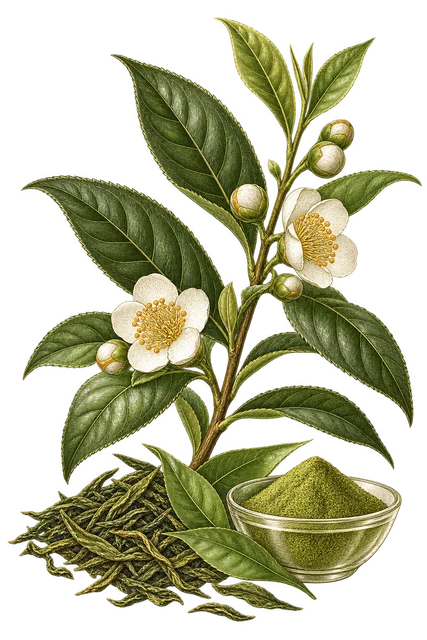
Key cautions
- Oral concentrated extracts can injure the liver. Do not take them fasting or treat a numerical regulatory limit as a guaranteed safe dose.
- Check caffeine, medicines and the intended route. Stop a skin product for irritation; homemade tea is not a validated stored serum or sunscreen.
What’s inside
Leaf extracts may contain the catechins EGCG, EGC, ECG and epicatechin, together with variable caffeine, theanine and other polyphenols. EGCG is one catechin, not the total extract. Decaffeinated, catechin-standardized and cosmetic extracts need their own specifications.
CIR: Safety assessment of Camellia sinensis leaf-derived cosmetic ingredients
Catechins, caffeine and the label
EGCG means epigallocatechin gallate; EGC is epigallocatechin, ECG is epicatechin gallate, and EC is epicatechin. These related polyphenols are not interchangeable with caffeine, a stimulant. Read extract mass, total catechins, EGCG and caffeine as separate quantities. Milligrams per capsule, per serving and per daily portion use different denominators; a percentage of the raw extract is not automatically the percentage in the finished cream.
CIR: Safety assessment of Camellia sinensis leaf-derived cosmetic ingredients · Health Canada (25 July 2025): Green tea extract natural-health-product monograph
A specified medicinal fraction
The prescription ointment’s 15% strength means 150 mg sinecatechins per gram of finished ointment, not 150 mg pure EGCG. Sinecatechins are a partially purified aqueous leaf-extract fraction. This specification cannot be assigned to cosmetic extracts, brewed tea or oral supplements.
DailyMed: Veregen, prescription sinecatechins 15% ointment label
Uses in brief

- Topical: antioxidant and skin-conditioning use; selected EGCG formulations have preliminary acne and photodamage research.
- Beverage: longstanding refreshment and alertness use. Prescription wart ointment is a separate, narrowly indicated medicine.
History, folklore and reported uses
Identity and preparation matter
Camellia sinensis supplies green, black and oolong tea. Processing changes its chemistry; green tea generally preserves more monomeric catechins, while black-tea oxidation produces more theaflavins and thearubigins. An extract label should identify the leaf and intended route. A product described only as “green tea” does not establish its catechin or caffeine dose.
Kew POWO: Camellia sinensis, accepted name and Theaceae family · CIR: Safety assessment of Camellia sinensis leaf-derived cosmetic ingredients
Tea stories, literature and teahouses
Green-tea extract inherits a name surrounded by tea stories, but those stories first belonged to leaves and the cup. The Hong Kong Museum of Tea Ware recounts the Chinese legend of Shennong, the divine herb-taster who used tea against the poisons he encountered. This is an origin myth about tea's protective reputation, not an account of a proven antidote. Lu Yu's Tang-dynasty Classic of Tea helped give tea an enduring literary identity; teahouses later became places for conversation, news and companionship as well as refreshment.
Hong Kong Government / Museum of Tea Ware (2012): A Date with Chinese Tea, legends and tea culture
Eisai and Japanese tea culture
In Japan, the monk Eisai linked tea with health in his early-thirteenth-century Kissa Yōjōki. The Five College Center for East Asian Studies places this writing within the development of Japanese tea culture and its connections with Buddhism. Such traditions join bodily care with attention, hospitality and repeated daily practice. They concern historical tea preparations, whose processing and drinking customs changed over time.
Five College Center for East Asian Studies: History of tea and Eisai’s Kissa Yōjōki
From the cup to concentrated products
Concentrated leaf extracts entered a different world of cosmetic ingredients and dietary supplements. NCCIH records their modern promotion for weight and cholesterol management, but these products cannot simply inherit every benefit or reassurance attached to tea drinking. The older heritage is worth preserving on its own terms, while identifying the actual preparation whenever a health claim is made.
NCCIH: Green tea, usefulness, safety and medication interactions
Fatigue and weakness
EMA recognizes a traditional role for specified green-tea leaf preparations in fatigue and weakness. The stimulating leaf infusion belongs to this history; concentrated EGCG supplements and cosmetic extracts are separate preparations.
EMA: Green tea leaf, traditional fatigue and weakness assessment
Stomach comfort and nausea
EMA’s historical review records Chinese use of green-tea beverages for nausea and digestive complaints, alongside European descriptions of tea as a stomachic. These accounts concern leaf preparations, not cosmetic green-tea extract.
EMA (2013): Green-tea leaf assessment report, section 2.2 on historical and traditional indications
Headache remedies
EMA’s historical review records green tea used for migraine in Chinese medicine, tea preparations for migraine in India, and older European headache remedies. The headache tradition sits alongside tea’s better-known role as a stimulating drink.
EMA (2013): Green-tea leaf assessment report, section 2.2 on historical and traditional indications
Astringent bowel remedies
Green-tea beverages appear in historical Chinese remedies for diarrhea, and Indian traditions also record tea preparations for that purpose. EMA’s review places these practices alongside European descriptions of tea’s astringency.
EMA (2013): Green-tea leaf assessment report, section 2.2 on historical and traditional indications
Weight and cholesterol supplements
NCCIH records concentrated green-tea products promoted for weight loss and cholesterol management. This is a modern oral-supplement use, with its own safety history: green-tea extracts have been linked to liver injury.
NCCIH: Green tea, usefulness, safety and medication interactions
Extract-based mouth rinses
Moghbel and colleagues in Iran developed a mouthwash using green-tea leaves grown in Lahijan. Their 2012 study documents a modern extract-based oral-hygiene application, partly motivated by a traditional belief that tea masks bad breath.
Wrinkle-care cosmetic research
A 2013 Korean study compared topical ordinary and tannase-treated green-tea extracts for wrinkle care. This documents a modern cosmetic research application; findings for the studied formulations do not establish equivalent effects for every green-tea extract.
Hong et al. (2013): Tannase-converted green tea catechins and their anti-wrinkle activity in humans
Prescription sinecatechins are distinct
Veregen is a prescription 15% sinecatechins ointment, with a specified partially purified tea fraction and ointment base, for external genital/perianal warts in immunocompetent adults. Local inflammatory reactions are common. It is not an oral product, general facial cosmetic, open-wound treatment or cure for HPV infection.
DailyMed: Veregen, prescription sinecatechins 15% ointment label
Skin formulation and storage
CIR’s cosmetic safety conclusion applies to the assessed leaf-derived profiles when formulated to avoid sensitization, not every homemade extract. Raw material quality, vehicle and preservation matter. FDA calls for safety substantiation and protection against microbial contamination. Tea’s laboratory antioxidant or antimicrobial activity cannot by itself establish a finished spray’s preservation, stability or safe shelf life.
CIR: Safety assessment of Camellia sinensis leaf-derived cosmetic ingredients · FDA: Small businesses and homemade cosmetics, safety and contamination · FDA: Cosmetic GMP guidelines, preservation testing and laboratory controls
Health topics: evidence and cautions
These notes describe a specific research context and preparation. A topic link is not a treatment recommendation.
Prostate health · No benefit or possible harm
Form and route: Oral standardized decaffeinated catechin mixture (Polyphenon E) · oral
A catechin extract trial did not show a significant reduction in prostate cancer diagnoses.
Evidence: Limited clinical evidence; negative primary outcome
NCI reports a one-year trial in 97 men with HGPIN or atypical small acinar proliferation. Cancer occurred in 5/49 on extract and 9/48 on placebo; the difference was not significant.
Limits
This does not prove benefit from brewed tea or all extracts. The small trial cannot rule out every possible effect.
Cautions
- Concentrated green tea extracts can injure the liver.
- Do not ingest cosmetic extracts; review medicine interactions.
Identity & detailed reference
Identity
Extract of Camellia sinensis (L.) Kuntze leaves, in Theaceae. Green-tea processing limits leaf oxidation, retaining catechins. Cosmetic extracts, brewed tea, whole-leaf powder and concentrated oral EGCG supplements differ in composition, concentration and route.
Ingredient details, preparation and research
Source plant or material
Leaves of Camellia sinensis processed as green tea; cultivar, harvest, oxidation, solvent and extract standardization determine the material. Seed oil is a separate plant fraction.
Plant family / material: Theaceae (tea family).
Forms and route
Finished topical creams, gels and serums; cosmetic water/glycerin or other specified extracts and powders. Separately: drinking tea, matcha whole-leaf powder and standardized oral capsules/liquids, with or without caffeine. Prescription sinecatechins ointment and Camellia seed oil are distinct preparations.
Food sources
Brewed green tea supplies catechins with variable caffeine; matcha contains dispersed whole-leaf powder. Neither should be assigned a capsule-equivalent EGCG dose without measurement. Cosmetic extracts are not food.
Vitamins and minerals
Catechins are polyphenols, not essential vitamins or minerals. A cosmetic extract supplies no dietary nutrition. Oral extract labels may declare added nutrients, but leaf composition does not establish the vitamin/mineral contribution of a serving of extract or brewed tea.
Absorption and preparation
Oral EGCG exposure is variable and generally limited; controlled studies found greater exposure when a concentrated extract was taken fasting. Greater exposure is not necessarily greater benefit and creates a safety tradeoff. Do not use fasting as an absorption strategy; follow food-taking warnings. Topical delivery depends on the finished vehicle and ingredient stability, not food pairings.
Practical preparation
For drinking, use a food-labeled tea and its brewing directions. For skin care, use a finished product or a fully specified cosmetic ingredient within a professionally validated formulation. Identify solvent, extract solids, EGCG/catechin and caffeine content where relevant. Do not convert an extract mass into teaspoons of leaf, ingest cosmetic material, or add brewed tea to a preserved product and assume its shelf life remains valid.
Combination notes
Weight-management and energy blends may combine tea extract with additional caffeine or other botanicals; review the complete label rather than attributing results or adverse effects to tea alone. For topical combinations, benefit and tolerance belong to the tested finished formula. Extra antioxidants do not replace preservation testing or sunscreen.
Traditional and reported uses
- Traditional beverage use: tea drinking for refreshment and alertness has a long Chinese history. EMA recognizes a traditional fatigue/weakness role for specified green-tea leaf preparations, not every concentrated extract.
- Cosmetic use: antioxidant and skin-conditioning ingredient. A small topical EGCG acne trial and experimental UV studies are promising, but do not establish that any green-tea serum treats acne, replaces sunscreen or reverses aging.
- Specific medicine: prescription sinecatechins ointment is approved for external genital and perianal warts in eligible adults. This indication does not transfer to a cosmetic extract or tea compress.
- Oral research: small changes in LDL cholesterol and body weight have been reported, with variable products and effects. Concentrated supplements are not established cancer prevention or a substitute for appropriate treatment.
Contraindications and cautions
- Concentrated oral extracts can cause uncommon but serious liver injury, sometimes requiring transplantation. Avoid self-treatment with extracts in liver disease; stop and seek prompt assessment for jaundice, dark urine, persistent abdominal pain or marked nausea.
- Do not take concentrated EGCG on an empty stomach to increase absorption. Food lowers exposure but does not eliminate idiosyncratic liver risk. A regulatory threshold is not a universally safe dose.
- Review medicines, including nadolol, atorvastatin and raloxifene. Beverage interactions can occur as well as supplement interactions. With iron deficiency, ask about tea or extract use rather than treating it as a nutrient supplement.
- Count caffeine from drinks, extracts and other stimulant products. Decaffeination does not remove the catechin-related liver concern. Pregnancy, breastfeeding and use in children require route-specific advice; EU covered-extract labels warn against use in pregnancy, breastfeeding and under 18.
- Topical products can irritate or cause allergy. Never ingest a cosmetic extract, put concentrated powder into the eyes, or substitute homemade tea into a stored serum. A botanical antioxidant does not validate preservation or SPF.
Similar items and how they compare
- Black tea extract
Comes from the same tea plant and is also used in beverages and cosmetics.
Greater leaf oxidation changes the polyphenol mixture; a black-tea extract is not compositionally equivalent to a green-tea EGCG preparation.
- Brewed green tea and matcha
They share the source leaf and several constituents.
Brewed infusion and whole-leaf powder differ from each other and from a standardized concentrate; their serving sizes and caffeine/catechin exposures cannot be interchanged.
- Caffeine products
Caffeine can contribute to the alertness and stimulant effects of tea.
Caffeine is a distinct compound; caffeine-free does not mean EGCG-free or eliminate concentrated-extract liver risk.
Traditional use and oral claims
EMA’s traditional assessment concerns specified leaf preparations for fatigue and weakness. It is not an endorsement of concentrated EGCG for every promoted use. NCCIH reports that LDL and weight effects are generally modest and product-dependent, while cancer-prevention results remain inconsistent.
Acne research: topical EGCG
Yoon and colleagues combined laboratory work with an eight-week randomized split-face study of topical EGCG and reported improvement in acne. This supports further study of that formulation. It does not show that drinking tea, swallowing capsules, or applying a differently standardized cosmetic extract produces the same result.
Sun damage and visible aging
In an experimental human UV-exposure study, applied green-tea fractions reduced several acute skin-injury markers. A separate eight-week trial in 40 women combined a tea cream with oral supplementation: histology improved, but clinical photoaging scores did not, and irritation was greater. Neither design establishes a retail serum’s SPF or a dependable visible-rejuvenation effect.
Liver injury is a real oral-extract risk
LiverTox documents acute liver injury from green-tea extracts, including severe outcomes. This is uncommon and does not mean an ordinary beverage carries the same risk as concentrated capsules. EFSA found increased liver enzymes in supplement trials at or above 800 mg EGCG/day and could not identify a generally safe extract intake; susceptible people may react at lower exposure.
Current thresholds have specific regulatory scopes
EU Regulation 2022/2340 requires covered extract-containing foods to provide less than 800 mg EGCG per daily portion and carry warnings against 800 mg/day or more, same-day use with other green-tea products, fasting, pregnancy/breastfeeding and use under 18. Beverage-reconstituted aqueous extracts comparable to traditional tea are excluded. Separately, Health Canada’s July 2025 adult oral-extract monograph uses maxima of 300 mg EGCG, 690 mg total catechins and 150 mg caffeine/day for its antioxidant category. These are jurisdiction- and product-specific conditions, not personal dosing advice or a promise of safety.
Absorption: fasting is a safety tradeoff
Chow’s crossover study found higher systemic EGCG exposure from Polyphenon E without food, with nausea more frequent in fasting/high-dose conditions. A pharmacokinetic increase does not establish better clinical outcomes. Current extract labeling precautions favor food-taking; a meal reduces exposure but cannot guarantee protection from liver injury.
Medicines, caffeine and nutrient context
A ten-volunteer crossover study found substantially lower nadolol exposure with repeated green-tea beverage consumption. NCCIH also identifies atorvastatin and raloxifene interactions. Caffeine and catechins need separate consideration: a decaffeinated extract can still concentrate EGCG. Nutritional contribution should be read from a serving-based label, not inferred from antioxidant activity.
Entry sources
- NCCIH: Green tea, usefulness, safety and medication interactions
- CIR: Safety assessment of Camellia sinensis leaf-derived cosmetic ingredients
- NIDDK LiverTox: Green tea and clinically apparent liver injury
- European Commission: Regulation (EU) 2022/2340, green tea extracts containing EGCG
- Kew POWO: Camellia sinensis, accepted name and Theaceae family
- EMA: Green tea leaf, traditional fatigue and weakness assessment
- Yoon et al. (2013): Topical EGCG, laboratory mechanisms and eight-week split-face acne trial
- Chiu et al. (2005): Placebo-controlled combined oral and topical green-tea photoaging trial
- Elmets et al. (2001): Human experimental UV injury and topical green-tea polyphenols
- DailyMed: Veregen, prescription sinecatechins 15% ointment label
- EFSA (2018): Scientific opinion on the safety of green tea catechins
- Health Canada (25 July 2025): Green tea extract natural-health-product monograph
- Chow et al. (2005): Fed versus fasting bioavailability of Polyphenon E catechins
- Misaka et al. (2014): Green-tea beverage reduces nadolol exposure in healthy volunteers
- FDA: Small businesses and homemade cosmetics, safety and contamination
- FDA: Cosmetic GMP guidelines, preservation testing and laboratory controls
- FDA: Daily Value on the Nutrition and Supplement Facts labels
- Moghbel et al. (2012): Evaluation of the Effect of Green Tea Extract on Mouth Bacterial Activity in the
- Hong et al. (2013): Tannase-converted green tea catechins and their anti-wrinkle activity in humans
Reference entry 81 · Recorded content review: 2026-10-05 · Review scope and dates