


Key cautions
- Concentrated supplements need review with blood-thinning medicines and before procedures. Never use raw crushed garlic as a skin treatment.
- Homemade garlic-in-oil needs prompt refrigeration and a maximum 4-day refrigerated storage period, or freezing; it is not shelf-stable.
- The EMA monograph contraindicates its medicinal garlic preparations with saquinavir/ritonavir because reduced drug exposure could compromise HIV treatment. Ask the HIV treatment team before using a garlic supplement; do not change prescribed treatment.
- The EMA monograph does not recommend its artery-health preparations below age 18 or its cold-symptom extract below age 12. These limits concern the specified medicinal products, not ordinary culinary seasoning.
What’s inside
Garlic’s sulfur mixture changes when a clove is cut, heated, dried, aged or distilled. Whole cloves, garlic powder, aged extracts and oils therefore need separate descriptions.
EMA: final garlic assessment, adopted 2017, published2020
An intact clove and a crushed one
Intact cloves contain alliin and the enzyme alliinase. Crushing or finely chopping brings the reaction into play, forming allicin and related sulfur compounds. Allicin is unstable; it is not a fixed ingredient delivered unchanged by every garlic food.
EMA: final garlic assessment, adopted 2017, published2020 · Lawson and Hunsaker (2018): Human allicin bioavailability and bioequivalence from garlic foods and supplements
Powder, aged extract and oils
Powder can retain allicin-forming capacity, depending on processing. Aging in water and alcohol favours more stable water-soluble compounds such as S-allylcysteine. Steam distillation produces a different mixture of allyl sulfides. Standardized preparations made by steeping garlic in oil differ from household garlic-infused cooking oils, whose strength and storage safety vary.
EMA: final garlic assessment, adopted 2017, published2020 · Lawson and Hunsaker (2018): Human allicin bioavailability and bioequivalence from garlic foods and supplements
Beyond the sulfur compounds
The bulb also contains carbohydrates, protein and smaller amounts of flavonoids and saponins. These constituents help describe the plant; their presence alone does not show that a seasoning portion has a medicinal effect.
Nutrients in a clove or a teaspoon
USDA’s 2015 reference portions are a 3 g raw clove and 3.1 g of garlic powder per teaspoon. These are small food portions; actual cloves and powders vary, and cooking changes composition. Oils, tinctures and aged extracts need their own nutrient data.
- Raw clove: about 0.9 mg vitamin C, 0.04 mg vitamin B6 and 0.05 mg manganese
- Teaspoon of powder: about 0.05 mg vitamin B6 and 0.3 g fibre
USDA Standard Reference Release28 (2015): raw garlic NDB11215 · USDA Standard Reference Release 28 (2015): spices and herbs
Uses in brief

- Food use: flavoring in ordinary meals; traditional digestive and respiratory applications.
- Selected supplements may modestly affect cholesterol or blood pressure, with inconsistent results and no guaranteed benefit for every product.
In the King James Bible
Garlic in the KJV
Named material
The KJV names garlic as “garlick” among the foods the Israelites remembered from Egypt during their wilderness journey. It appears alongside leeks and onions as a familiar food.
We remember the fish, which we did eat in Egypt freely; the cucumbers, and the melons, and the leeks, and the onions, and the garlick:
Numbers 11:5 (KJV)
Scripture and identification sources
Words & their stories
WORDS & THEIR STORIES
The name behind the KJV
Biblical Hebrew · Numbers 11:5 (KJV)
הַשּׁוּמִיםhaššūmīm
Garlic, among the foods remembered from Egypt.
Dictionary form: שׁוּם · šūm
The verse has the plural with the definite article ha-, “the.” The dictionary form is singular.
What the language reveals
A remembered food
Garlic appears in a complaint about the wilderness diet. Its place in a food list supplies no medicinal instruction.
The usual identification is garlic, Allium sativum. The passage does not distinguish modern cultivars or concentrated supplements.
Language and identification bibliography
History, folklore and reported uses
Digestive and respiratory traditions
Pliny’s first-century catalogue includes garlic for cough and asthma. Kew records Indian cough remedies made from bulb juice or paste, and Ayurvedic and Siddha uses of juice for sinus complaints. Dried-bulb extracts appear in Unani digestive practice; oral extracts were also used in Pakistan to settle the stomach. NCCIH notes gastrointestinal and throat or respiratory uses in ancient Egyptian, Greek and Indian writings.
Pliny: Natural History, Book 20, chapter 23, Garlic; Perseus Digital Library · Kew: Garlic · NCCIH: Garlic, usefulness and safety
Toothache, worms and skin remedies
Pliny described decoctions as mouth rinses and other applications for toothache, and cooked preparations intended to expel intestinal worms. Kew records later hot-water bulb extracts with honey for worms. Encyclopaedia Iranica describes powdered garlic in ointments for skin complaints producing pus. These are historical purposes: raw garlic can burn skin and oral tissue, and should not be placed on a painful tooth, gum or wound.
Pliny: Natural History, Book 20, chapter 23, Garlic; Perseus Digital Library · Kew: Garlic · Etrat Elahi: Garlic, Encyclopaedia Iranica · NCCIH: Garlic, usefulness and safety
Everyday medicine and moon lore
The Roman author Pliny described garlic remedies for toothache, cough and breathing complaints, worms and encounters with dangerous creatures. He also recorded a belief that planting and harvesting by the moon could remove its smell.
Pliny, Natural History, Books 19 and 20: Bostock and Riley translation
Nowruz, protective folklore and Persian pickles
Kew identifies garlic, seer, as a symbol of medicine and good health on the haft-sin table displayed for Nowruz, the Persian New Year, and records Central European beliefs that it could ward off demons, werewolves and vampires. Etrat Elahi’s Persian food account describes whole bulbs in toršī-e sīr and garlic-stuffed pickled aubergines. The festival symbolism, protective lore and pickling tradition have distinct purposes.
Garlic leaves and decorated dishes
Etrat Elahi’s account of Persian food includes fresh garlic leaves among the herbs used in rice and egg dishes. Sautéed garlic and onion also decorate bowls of āš, a family of thick soups. For formal occasions, including weddings, the slices may be arranged as flowers or an appropriate inscription. The same account highlights garlic in northern Gilan cooking and Persian Gulf fish stew.
A disputed plague remedy in 1348
According to historian Thomas Asbridge, Gentile da Foligno discussed garlic as an ordinary people’s remedy in his Perugia plague writings but judged it not particularly useful against plague. Medieval medical opinion was not a unanimous endorsement of familiar herbs.
Thomas Asbridge: How Medieval Doctors, Christian and Muslim, Treated the Black Death · CDC: Clinical Care of Plague
What Europe’s traditional-use monograph means
The European Medicines Agency’s final monograph covers specified oral powders and extracts, including traditional use for cold symptoms and as an adjunct intended to prevent artery hardening. These indications rest on longstanding use, not proof of preventing heart attacks. The agency’s 2025 revision was still listed as a draft when checked.
EMA: final garlic monograph, adopted2017, published2020 · EMA: Garlic assessment and final versus draft document status
What cholesterol and blood-pressure trials found
NCCIH concludes that supplements may produce small reductions in total/LDL cholesterol and possibly blood pressure. Results are not uniform: a well-characterized 192-person trial comparing raw garlic, powder, aged extract and placebo over six months found no significant LDL benefit. Conversely, a 12-week trial completed by 88 people with uncontrolled hypertension found lower systolic pressure with its specific aged extract. These are risk-marker studies, not evidence that every garlic product prevents heart attacks.
NCCIH: Garlic, usefulness and safety · Gardner et al. (2007): Raw garlic, garlic powder and aged garlic extract in a 192-person lipid trial · Ried et al. (2016): AGE at Heart randomized trial of aged garlic extract
Infection experiments and cold claims
Respiratory folk uses and laboratory activity are different evidence categories. Human research on preventing or treating ordinary respiratory infections is sparse, and NCCIH does not support an immune-boosting guarantee. Experiments using purified allicin or concentrated extracts do not establish that a food portion achieves the same exposure or treats a bacterial, viral or fungal infection.
NCCIH: Garlic, usefulness and safety · Lawson and Hunsaker (2018): Human allicin bioavailability and bioequivalence from garlic foods and supplements
What absorption studies actually measured
The 2018 human comparison measured allyl methyl sulfide in the breath of 13 volunteers as an indirect marker of how the body handled garlic compounds. Product formulation and meals changed the result, and cooked foods still generated measurable breakdown products. The study did not measure infection recovery or cardiovascular events. It does not justify a universal recommendation to eat garlic raw, avoid protein, add fat or use a fixed post-crushing wait for better health outcomes.
Bleeding and a documented drug interaction
The general supplement caution is increased bleeding risk, especially with anticoagulants/antiplatelets or around procedures. A ten-volunteer study found that one garlic supplement reduced exposure to saquinavir, an HIV medicine, by about half, illustrating why preparation-specific medication checks matter. Pregnancy/breastfeeding advice for more-than-food amounts differs from ordinary seasoning use. Positive tolerability in one aged-extract trial does not cancel wider cautions for other preparations.
NCCIH: Garlic, usefulness and safety · Piscitelli et al. (2002): Garlic supplement interaction with saquinavir in volunteers · Ried et al. (2016): AGE at Heart randomized trial of aged garlic extract
Raw skin applications and garlic-in-oil
Fresh raw garlic can burn skin and should not be put on wounds or under dressings. Garlic-in-oil also introduces a separate food-safety risk: an oxygen-poor, low-acid mixture can support botulism toxin formation. University of Georgia Extension advises refrigeration and disposal after four days for nonacidified homemade garlic/herb oils, or freezing. Room-temperature storage requires an exact validated preservation process; casual acid additions are not equivalent.
NCCIH: Garlic, usefulness and safety · University of Georgia Extension (2024): Safe handling and storage of infused oils
Other health claims
NCCIH finds that supplements may slightly lower blood sugar in people with diabetes. Eating garlic has not been shown to reduce stomach-cancer risk, while the evidence for colorectal cancer remains uncertain. These questions are separate from the cholesterol and blood-pressure trials.
Women’s Health: traditions, evidence and cautions
Historical use does not establish benefit or safety. Pregnancy, breastfeeding and fertility care require particular caution: food, tea, essential oil and concentrated extract are not interchangeable. These records are not treatment, dosing or pregnancy-management instructions. Discuss supplements with a qualified clinician or pharmacist; do not delay evaluation of persistent symptoms.
Garlic bulb
Allium sativum L.
- Plant part / material
- Bulb/cloves
- Preparation studied or reported
- Culinary garlic; supplements differ. Raw topical poultices are excluded.
LactMed records milk-supply use in India and Türkiye. West Bank respondents instead described avoidance because of milk odor/taste.
Lactation / milk-supply tradition
Milk-flavor studies; galactagogue efficacy unproven
Reported or traditional useUsed in some food-based lactation traditions; the opposite avoidance belief also exists.
What the evidence supportsGarlic changes milk odor and can transiently lengthen suckling, but that does not demonstrate increased milk production. Good garlic-only galactagogue evidence is absent.
Food use is generally compatible with lactation. Medicinal garlic may increase bleeding risk and cause allergy; raw garlic on the breast can cause severe burns.
- The cited lactation evidence does not establish medicinal-use safety during pregnancy; postpartum traditions must not be extrapolated to pregnancy.
Health topics: evidence and cautions
These notes describe a specific research context and preparation. A topic link is not a treatment recommendation.
Viruses: prevention, symptoms and research · No benefit or possible harm
Form and route: culinary food · oral food
Garlic is food; evidence does not establish it as a cold remedy.
Evidence: insufficient clinical evidence
NCCIH reports too little evidence for cold prevention or symptom relief.
Limits
Supplement studies cannot establish benefit for eating cloves or prove viral clearance.
Cautions
- Do not put raw garlic in the nose or on skin; it can burn. Supplements may increase bleeding risk.
Read the full Viruses: prevention, symptoms and research topic record
Cardiovascular health · Support during care
Form and route: Characterized oral garlic products; formulations differ · oral
Some garlic products modestly lower LDL or blood pressure.
Evidence: limited_risk_factor_evidence
NCCIH reports small effects in people with elevated cholesterol or blood pressure.
Limits
Powder, oil and aged extracts are not interchangeable. Clinical-event prevention is unproven.
Cautions
- Can increase bleeding, particularly with blood thinners or before surgery; discuss use first.
Cancer by type · Traditional reports
Form and route: Raw culinary cloves · oral
A West Bank survey recorded garlic use for lung, esophageal and breast cancers.
Evidence: Ethnobotanical survey only
Practitioners reported these uses; no outcomes were tested.
Limits
This is not evidence that eating garlic treats those cancers.
Cautions
- Discuss medicinal amounts during cancer treatment.
Identity & detailed reference
Identity
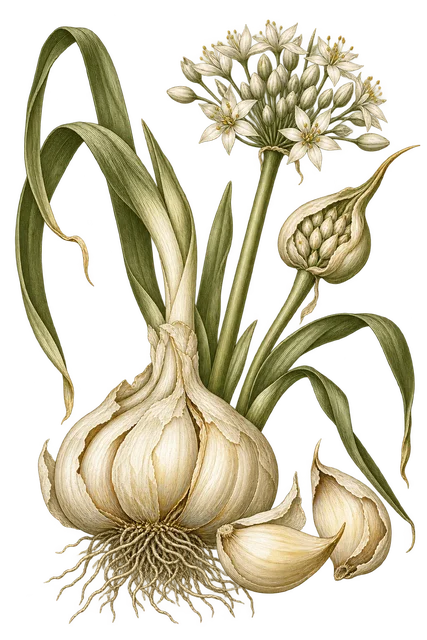
Allium sativum L.; the bulb, divided into cloves, in Amaryllidaceae. Culinary garlic, garlic powder, oils and aged extracts are chemically different materials.
Ingredient details, preparation and research
Source plant or material
Allium sativum L.; bulb/cloves.
Plant family / material: Amaryllidaceae (amaryllis family; Allioideae subfamily).
Forms and route
Fresh/raw or cooked culinary cloves; dried culinary powder; oral powder tablets/capsules, aged garlic extracts, liquid extracts and tinctures; steam-distilled or oil-macerated products. A culinary garlic-infused oil is not the same as distilled garlic oil. Isolated allicin is a separate compound, not a synonym for whole garlic.
Practical preparation
Peel and chop, crush or cook garlic as the recipe calls for. Tissue disruption begins sulfur chemistry; heat and storage change it, so no fixed waiting period can promise a medicinal effect. Use food-grade commercial oils according to their label. For homemade nonacidified garlic-in-oil, refrigerate promptly and use/discard within 4 days, or freeze; a splash of lemon juice is not a validated preservation method.
Combination notes
Garlic works as a culinary seasoning with vegetables, legumes, herbs and oils, but those pairings are not proven absorption enhancers. Taking it with food may be more tolerable for some people; follow the product’s instructions. Combining concentrated “circulation” supplements can complicate bleeding and medication review.
Traditional and reported uses
- Longstanding food use as a pungent flavoring, raw or cooked.
- Historical Egyptian, Greek and Indian sources describe gastrointestinal and throat/respiratory uses; these are traditional attributions, not proof that garlic treats an infection.
- Some oral supplements have been studied for cholesterol, blood pressure and blood sugar. Average effects may be small and are preparation-specific; these products do not replace indicated treatment.
- Laboratory antimicrobial activity of garlic compounds does not establish that eating garlic, swallowing allicin or applying raw cloves cures an infection.
Contraindications and cautions
- Garlic supplements may increase bleeding risk. Review anticoagulants, aspirin/other antiplatelet medicines and planned procedures with the prescribing or surgical team.
- Fresh crushed garlic on skin can cause chemical burns. Keep it off wounds, mucous membranes and skin under dressings; culinary use does not establish topical safety.
- Oral garlic can cause odor, abdominal discomfort, gas, nausea or allergy. More is not necessarily better tolerated.
- Amounts greater than normal food use may be unsafe in pregnancy or breastfeeding; concentrated extracts require separate advice.
- A human study found a substantial interaction between a particular garlic supplement and saquinavir. Other medicines, including glucose- or blood-pressure-lowering treatment, merit product-specific review.
- Homemade garlic-in-oil can support botulism toxin formation. Refrigerate promptly and use or discard within 4 days, or freeze; do not store a homemade nonacidified preparation at room temperature.
- The EMA monograph contraindicates its medicinal garlic preparations with saquinavir/ritonavir because reduced drug exposure could compromise HIV treatment. Ask the HIV treatment team before using a garlic supplement; do not change prescribed treatment.
- The EMA monograph does not recommend its artery-health preparations below age 18 or its cold-symptom extract below age 12. These limits concern the specified medicinal products, not ordinary culinary seasoning.
Similar items and how they compare
- Ginger
Both are pungent food ingredients with digestive/respiratory traditions and concentrated supplement forms.
Garlic uses a sulfur-rich bulb; ginger uses a gingerol-containing rhizome. They are not dose-equivalent.
- Hibiscus
Both have food uses and research concerning cardiovascular risk markers.
Hibiscus usually uses anthocyanin-rich calyces in beverages; garlic preparations center on processing-dependent sulfur compounds.
Practical comparison with related ingredients
Like ginger, garlic can be used for flavor alongside a digestive folk tradition; like hibiscus, selected preparations have been researched for blood-pressure-related outcomes. The parts, compounds and cautions differ. Normal meal pairings do not establish medicinal synergy, and combining concentrated products makes a complete ingredient and medication review more important.
Plague care boundary
No historical plant or material here is established to prevent or cure plague. Suspected plague requires urgent medical assessment and prompt antibiotics.
Entry sources
- NCCIH: Garlic, usefulness and safety
- University of Georgia Extension (2024): Safe handling and storage of infused oils
- Kew: Allium sativum, accepted name and Amaryllidaceae family
- EMA: Garlic assessment and final versus draft document status
- Lawson and Hunsaker (2018): Human allicin bioavailability and bioequivalence from garlic foods and supplements
- Gardner et al. (2007): Raw garlic, garlic powder and aged garlic extract in a 192-person lipid trial
- Ried et al. (2016): AGE at Heart randomized trial of aged garlic extract
- Piscitelli et al. (2002): Garlic supplement interaction with saquinavir in volunteers
- USDA FoodData Central: Raw garlic FDC 169230 and garlic powder FDC 171325, SR Legacy downloadable records
- FDA: Daily Value on the Nutrition and Supplement Facts labels
- Etrat Elahi: Garlic, Encyclopaedia Iranica
- Thomas Asbridge: How Medieval Doctors, Christian and Muslim, Treated the Black Death
- CDC: Clinical Care of Plague
Reference entry 05 · Recorded content review: 2026-10-05 · Review scope and dates