


Key cautions
- Watch for daisy-family (Asteraceae) allergy; avoid the eyes and stop for irritation. Homemade tea is not sterile.
- Check medicinal oral use with medicines. Pregnancy and children’s guidance depends on the exact preparation and route.
- Do not use chamomile full baths with open wounds, large skin injuries, acute skin disease, high fever, severe infection, serious circulatory problems or heart failure. Partial or hip baths also have the wound, skin-disease, fever and infection restrictions. Check a medicinal bath product’s label rather than treating a historical bath use as suitable for everyone.
What’s inside
Flower tea, alcohol-based extracts, distilled essential oil and the water-based distillate, or hydrosol, contain different mixtures. The amounts in a dried flower head cannot simply be assigned to a cup or a skin product.
EMA: German chamomile flower and essential-oil assessment report
Flavonoids and water-soluble compounds
The flowers contain apigenin glycosides and other flavonoids. The EMA assessment also identifies mucilaginous compounds in flower tea. Detecting apigenin in a tea does not establish a sedative dose.
EMA: German chamomile flower and essential-oil assessment report · Human apigenin absorption study including chamomile tea
Aromatic oil and blue colour
Bisabolol and its oxides are among the aromatic-oil constituents. Matricin and related compounds change during steam distillation to form chamazulene, associated with blue chamomile oil. An ordinary flower infusion is a different preparation, not diluted essential oil.
EMA: German chamomile flower and essential-oil assessment report
Other flower constituents
Small amounts of coumarins, including herniarin and umbelliferone, are recorded in the flower assessment. A compound name alone does not establish the effect or safety of a finished preparation.
EMA: German chamomile flower and essential-oil assessment report
Minerals in a brewed-tea benchmark
USDA’s 2015 generic brewed-chamomile record gives a cup as 237 g. Calculating from that record gives the small mineral amounts below; it does not identify German chamomile specifically or a standardized brewing strength. These figures do not describe extracts, essential oil or skin rinses.
- Calcium: about 4.7 mg per cup
- Potassium: about 21 mg per cup
- Manganese: about 0.10 mg per cup
USDA Standard Reference Release 28 (2015): NDB 14545, brewed chamomile tea
Uses in brief

- Traditional: minor digestive cramps, skin or mouth irritation, and a relaxing tea ritual.
- Cosmetic tradition: flower infusion as a hair rinse, especially for blonde-hair appearance; scalp-disease benefits are unproven.
History, folklore and reported uses
Digestive, sleep and menstrual traditions
European flower infusions and extracts were used for bloating, indigestion and stomach or bowel cramps. Berlin’s Botanic Garden also records sleep and menstrual complaints. In pharmacy the dried flower heads are called Matricariae flos; Roman chamomile, Chamaemelum nobile, is a different plant. These uses concern flower preparations rather than essential-oil drops.
EMA: Matricaria flower · Botanischer Garten Berlin: Echte Kamille
Mouth rinses, skin washes and baths
European practice used flower rinses for irritated gums, small mouth sores and throat inflammation, and washes, ointments or baths for minor skin inflammation, superficial wounds and boils. Berlin also records anal and genital-area baths and rinses. The European Medicines Agency treats these as local preparations with their own restrictions, not as indications to drink a stronger tea.
EMA: Matricaria flower · Botanischer Garten Berlin: Echte Kamille · EMA: Matricaria recutita flower, adopted monograph (2015, published 2016)
Classical and Arabic medicine
Historians Alain Touwaide and Emanuela Appetiti describe chamomile in ancient Mediterranean and later Arabic writing. Avicenna (980–1037) discussed swellings, fatigue and headaches within a medical theory based on bodily humours. The older sources describe more than one chamomile, so their accounts cannot all be assigned to today’s German species.
An annual flower crop
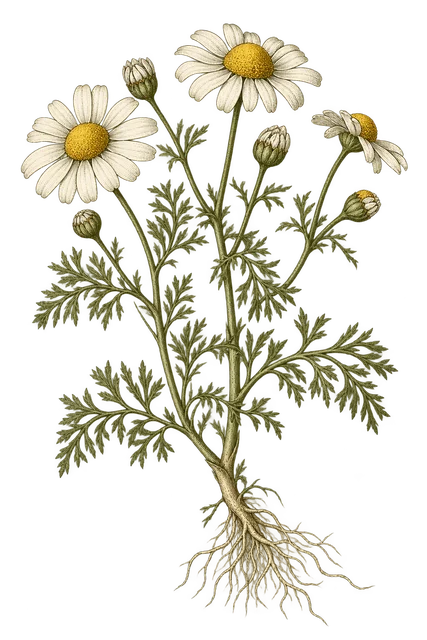
Berlin’s Botanic Garden describes German chamomile as an annual native to southern and eastern Europe and now naturalized across Europe, North America and Australia. The medicinal crop is harvested for its flower heads, rather than treating the stems and leaves as an equivalent material.
A medieval amulet
The same historical account describes a thirteenth-century southern Italian herbal that linked chamomile with eye complaints, prescribed gathering it before sunrise with a prayer, and described wearing it around the neck as an amulet. This preserves a ritual history; it is not a reason to put a nonsterile herbal preparation in the eyes.
Yellow wool and lighter hair
Paolo Maria Guarrera’s 2006 survey records flower heads used to colour wool yellow in the Majella district of Abruzzo, Italy. It also describes concentrated flower preparations used to lighten hair. A 2019 Ancona survey records a similar hair-infusion practice. These are dyeing and cosmetic traditions, not evidence for treating dandruff or hair loss.
Guarrera (2006): Household dyeing plants and traditional uses in some areas of Italy, Table 1 · Lucchetti et al. (2019): Ethnobotanical uses in the Ancona district, Table 1
Flowers around the home and in celebrations
The Ancona survey records chamomile flowers scenting drawers, flavouring liqueurs, and being made into necklaces and bracelets. They also appeared in religious floral displays called infiorate. One elderly informant recalled a Conero-area belief that young boys should not gather the plant. The report preserves that local restriction without presenting it as a universal Italian custom.
Lucchetti et al. (2019): Ethnobotanical uses in the Ancona district, Table 1
Local poultice traditions
Ancona records include flower poultices placed on the forehead for headache and over the eyes for inflammation, alongside flower-infusion uses for digestion, calming and haemorrhoids. The eye application belongs to historical reporting: homemade tea and poultices are not sterile and should be kept out of the eyes.
Lucchetti et al. (2019): Ethnobotanical uses in the Ancona district, Table 1 · FDA: Microbiological safety and cosmetics
Human anxiety research
In 2009, 57 adults with mild-to-moderate generalized anxiety disorder were randomized to a particular oral chamomile extract or placebo for eight weeks. Anxiety scores improved more with the extract, a preliminary finding from a small trial. A later study randomized 93 people who had already responded to an initial course: continued extract produced lower symptom scores, but did not significantly reduce relapse. Neither study establishes an equivalent effect from household tea.
Amsterdam et al. (2009): German-chamomile extract in generalized anxiety disorder · Mao et al. (2016): Continued chamomile extract and anxiety relapse
Human sleep research
A 2011 trial studied a standardized alcohol-and-water extract of chamomile flowering tops in 34 adults with chronic insomnia over 28 days. Sleep-diary measures, including total sleep time and time taken to fall asleep, did not improve significantly more than placebo. A bedtime drink and a tested extract are different preparations, and the traditional sleep use should not be presented as an established insomnia treatment.
Zick et al. (2011): Chamomile extract for chronic primary insomnia
Mouthwash research and mixed-herb products
Small studies of chamomile-containing mouthwashes concern treatment-related mouth irritation in settings such as chemotherapy or radiation care. Other studies use multi-herb products for childhood digestive symptoms. These findings cannot isolate a benefit of chamomile in every mixture or justify replacing clinical care with a home rinse.
What absorption research measured
A 2022 study detected apigenin metabolites after adults drank chamomile tea. This shows uptake and processing of plant compounds, not a demonstrated sleep or digestive benefit. The study does not establish that adding fat improves tea, and oral measurements say nothing about absorption from a scalp rinse.
Preparing tea and cosmetic rinses
Follow the instructions for correctly identified flower tea or a finished skin product. For an occasional household hair rinse, strain and cool the infusion, use it immediately on intact skin or hair, and discard leftovers. Keep it away from eyes and open or weeping skin. Water does not reliably dilute essential oil; do not add undiluted oil to tea, baths or a scalp rinse.
EMA: Matricaria flower · FDA: Microbiological safety and cosmetics · National Capital Poison Center: Essential oils and poisoning risks
Regional reading paths
These sourced notes describe cultivation, trade, food traditions or material history. A regional connection does not claim exclusive origin.
Europe
Traditional processing/use: European dried-flower preparations assessed by EMA.
Dried flower infusions and labelled preparations; allergy precautions remain relevant.
Identity & detailed reference
Identity
Matricaria chamomilla (syn. Matricaria recutita, Chamomilla recutita); flower heads. Roman chamomile is a different species.
Ingredient details, preparation and research
Source plant or material
Matricaria chamomilla (syn. Matricaria recutita); flower heads.
Plant family / material: Asteraceae (daisy family).
Forms and route
Dried flower tea, oral extracts/tinctures, and formulated skin or mouth-rinse preparations. Distilled essential oil and hydrosol (the water portion of distillation) have different compositions; neither is equivalent to flower tea. Follow the product’s intended route.
Traditional and reported uses
- Historical use: medicinal herb documented in ancient Egypt, Greece, Rome and China.
- Traditional European use, recorded by EMA: symptomatic relief of minor digestive complaints such as bloating and mild gut spasms. This rests on long-standing use; reliable clinical evidence remains limited.
- Traditional/reported use: relaxation and sleep; externally, minor skin or mouth irritation. A primary Italian ethnobotanical survey also records flower infusions for lightening hair. These cosmetic traditions do not establish treatment of dandruff, scalp disease or hair loss.
- No established evidence shows that chamomile supplies lactase, breaks down lactose or corrects lactose malabsorption; possible symptom comfort is a different claim.
Contraindications and cautions
- Avoid with known chamomile allergy. Related Asteraceae allergy, including ragweed, increases concern, but not everyone cross-reacts; EMA medicinal preparations contraindicate known family hypersensitivity. Reactions can occasionally be severe. Keep preparations out of the eyes.
- Oral drug-interaction reports include warfarin and medicines handled by liver enzymes; additive sedation is theoretical. EMA specifically notes prolonged high-dose use in renal-transplant patients, but no reported interactions for its local-use routes. Check medicinal oral use with a pharmacist.
- NCCIH notes preliminary estrogen-related concerns with hormone-sensitive conditions and hormonal contraception; these are cautions, not proof of a clinically important effect from an occasional cup of tea.
- Pregnancy advice is preparation-specific: EMA accepts preparations made from finely cut or crushed flowers but not extracts without adequate safety data; NCCIH says pregnancy/breastfeeding safety is insufficiently known overall. Ask the maternity team about medicinal use. Remove topical chamomile from nipples before nursing to avoid infant exposure.
- Consult a clinician if symptoms worsen or persist beyond one week. Children need an age-appropriate product and professional advice; preparations and age limits vary.
- Homemade tea is not sterile. Avoid eye compresses, leave-on stored water mixtures and untreated broken scalp skin. Do not swallow aromatherapy oil or add undiluted essential oil to tea, baths or the scalp.
- Do not use chamomile full baths with open wounds, large skin injuries, acute skin disease, high fever, severe infection, serious circulatory problems or heart failure. Partial or hip baths also have the wound, skin-disease, fever and infection restrictions. Check a medicinal bath product’s label rather than treating a historical bath use as suitable for everyone.
Similar items and how they compare
- Lemon balm
Both are aromatic tea herbs traditionally used for digestive discomfort and relaxation, with flavonoids among their constituents.
Chamomile uses daisy-family flowers; lemon balm uses mint-family leaves with rosmarinic acid.
- Calendula
Both provide daisy-family flowers used in prepared products for minor skin or mouth irritation in European herbal traditions.
Calendula emphasizes triterpenes and topical preparations; chamomile also has a strong tea tradition.
- Roman chamomile
Both are daisy-family flower teas with traditional use for minor digestive symptoms.
Roman chamomile is Chamaemelum nobile and has an ester-rich volatile oil; German chamomile is Matricaria chamomilla/recutita with bisabolol-related volatiles. They have separate monographs and are not interchangeable.
Related ingredients
Calendula shares daisy-family topical tradition but emphasizes different triterpenes and pigments. Roman chamomile has an ester-rich volatile profile and a separate monograph. Lemon balm is a mint-family leaf with its own digestive and calming tradition; these comparisons do not make the herbs interchangeable or demonstrate a synergistic blend.
Entry sources
- NCCIH: Chamomile
- Kew: Matricaria chamomilla
- EMA: Chamomile flower and oil assessment
- Human apigenin absorption study including chamomile tea
- USDA FoodData Central, SR Legacy: Beverages, tea, herb, brewed, chamomile (FDC 174156; official downloadable dataset)
- EMA: German chamomile flower traditional uses and safety
- EMA: Matricaria recutita flower, adopted monograph (2015, published 2016)
- Lucchetti et al. (2019): Original ethnobotanical survey of Ancona district, including German chamomile hair infusion
- FDA: Microbiological safety and cosmetics
- National Capital Poison Center: Essential oils and poisoning risks
- EMA: Calendula officinalis flower assessment report revision 1 (2018)
- EMA: Roman chamomile flower assessment report, including small topical study and safety limitations
- EMA: Melissa leaf, traditional digestive and calming uses
- Guarrera (2006): Household dyeing plants and traditional uses in some areas of Italy, Table 1
- Lucchetti et al. (2019): Ethnobotanical uses in the Ancona district, Table 1
Reference entry 02 · Recorded content review: 2026-10-05 · Review scope and dates