


Key cautions
- Do not eat raw cassava or assume a brief soak, fermentation or household roasting step removes its cyanogenic hazard. Choose properly processed food-grade gari.
- Discard moldy or damp spoiled product. Do not use sour flavor, color or taste to certify cyanide reduction or microbiological safety.
What’s inside
Mostly starch, with fiber and minor nutrients depending on processing. Palm oil, fortification or additional ingredients alter composition; cyanogenic-compound control is a central production issue.
Uses in brief

- Eba
- Dry cassava pantry food
History, folklore and reported uses
History, folklore and traditional uses
Traditional processing: West Africa, including Nigeria and Ghana.
A closer look at its history
A transatlantic processing story
FAO’s history of cassava processing relates West African gari technology to Brazilian farinha de mandioca, describing its introduction by settlers returning from Brazil in the early nineteenth century. Grating, pressing, sieving and roasting turned a perishable root into a granular product that could be stored and traded. The account distinguishes the longer fermentation associated with gari and its sour flavor from the farinha process it describes. This is a documented connection between food technologies, not a claim that every Brazilian cassava meal or West African gari follows one unchanged recipe.
A storable staple built on processing labor
The same FAO report records Nigerian village gari production as women’s work, carried out individually or in groups from lifting and transporting roots through the final roasting. Properly dried granules could be held far longer than fresh roots, then eaten in a liquid preparation or made into a thicker food with soup or stew. A CIRAD account likewise identifies fermentation as integral to flavor and the reduction of cassava’s cyanogenic compounds. These descriptions explain the value of skilled processing; they are not a complete household detoxification procedure or a guarantee that any home ferment is safe.
Additional history reviewed 2026-10-09
Traditional, historical and reported uses
- Eba
Food or household practiceWhy this label?
The source supports the named food, cosmetic or material practice; no treatment effect is inferred and the card’s form and safety limits remain attached.
FAO records gari made into a thick cooked paste called eba. Serve a safely manufactured product as a staple alongside other foods, rather than treating it as a nutritionally complete meal.
- Dry cassava pantry food
Food or household practiceWhy this label?
The source supports the named food, cosmetic or material practice; no treatment effect is inferred and the card’s form and safety limits remain attached.
FAO distinguishes gari’s fermented and roasted character from other cassava products. Dry storage is convenient, but granules remain vulnerable to dampness and poor handling.
2 sourced featured uses; cultural or material records are not clinical efficacy evidence.
Historical-use additions reviewed 2026-10-09
Regional reading paths
These sourced notes describe cultivation, trade, food traditions or material history. A regional connection does not claim exclusive origin.
Africa
Traditional processing: West Africa, including Nigeria and Ghana.
Cassava granules used for eba and other foods; safe processing is essential.
Identity & detailed reference
Identity
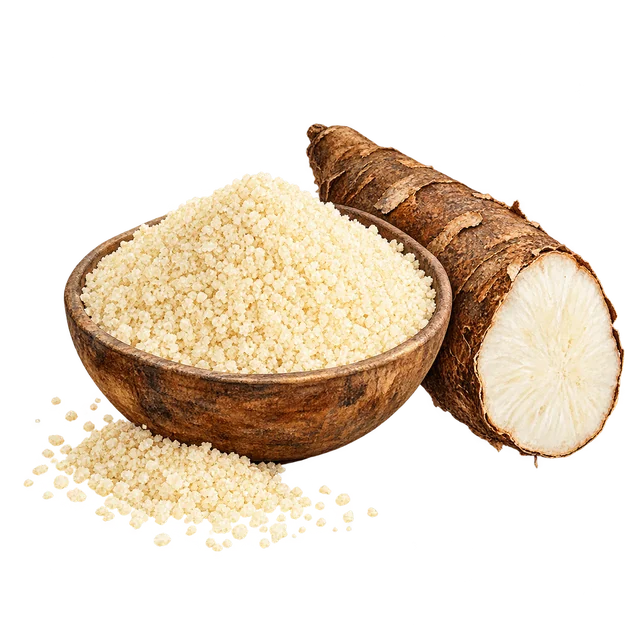
Gari or garri is a processed cassava-root food made through established fermentation, pressing and roasting stages. It is neither raw cassava, pure tapioca starch nor every cassava flour.
Ingredient details, preparation and research
Also known as: Gari; garri
Source plant or material
Fermented and roasted Manihot esculenta root granules
Plant family / material: Euphorbiaceae source plant
Forms and route
Dry prepared granules, including white and palm-oil-colored types, and cooked eba. Ready-to-eat status and preparation instructions depend on the purchased product.
Vitamins and minerals
Gari is a carbohydrate staple with relatively little protein. Fortified gari, yellow gari and plain white gari should not be assigned identical nutrient values.
Absorption and preparation
Processing and starch structure affect digestion, but the glycemic response depends on portion and the accompanying meal. No detoxifying food pairing is established.
Practical preparation
Prepare a reputable finished product according to its label, using safe water and clean utensils. Keep dry granules sealed and protect them from moisture; refrigerate cooked eba appropriately.
Traditional and reported uses
- Eba
- Dry cassava pantry food
Contraindications and cautions
- Do not eat raw cassava or assume a brief soak, fermentation or household roasting step removes its cyanogenic hazard. Choose properly processed food-grade gari.
- Discard moldy or damp spoiled product. Do not use sour flavor, color or taste to certify cyanide reduction or microbiological safety.
Safe processing is the evidence boundary
FAO and IITA describe cassava processing as multiple complementary stages and identify naturally occurring cyanogenic compounds. Those descriptions explain the product, but they are not a validated home detoxification protocol or proof of every vendor’s quality.
Evidence limits
Finished gari only. No raw-root detox recipe, universal cyanide value or claim of probiotic organisms surviving roasting.
Entry sources
- FAO: Traditional processing and utilization of cassava in Africa
- FAO: Roots, tubers, plantains and bananas in human nutrition; cooking and processing
- IITA: Cassava crop profile
Reference entry 316 · Recorded content review: 2026-10-09 · Review scope and dates