


Key cautions
- Serious liver-injury risk; no safe hair-growth dose is established.
- Do not restart after suspected liver injury.
What’s inside
Root constituents include anthraquinones such as emodin and related compounds, and stilbene glycosides. Composition varies with material and processing; constituents do not establish clinical efficacy.
Uses in brief

- Traditional-use and toxicity reference only; not a hair-loss recommendation.
History, folklore and reported uses
History, folklore and traditional uses
Chinese traditional use includes claims concerning graying hair and aging. These historical purposes are different from demonstrating regrowth in a controlled clinical trial.
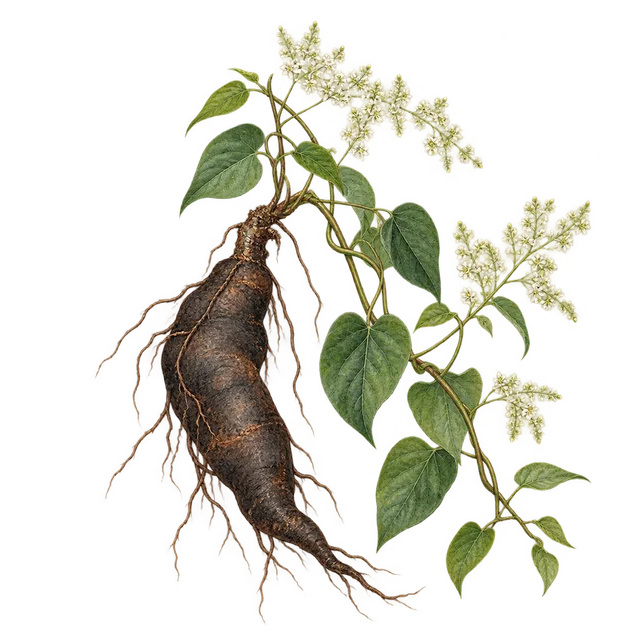
Kew describes a climbing tuberous plant native from China into northern Indo-China and Taiwan. Recognizing the plant does not validate the safety of a finished oral product.
Traditional, historical and reported uses
- Hair-graying tradition
Traditional accountWhy this label?
Historical and safety context only; no hair-regrowth efficacy is inferred.
NIH LiverTox records long-standing use for graying hair and other complaints. The history is preserved as context, not a regrowth claim.
- Root preparations are distinct
Traditional accountWhy this label?
Historical and safety context only; no hair-regrowth efficacy is inferred.
Unprocessed roots, processed preparations and extracts differ. Neither a traditional name nor processing establishes a safe household preparation.
- Modern clinical warning
Mixed/contextual sourcesWhy this label?
Historical and safety context only; no hair-regrowth efficacy is inferred.
A 25-patient hospital series involved several oral preparations, including teas and powders. One patient required transplantation and one died; the series cannot estimate incidence among all users.
Historical claims remain labeled traditional; serious clinical harm is prominent. No recipe, dose, efficacy claim or claim that processing eliminates toxicity is included.
Health topics: evidence and cautions
These notes describe a specific research context and preparation. A topic link is not a treatment recommendation.
Hair loss · Safety reference
Form and route: Oral root preparations, extracts and teas; products and processing differ · oral
Condition and setting: traditional_hair_claims_with_liver_injury_risk
NIH LiverTox describes traditional use and unproven controlled-trial efficacy, alongside numerous reports of clinically apparent liver injury, occasionally severe or fatal.
Evidence: Traditional hair claims; clinically documented liver-injury risk
Root extracts in oral products/teas have traditional hair-graying uses; commercial hair products vary. No established effective hair-loss preparation or dose can be supplied.
Limits
Traditional use is not evidence of effective hair-loss treatment; processing or a natural label does not establish liver safety.
Cautions
- Do not present “processed,” “natural,” or “traditional” as assurance against liver injury. A liver-injury warning must remain prominent; do not supply a preparation recipe or position this as a safe alternative to standard care.
Identity & detailed reference
Identity
The root known as Fo-ti or He Shou Wu belongs to Pleuropterus multiflorus. Kew treats Polygonum multiflorum, Fallopia multiflora and Reynoutria multiflora as synonyms. This is a liver-safety and traditional-use reference.
Ingredient details, preparation and research
Also known as: Fo-ti; Fo Ti; He Shou Wu; Shou Wu Pian; Polygonum multiflorum; Pleuropterus multiflorus; Fallopia multiflora; Reynoutria multiflora
Source plant or material
Pleuropterus multiflorus (Thunb.) Turcz. ex Nakai, commonly reported in medical literature as Polygonum multiflorum Thunb.; tuberous root.
Plant family / material: Polygonaceae
Forms and route
Unprocessed or traditionally processed root preparations, teas, powders and extracts differ. A processing label does not establish safety, and this card supplies no preparation method or dose.
Vitamins and minerals
Not presented as a food or a meaningful nutrient source. No nutrition or daily-intake target is assigned.
Absorption and preparation
Different root products and extraction/processing methods produce different exposures. No human absorption figure or safe therapeutic hair-growth dose is assigned.
Traditional and reported uses
- Historical context for Chinese hair-graying and tonic claims, without endorsing efficacy.
- Safety reference for liver injury linked to oral root preparations.
Contraindications and cautions
- Clinically apparent liver injury can be severe or fatal. Do not self-treat hair loss with this root.
- Raw and processed forms are not interchangeable; processing does not provide a verified guarantee of safety.
- Yellow eyes/skin, dark urine, nausea or upper abdominal pain during use need prompt medical assessment.
- Do not restart after suspected herb-related liver injury.
Case-series evidence
The 2011 series reported 25 suspected cases of herb-induced hepatitis, predominantly hepatocellular injury. Twenty-three recovered; one transplant and one death demonstrate the possible severity, not the population risk rate.
Evidence boundary
LiverTox identifies this herb as a well-established cause of clinically apparent liver injury. Tradition and laboratory findings do not establish a safe or effective hair-loss regimen.
Evidence limits
- Case series cannot establish a safe threshold or quantify the risk for every product.
- Different preparations are not shown to have identical risk; none is certified safe by this record.
- The common medical name Polygonum multiflorum is retained for searchability alongside Kew’s current accepted name.
Entry sources
- Kew: Pleuropterus multiflorus accepted taxon and synonyms
- NIH LiverTox: Polygonum multiflorum
- Jung et al. 2011: 25 cases of acute hepatitis after Polygonum multiflorum
Reference entry 606 · Recorded content review: 2026-10-11 · Review scope and dates