


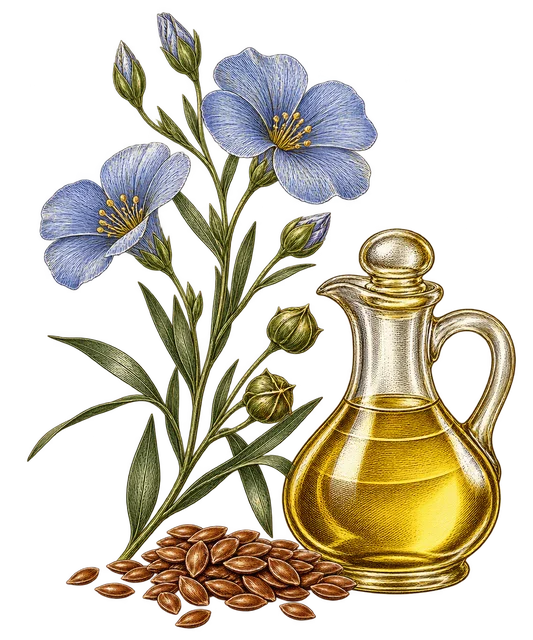
Key cautions
- Use food-grade seed and follow its preparation label. Do not eat unripe or raw flaxseeds; products labeled for cooking must be cooked. Large quantities of untreated ground seed are not a harmless fiber challenge.
- Take swelling seed or medicinal mucilage preparations with adequate fluid. Avoid self-treatment if you have swallowing difficulty, bowel narrowing or obstruction.
What’s inside
Seed oil rich in alpha-linolenic acid (ALA); fiber and mucilage; lignans including secoisolariciresinol diglucoside; protein and minerals. Seeds contain cyanogenic glycosides. Oil does not supply the seed’s fiber.
Uses in brief

- Food-grade ground seed in appropriately prepared cooked or baked foods as a source of fiber and ALA.
- A distinct documented linseed-medicine tradition for constipation and mild gut discomfort, using labeled preparations rather than improvised dosing.
In the King James Bible
In the King James Bible
Source plant or material; different preparation
Exodus 9:31 names flax as a crop, and Joshua 2:6 names its stalks on Rahab’s roof. These establish the source plant and fiber context. They do not explicitly describe eating flaxseed or drinking flaxseed/linseed oil; the modern food information below is independently sourced.
And the flax and the barley was smitten: for the barley was in the ear, and the flax was bolled.
Exodus 9:31 (KJV)
But she had brought them up to the roof of the house, and hid them with the stalks of flax, which she had laid in order upon the roof.
Joshua 2:6 (KJV)
Scripture and identification sources
Words & their stories
WORDS & THEIR STORIES
The name behind the KJV
Biblical Hebrew · Exodus 9:31 (KJV)
וְהַפִּשְׁתָּהwəhappištāh
“And the flax,” the crop damaged by hail.
Dictionary form: פִּשְׁתָּה · pištāh
The attached elements mean “and the”; the noun names the growing crop.
Biblical Hebrew · Joshua 2:6 (KJV)
בְּפִשְׁתֵּיbəpištē
“With flax,” in the phrase describing the stalks on Rahab’s roof.
Dictionary form: פֵּשֶׁת · pēšet
The preposition is attached to a plural construct form. BDB gives a reconstructed dictionary form pēšet for flax or linen; the following “of wood” specifies the stalks.
What the language reveals
Crop and gathered stalks
Exodus concerns a crop in the field, while Joshua describes stalks already arranged on a roof.
A textile word has a wider range
The second noun can name flax material or linen in other contexts. Here the accompanying word for wood or stalk keeps the reference to the plant material.
These passages establish flax as a source plant and stalk material. They do not explicitly describe eating flaxseed or using food-grade or industrial linseed oil.
History, folklore and reported uses
History, folklore and traditional uses
Flax has two intertwined stories: the seed in food and the long stem fibers made into linen. Scripture makes the second connection especially tangible. Exodus mentions the damaged crop, and Joshua describes stalks laid on Rahab’s roof. Those are direct references to the plant, but they do not state that anyone ate flaxseed. The crop’s ability to provide fiber as well as food helps explain why its history belongs in a food collection with an explicit source-plant label.
Later records show seed preparations crossing between kitchen and medicine. NCCIH describes Ethiopian stews, Greek laxative use and poultices made by European settlers in North America. European linseed medicines still distinguish a bulk-forming constipation use from traditional soothing preparations for mild gastrointestinal discomfort. Today’s spoonful of ground seed, a bottle of culinary oil, and an industrial oil for wood or paint are different materials. Respecting those differences preserves the heritage without treating every flax product as the same remedy.
A closer look at its history
From stalk to linen
At seventeenth-century Jamestown, flax joined silk, wine and glass among the Virginia Company’s proposed alternatives to tobacco. Linen never became the hoped-for major cash crop, but households continued growing flax. Separating its fibers required retting, breaking, scutching and combing before spinning, making cloth a labor-intensive product quite distinct from the seed.
A named seed-food tradition
CFIA’s historical account records northern Indian tisi or alsi: flaxseed roasted, powdered and eaten with boiled rice, water and salt. This gives the seed its own culinary history alongside the better-known linen story.
Additional history reviewed 2026-10-09
Traditional, historical and reported uses
- Seed as a food ingredient
Food or household practiceWhy this label?
Flaxseed used as an ingredient in Ethiopian stews.
NCCIH records flaxseed used in Ethiopian stews. This is a culinary seed tradition, separately sourced from the biblical references to the crop and stalks.
- Linen, clothing and household fiber
Food or household practiceWhy this label?
Stem fibre processed into linen textiles.
The flax stem supplies the fibers from which linen is made. ODU’s Bible-plant account discusses retting and the textile connection, helping explain the stalks on Rahab’s roof.
- Bulk-forming constipation medicines
Mixed/contextual sourcesWhy this label?
Regulatory medicinal-use context for constipation, without a specific research claim.
Linseed has a longstanding laxative history. EMA recognizes well-established medicinal use for habitual constipation through seed swelling and stool softening; this applies to suitable preparations and their directions.
- Soothing preparations for mild gut discomfort
Traditional accountWhy this label?
Explicit traditional-use category for medicinal mucilage preparations.
EMA recognizes a separate traditional-use category for mild gastrointestinal discomfort. Mucilage preparations have their own form and rationale rather than simply being a bottle of seed oil.
- Historical external poultices
Traditional accountWhy this label?
Settler poultice practice is the claim; regulatory limitations supply context.
NCCIH records North American settler use of flaxseed poultices for cuts and burns. EMA’s assessment did not establish sufficient support for a skin-poultice indication; this remains historical context, not recommended wound care.
- Drying oil in paints and varnishes
Food or household practiceWhy this label?
Drying oil used in paint and varnish manufacture.
Oil extracted from flaxseed has a recorded industrial role in paints and varnishes because of its drying properties. This concerns prepared linseed-oil materials; artists’ and industrial products are separate from culinary flaxseed oil.
- Linoleum for household floors
Food or household practiceWhy this label?
Linseed oil used to manufacture household flooring.
The Canadian Food Inspection Agency lists linseed oil among the materials used to make linoleum. This household-material role is separate from weaving the stem into linen and from eating flaxseed.
Historical-use additions reviewed 2026-10-08
Story sources
- Lytton John Musselman, Old Dominion University: Flax
- NCCIH: Flaxseed and Flaxseed Oil
- European Medicines Agency: Lini semen, linseed
- EMA: Assessment report on Linum usitatissimum L., semen
- King James Bible: Project Gutenberg eBook 10
- Canadian Food Inspection Agency: The Biology of Linum usitatissimum L. (Flax), section 4.3.4.3
Growing notes
Linum usitatissimum L.; seed-producing linseed cultivars, rather than ornamental perennial flax.
- Climate and planting
- Cool-season annual. Sow early in the locally suitable cool growing season into a firm, moist seedbed; avoid delaying flowering into heat. Emerging seedlings tolerate light frost. [1]
- Habit and cultivar
- Linseed types are shorter and more branched than linen-fiber types. Choose a locally adapted seed cultivar; seed flax commonly reaches 20–30 inches. [2] [1]
- Sun and soil
- Full sun. Use well-drained soil; CFIA reports good performance around pH 5.5–7.0. Avoid saline, persistently wet or drought-prone ground. [3] [2] [1]
- Water
- Keep the seedbed moist for establishment. Both drought and waterlogging reduce crop performance; rainfall and soil determine supplemental watering. [1] [2]
- Nutrition
- Use soil tests and previous-crop nutrient credits. Excess nitrogen encourages lodging and disease; do not add phosphorus routinely. Correct documented potassium or zinc shortages. [4]
- Harvest
- Usually about 90–125 days, varying with climate and cultivar. Harvest when roughly 90% of capsules are brown; stems can still be green. [2] [1]
- Pollination
- Predominantly self-pollinating; a second cultivar or managed bees are not normally needed for seed set. [2]
- Pests and rotation
- Control weeds early. Watch for cutworms, grasshoppers, wilt, rust and pasmo. Use resistant, clean seed and avoid repeating flax more often than once in three years. [1]
- Food caution
- NCCIH advises against eating raw or unripe flaxseed because of potentially toxic compounds. [5]
Growing sources and regional guidance
- NDSU Extension: Flax Production for Oil and Seed in North Dakota, revised September 2026
- Canadian Food Inspection Agency: The Biology of Linum usitatissimum L. (Flax)
- NC State Extension Gardener Plant Toolbox: Common Flax
- NDSU Extension: Fertilizing Flax, reviewed November 2022
- NCCIH: Flaxseed and Flaxseed Oil, updated February 2025
- National Park Service: Flax Production in the Seventeenth Century
Growing notes reviewed 2026-10-09
Women’s Health: traditions, evidence and cautions
Historical use does not establish benefit or safety. Pregnancy, breastfeeding and fertility care require particular caution: food, tea, essential oil and concentrated extract are not interchangeable. These records are not treatment, dosing or pregnancy-management instructions. Discuss supplements with a qualified clinician or pharmacist; do not delay evaluation of persistent symptoms.
Flax / linseed
Linum usitatissimum
- Plant part / material
- seed; oil is separate
- Preparation studied or reported
- ground seed or lignan preparations in studies; oil is not equivalent
Flax carries a food-and-material history: cultivation near the Middle East, Egyptian linen, Ethiopian stews and Greek laxative use. Its seed lignans led to modern menopause research; this is distinct from claiming a longstanding menopause treatment.
menopause
inconsistent clinical evidence
Reported or traditional useModern use for hot flashes, alongside older food, fiber and laxative traditions.
What the evidence supportsHot-flash findings conflict; some trials found no advantage over placebo. Seed, lignan extract and oil have different constituent profiles.
Medicinal pregnancy safety is uncertain and some findings suggest risk; lactation evidence is limited. Concentrated products may cause gastrointestinal effects or interact with medicines.
- Medicinal pregnancy safety is uncertain and some findings suggest risk; lactation evidence is limited. Concentrated products may cause gastrointestinal effects or interact with medicines.
Health topics: evidence and cautions
These notes describe a specific research context and preparation. A topic link is not a treatment recommendation.
Cardiovascular health · Risk reduction
Form and route: Food-grade whole or ground seed, prepared as labeled · oral
Flaxseed may modestly improve cholesterol.
Evidence: limited_to_moderate_risk_factor_evidence
NCCIH distinguishes favorable seed findings from flaxseed oil, which does not show the same cholesterol effect.
Limits
No demonstrated replacement for cholesterol medicine or proof of fewer heart attacks.
Cautions
- Can cause bloating or diarrhea; review medicines and use food-grade products.
Colon and bowel health · Traditional reports
Form and route: Ground seeds · oral
A West Bank survey reported use for colon cancer.
Evidence: Ethnobotanical report only
This records practitioners’ reports, not patient outcomes.
Limits
The source also names breast and ovarian cancer. It does not establish diagnosis, benefit or safe treatment.
Cautions
- Do not replace oncology care.
Regional reading paths
These sourced notes describe cultivation, trade, food traditions or material history. A regional connection does not claim exclusive origin.
Europe
Cultivated and traditional processing/use: European flaxseed preparations assessed by EMA.
Food-grade seeds used in foods; industrial boiled linseed oil is not edible.
North America
Introduced/cultivated: Canada and United States.
Food-grade seeds used in grain foods; industrial linseed products are separate.
Identity & detailed reference
Identity
The edible mature seeds of the flax plant, separate from its linen-producing stem fibers. The KJV names the crop and stalks, not eating the seeds. Food-grade flaxseed oil and industrial linseed oil are also different products.
Ingredient details, preparation and research
Also known as: Flaxseed; Linseed; Flax (the source plant)
Source plant or material
Linum usitatissimum L.; The edible mature seeds of the flax plant, separate from its linen-producing stem fibers. The KJV names the crop and stalks, not eating the seeds. Food-grade flaxseed oil and industrial linseed oil are also different products.
Plant family / material: Linaceae (flax family)
Forms and route
Food-grade mature whole or ground seed used according to preparation directions, including cooked or baked foods; separate food-grade oil. Medicinal bulk-forming seed preparations, isolated lignans and mucilage products are not interchangeable.
Vitamins and minerals
Modern ingredient reference: 1 tablespoon ground flaxseed, about 7 g, supplies approximately 37 kcal, 1.3 g protein, 3.0 g fat, 1.9 g fiber and 27 mg magnesium; USDA reports about 1.6 g 18:3 fatty acids in this portion, predominantly ALA. USDA SR28 NDB 12220 gives 1 tablespoon ground = 7 g and 1 tablespoon whole = 10.3 g (pages 294–296). The comparison describes the seed ingredient before adding it to a safely prepared recipe, not a recommendation to eat it raw. Flax oil has no comparable fiber serving and cannot use this panel.
Absorption and preparation
Grinding makes the seed’s oil more accessible: a human comparison found better ALA availability from milled seed or oil than from whole seed. Use the prepared ground seed in moist cooked food and maintain normal fluid intake. There is no demonstrated need to combine it with a special juice, spice or oil. ALA is a plant omega-3 and should not be described as nutritionally identical to EPA/DHA; the seed’s fiber does not transfer to flax oil.
Traditional and reported uses
- Food-grade ground seed in appropriately prepared cooked or baked foods as a source of fiber and ALA.
- A distinct documented linseed-medicine tradition for constipation and mild gut discomfort, using labeled preparations rather than improvised dosing.
Contraindications and cautions
- Use food-grade seed and follow its preparation label. Do not eat unripe or raw flaxseeds; products labeled for cooking must be cooked. Large quantities of untreated ground seed are not a harmless fiber challenge.
- Take swelling seed or medicinal mucilage preparations with adequate fluid. Avoid self-treatment if you have swallowing difficulty, bowel narrowing or obstruction.
- For medicinal or supplement use, check with a clinician if you take medicines, especially anticoagulant or antiplatelet drugs, or are pregnant or breastfeeding.
- Never ingest hardware-store or boiled linseed oil. Oil is not nutritionally interchangeable with the whole or ground seed.
- Stop if an allergic reaction occurs. Persistent constipation, rectal bleeding or a sudden continuing change in bowel habit needs medical assessment.
Similar items and how they compare
- Wheat
Both crops appear in ancient agriculture and contribute to food traditions.
Flax is an oilseed and fiber plant; wheat is a starchy cereal and contains gluten.
- Olives (fruit)
Both can be discussed as foods and as sources of separately processed oils.
An extracted oil does not keep the whole food’s fiber or its full nutrient profile.
Source plant versus food form
The biblical passages identify Linum usitatissimum as crop or stalk material. The edible-seed discussion is supported independently and should not be presented as a biblical nutrition recommendation. Linen fiber and expressed oil cannot inherit the ground seed’s nutrient profile.
Seed, oil and medicinal products
Ground seed contributes fiber, whereas oil does not. Trials or monographs of mucilage, lignans, oil or bulk-forming seed products should not be generalized across all flax preparations.
Food preparation and cyanogenic compounds
Flaxseed contains cyanogenic glycosides. NCCIH advises against eating raw or unripe flaxseed; BfR emphasizes moderate adult quantities and preparation warnings. This card uses a small ingredient comparison, not a maximum safe dose or a raw-seed protocol.
Medicinal-use cautions
A swelling seed preparation needs adequate liquid and is unsuitable for swallowing problems or bowel obstruction. EMA’s constipation and mild-gut-discomfort categories are separate from a general daily supplement recommendation.
Food portion and nutrition
Modern ingredient reference: 1 tablespoon ground flaxseed, about 7 g, supplies approximately 37 kcal, 1.3 g protein, 3.0 g fat, 1.9 g fiber and 27 mg magnesium; USDA reports about 1.6 g 18:3 fatty acids in this portion, predominantly ALA. USDA SR28 NDB 12220 gives 1 tablespoon ground = 7 g and 1 tablespoon whole = 10.3 g (pages 294–296). The comparison describes the seed ingredient before adding it to a safely prepared recipe, not a recommendation to eat it raw. Flax oil has no comparable fiber serving and cannot use this panel.
Preparation and meal pairing
Grinding makes the seed’s oil more accessible: a human comparison found better ALA availability from milled seed or oil than from whole seed. Use the prepared ground seed in moist cooked food and maintain normal fluid intake. There is no demonstrated need to combine it with a special juice, spice or oil. ALA is a plant omega-3 and should not be described as nutritionally identical to EPA/DHA; the seed’s fiber does not transfer to flax oil.
Evidence limits
- No biblical seed-eating claim is made.
- Nutrient values are a modern seed-ingredient comparison and not values for oil, mucilage or linen.
- Medicinal doses and concentrated supplements require product-specific guidance.
Entry sources
- Rustins: Boiled Linseed Oil product label, 2024
- Lytton John Musselman, Old Dominion University: Flax
- NCCIH: Flaxseed and Flaxseed Oil
- European Medicines Agency: Lini semen, linseed
- EMA: Assessment report on Linum usitatissimum L., semen
- German Federal Institute for Risk Assessment: Acute food poisoning, possible causes and prevention
- USDA Standard Reference 28 (2015): nut and seed products, food group 12
- Austria et al. (2008): Bioavailability of alpha-linolenic acid after ingestion of three different forms of flaxseed
- King James Bible: Project Gutenberg eBook 10
- Canadian Food Inspection Agency: The Biology of Linum usitatissimum L. (Flax), section 4.3.4.3
Reference entry 160 · Recorded content review: 2026-10-06 · Review scope and dates