


Key cautions
- Use properly cleaned food-grade grain; tiny grains can retain grit if poorly processed. Follow the packet’s preparation directions rather than assuming every product is prewashed.
- If strict gluten avoidance is needed, check cross-contact controls and blends.
What’s inside
Mainly starch with cereal protein and variable fiber and minerals. Removing hull and bran changes the food, so unprocessed grain analyses do not describe every retail packet.
Uses in brief

- Steamed or cooked grain
- Porridge and flour foods
History, folklore and reported uses
History, folklore and traditional uses
Native/cultivated: West Africa, including Guinea, Mali and Nigeria.
A closer look at its history
Two fonios, two domestication histories
White fonio and black fonio share a food name, but a 2025 study of 265 cultivated and wild accessions found two independent domestication histories. CIRAD’s account of the research emphasizes their genetic separation despite similar appearance and uses. This is a stronger basis for explaining the crop’s past than repeating a precise but unsupported age for the “oldest African cereal.” White fonio is more widely distributed, while black fonio has a more restricted West African cultivation history; preserving both matters to understanding the farmers’ selections behind the grain.
Prestige foods and a demanding small grain
The 1996 National Research Council account challenges the dismissive English name hungry rice: fonio could be a prized food and a special-occasion crop as well as an early harvest bridging a food gap. It records wusu-wusu couscous in Hausa-speaking areas of Nigeria and Benin, tchapalo beer among Lamba communities in northern Togo, and fonio with beans for special occasions among Akposso and Akebou communities. Tiny seeds required laborious dehulling and careful removal of grit. Beyond the kitchen, chopped straw was mixed into clay for walls, showing how the harvest supplied building material too.
Additional history reviewed 2026-10-09
Traditional, historical and reported uses
- Steamed or cooked grain
Food or household practiceWhy this label?
The source supports the named food, cosmetic or material practice; no treatment effect is inferred and the card’s form and safety limits remain attached.
The National Research Council describes fonio in couscous-like preparations. Properly cleaned culinary grain supplies a light-textured starch component, with the overall meal determined by accompaniments.
- Porridge and flour foods
Food or household practiceWhy this label?
The source supports the named food, cosmetic or material practice; no treatment effect is inferred and the card’s form and safety limits remain attached.
The crop chapter and Mali-focused research document fonio as a staple ingredient. Thin porridge, flour and cooked whole grain differ in water and nutrient density.
2 sourced featured uses; cultural or material records are not clinical efficacy evidence.
Historical-use additions reviewed 2026-10-09
Regional reading paths
These sourced notes describe cultivation, trade, food traditions or material history. A regional connection does not claim exclusive origin.
Africa
Native/cultivated: West Africa, including Guinea, Mali and Nigeria.
Small cereal grain cooked in porridge and couscous-like dishes.
Identity & detailed reference
Identity
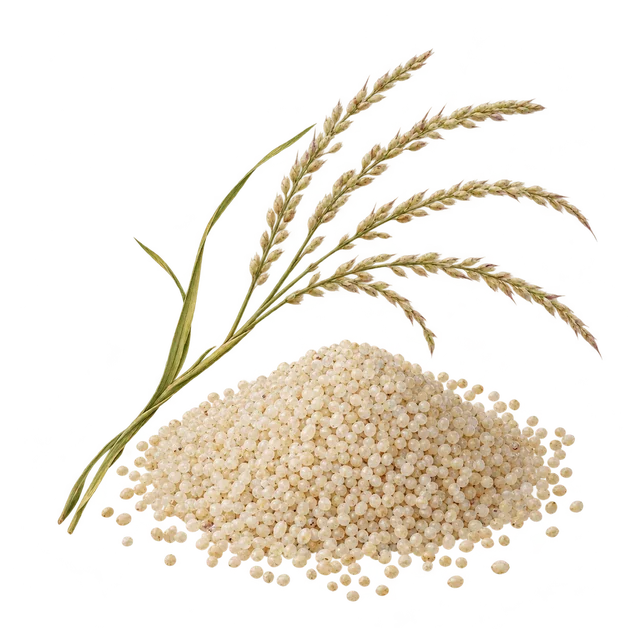
Fonio is a small West African cereal, chiefly white fonio, Digitaria exilis. Black fonio, D. iburua, is a related cultivated crop; neither is rice despite the common name hungry rice.
Ingredient details, preparation and research
Source plant or material
Digitaria exilis; D. iburua is a related cultivated fonio
Plant family / material: Poaceae
Forms and route
Cleaned, dehulled grain, precooked grain, flour and cooked dishes. The degree of polishing and ready-to-cook processing matters more than a generic ancient-grain claim.
Vitamins and minerals
Fonio supplies carbohydrate and some protein; it is not a complete diet. Polishing, washing and dilution influence mineral contribution, and generic superiority over other grains is not established here.
Absorption and preparation
The food matrix and phytate influence mineral availability. A nutrient-content result is not a direct measure of absorption, and no special pairing is required to enjoy fonio.
Practical preparation
Choose a reliable cleaned product and cook as directed, allowing for whether it is precooked. Keep dry grain sealed and refrigerate prepared leftovers promptly.
Traditional and reported uses
- Steamed or cooked grain
- Porridge and flour foods
Contraindications and cautions
- Use properly cleaned food-grade grain; tiny grains can retain grit if poorly processed. Follow the packet’s preparation directions rather than assuming every product is prewashed.
- If strict gluten avoidance is needed, check cross-contact controls and blends.
Traditional-food assessment has a bounded scope
The UK assessment paper concerns a specified Digitaria exilis food product and history of use. That does not automatically authorize every species, extract, processing method or medical claim carrying the fonio name.
Evidence limits
Food-use and identity review, without a therapeutic diet prescription, production ranking or universal nutrient value.
Entry sources
- National Research Council, Lost Crops of Africa: Fonio
- Wageningen University: Fonio as a staple food, food-consumption and nutrition research
- UK ACNFP: Digitaria exilis traditional-food assessment paper
Reference entry 320 · Recorded content review: 2026-10-09 · Review scope and dates