


Key cautions
- Avoid with known pea allergy; assess the entire formulation and other allergens.
What’s inside
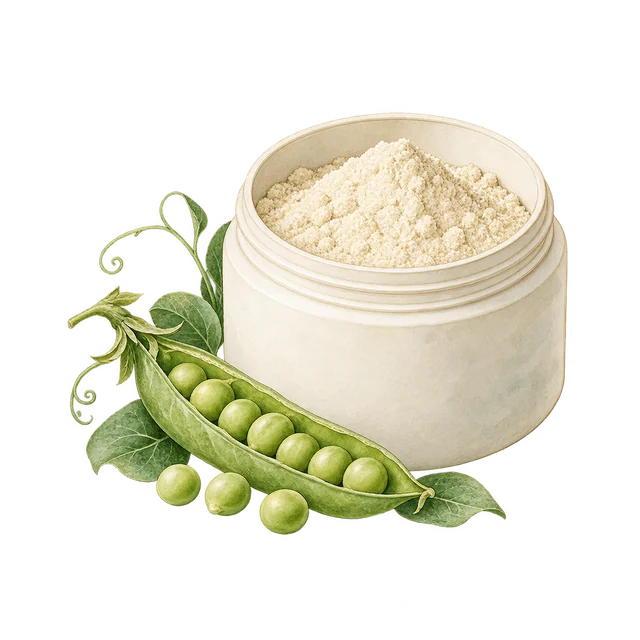
Concentrated pea protein and amino acids; the studied NUTRALYS isolate is distinct from whole peas.
Uses in brief

- Pea protein isolate is a practical protein source. One training trial suggested a muscle-thickness benefit in initially weaker men, but the overall between-group result was not significant.
History, folklore and reported uses
History, folklore and traditional uses
The 2015 trial gives a concrete example of how an edible pea becomes a concentrated protein ingredient. Its yellow peas were milled, mixed with water, and separated into starch, fiber and protein fractions; the protein fraction was purified and spray-dried. The resulting isolate was then incorporated into flavored research drinks.
That processing removes the whole seed’s original balance of components. It is why the isolate, pea flour, cooked peas and edible pea pods need separate descriptions, even when they share a crop name.
Traditional, historical and reported uses
- A manufactured protein-drink ingredient
Human researchWhy this label?
Identifies the source-supported production, formulation or dated research context; no additional therapeutic effect is inferred.
The researchers incorporated their specified yellow-pea isolate into flavored drinks. The primary paper describes the fractionation and drying process, not a home recipe or a serving of whole peas.
Source-backed material history, manufacturing or food-use context is separated from efficacy evidence; no additional uses are invented.
Health topics: evidence and cautions
These notes describe a specific research context and preparation. A topic link is not a treatment recommendation.
Muscle mass · Support during care
Form and route: Oral yellow-pea protein isolate (NUTRALYS), 25 g twice daily, in drinks; 12 weeks. · oral
Condition and setting: Protein provision during resistance training in young men
Pea protein isolate is a practical protein source. One training trial suggested a muscle-thickness benefit in initially weaker men, but the overall between-group result was not significant.
Evidence: Limited resistance-training evidence; subgroup result
Babault et al. 2015: 161 healthy men aged 18–35, without recent strength-building training, randomized to pea, whey, or maltodextrin placebo with upper-body training three times weekly. Overall thickness comparisons only trended toward a group difference (p=0.09). In the initially weaker subgroup, biceps thickness rose 20.2% with pea versus 8.6% with placebo. Strength improvements did not differ by group.
Limits
Subgroup evidence should not become a blanket hypertrophy claim. Pea powder is not nutritionally interchangeable with a serving of green peas.
Cautions
- Avoid with known pea allergy; assess the entire formulation and other allergens.
Identity & detailed reference
Identity
Protein isolated from yellow-pea seed (Pisum sativum).
Ingredient details, preparation and research
Source plant or material
Protein isolated from yellow-pea seed (Pisum sativum).
Plant family / material: Fabaceae (source pea).
Forms and route
Studied oral preparation: Oral yellow-pea protein isolate (NUTRALYS), 25 g twice daily, in drinks; 12 weeks. Research exposure only; this is not a recommended dose or personal regimen.
Vitamins and minerals
This is a preparation-specific supplement reference. No generic food serving, Daily Value badge, or nutrient quantity is assigned; the label and study preparation must be checked.
Absorption and preparation
No special food pairing or absorption-enhancement recipe is established here. Trial findings apply to the specified oral material and cannot be transferred to a tea, whole food or different supplement blend.
Traditional and reported uses
- Pea protein isolate is a practical protein source. One training trial suggested a muscle-thickness benefit in initially weaker men, but the overall between-group result was not significant.
Contraindications and cautions
- Avoid with known pea allergy; assess the entire formulation and other allergens.
Population, preparation and outcome
Babault et al. 2015: 161 healthy men aged 18–35, without recent strength-building training, randomized to pea, whey, or maltodextrin placebo with upper-body training three times weekly. Overall thickness comparisons only trended toward a group difference (p=0.09). In the initially weaker subgroup, biceps thickness rose 20.2% with pea versus 8.6% with placebo. Strength improvements did not differ by group.
What the result does not establish
Subgroup evidence should not become a blanket hypertrophy claim. Pea powder is not nutritionally interchangeable with a serving of green peas.
Preparation and safety boundaries
Avoid with known pea allergy; assess the entire formulation and other allergens.
Evidence limits
- Subgroup evidence should not become a blanket hypertrophy claim. Pea powder is not nutritionally interchangeable with a serving of green peas.
- Focused educational review, not a systematic review or a personal supplement plan.
Entry sources
Reference entry 601 · Recorded content review: 2026-10-11 · Review scope and dates