


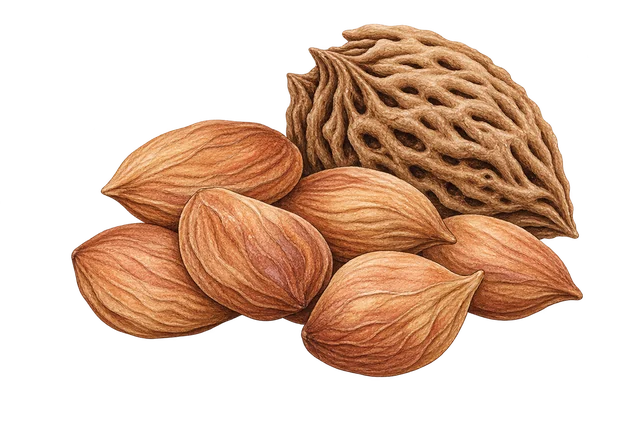
Key cautions
- Safety-only historical reference, not a home-use suggestion.
- Kernel toxicity is different from the food safety of peach flesh.
- Do not chew, grind or prepare peach pits as a reproductive remedy.
What’s inside
Peach seed kernels contain cyanogenic glycosides that can release cyanide. Kernel chemistry is distinct from peach flesh and cannot be neutralized by assuming a household preparation is safe.
Uses in brief

- Historical reference only; cyanogenic kernels are not a home remedy.
History, folklore and reported uses
History, folklore and traditional uses
Tao ren is a seed medicine in Chinese materia medica, recorded for painful or absent periods under traditional blood-stasis concepts. Eating peach fruit does not reproduce this use.
Traditional, historical and reported uses
- menstruation
Traditional accountWhy this label?
The cited traditional record documents use, not clinical efficacy. No benefit for this single ingredient can be established from that source; multi-herb formula findings cannot be assigned to it.
Historical use for amenorrhea and dysmenorrhea. The cited traditional record documents use, not clinical efficacy. No benefit for this single ingredient can be established from that source; multi-herb formula findings cannot be assigned to it.
- Other recorded traditional aims
Historical recordWhy this label?
HKBU describes constipation and injury-related uses in addition to menstrual complaints. These are historical materia-medica claims, not recommended self-care uses or clinical proof.
HKBU describes constipation and injury-related uses in addition to menstrual complaints. These are historical materia-medica claims, not recommended self-care uses or clinical proof.
Coverage reflects verified sources, without a minimum use quota.
Women’s Health: traditions, evidence and cautions
Historical use does not establish benefit or safety. Pregnancy, breastfeeding and fertility care require particular caution: food, tea, essential oil and concentrated extract are not interchangeable. These records are not treatment, dosing or pregnancy-management instructions. Discuss supplements with a qualified clinician or pharmacist; do not delay evaluation of persistent symptoms.
Peach kernel / tao ren
Prunus persica (L.) Batsch; pharmacopoeial material may also be Prunus davidiana (Carrière) Franch.
- Plant part / material
- Dried mature seed kernel (Persicae Semen)
- Preparation studied or reported
- Professionally identified medicinal seed material in compound preparations; not edible peach flesh or a home-prepared pit remedy.
Persicae Semen safety/history reference. HKBU names both Prunus persica and Prunus davidiana as pharmaceutical sources; preserve this defined multi-source drug identity, and never describe every sample as authenticated P. persica. No home-use instructions.
Tao ren is a seed medicine in Chinese materia medica, recorded for painful or absent periods under traditional blood-stasis concepts. Eating peach fruit does not reproduce this use.
menstruation
Traditional account
Reported or traditional useHistorical use for amenorrhea and dysmenorrhea. The cited traditional record documents use, not clinical efficacy. No benefit for this single ingredient can be established from that source; multi-herb formula findings cannot be assigned to it.
What the evidence supportsThe cited traditional record documents use, not clinical efficacy. No benefit for this single ingredient can be established from that source; multi-herb formula findings cannot be assigned to it.
Safety-only historical reference, not a home-use suggestion. Kernel toxicity is different from the food safety of peach flesh. Do not chew, grind or prepare peach pits as a reproductive remedy. Avoid medicinal pregnancy/breastfeeding use. Possible kernel poisoning requires urgent poison-control or emergency advice.
Other recorded traditional aims
Historical record
Reported or traditional useHKBU describes constipation and injury-related uses in addition to menstrual complaints. These are historical materia-medica claims, not recommended self-care uses or clinical proof.
What the evidence supportsHKBU describes constipation and injury-related uses in addition to menstrual complaints. These are historical materia-medica claims, not recommended self-care uses or clinical proof.
Safety-only historical reference, not a home-use suggestion. Kernel toxicity is different from the food safety of peach flesh. Do not chew, grind or prepare peach pits as a reproductive remedy. Avoid medicinal pregnancy/breastfeeding use. Possible kernel poisoning requires urgent poison-control or emergency advice.
Persicae Semen safety/history reference. HKBU names both Prunus persica and Prunus davidiana as pharmaceutical sources; preserve this defined multi-source drug identity, and never describe every sample as authenticated P. persica. No home-use instructions.
- Safety-only historical reference, not a home-use suggestion.
- Kernel toxicity is different from the food safety of peach flesh.
- Do not chew, grind or prepare peach pits as a reproductive remedy.
- Avoid medicinal pregnancy/breastfeeding use.
- Possible kernel poisoning requires urgent poison-control or emergency advice.
Read the complete historical reference and its material distinctions
Identity & detailed reference
Identity
Prunus persica (L.) Batsch; pharmacopoeial material may also be Prunus davidiana (Carrière) Franch.; Dried mature seed kernel (Persicae Semen).
Ingredient details, preparation and research
Also known as: tao ren; Persicae Semen; peach seed kernel
Source plant or material
Prunus persica (L.) Batsch; pharmacopoeial material may also be Prunus davidiana (Carrière) Franch. — Dried mature seed kernel (Persicae Semen)
Plant family / material: Rosaceae (rose family)
Forms and route
Professionally identified medicinal seed material in compound preparations; not edible peach flesh or a home-prepared pit remedy.
Vitamins and minerals
No nutrient quantities or daily-value claims are assigned to this medicinal material. Do not borrow the food nutrient profile of another plant part or use an extract as a dietary substitute.
Absorption and preparation
Safety/history reference only. No preparation, dosing, extraction, absorption-enhancement or home detoxification instructions are provided.
Traditional and reported uses
- Historical use for amenorrhea and dysmenorrhea. The cited traditional record documents use, not clinical efficacy. No benefit for this single ingredient can be established from that source; multi-herb formula findings cannot be assigned to it.
- HKBU describes constipation and injury-related uses in addition to menstrual complaints. These are historical materia-medica claims, not recommended self-care uses or clinical proof.
Contraindications and cautions
- Safety-only historical reference, not a home-use suggestion.
- Kernel toxicity is different from the food safety of peach flesh.
- Do not chew, grind or prepare peach pits as a reproductive remedy.
- Avoid medicinal pregnancy/breastfeeding use.
- Possible kernel poisoning requires urgent poison-control or emergency advice.
Similar items and how they compare
- Peach flesh
Same fruit
The flesh is a food; its nutrient and safety profile cannot be assigned to the seed kernel.
- Apricot kernels
Related cyanogenic seed material
Different species and medicinal identity; neither is a safe substitute.
- Prunus davidiana seed
Another pharmacopoeial source
The source species must be declared instead of treating every kernel as P. persica.
Identity and composition
Prunus persica (L.) Batsch; pharmacopoeial material may also be Prunus davidiana (Carrière) Franch.; Dried mature seed kernel (Persicae Semen). Peach seed kernels contain cyanogenic glycosides that can release cyanide. Kernel chemistry is distinct from peach flesh and cannot be neutralized by assuming a household preparation is safe.
menstruation: what evidence can say
The cited traditional record documents use, not clinical efficacy. No benefit for this single ingredient can be established from that source; multi-herb formula findings cannot be assigned to it. Peach kernels contain cyanogenic glycosides capable of releasing toxic cyanide. Do not chew or prepare pits as a reproductive remedy. Avoid pregnancy/breastfeeding medicinal use.
Exact material and preparation boundaries
Persicae Semen safety/history reference. HKBU names both Prunus persica and Prunus davidiana as pharmaceutical sources; preserve this defined multi-source drug identity, and never describe every sample as authenticated P. persica. No home-use instructions.
Medicines, pregnancy and breastfeeding
This safety reference gives no dose, detoxification technique or home preparation. Reliable pregnancy/lactation and interaction evidence for medicinal kernels is inadequate; the potential for intrinsic poisoning is sufficient reason not to experiment. Processing descriptions in historical sources are not a guarantee of safety.
Why the kernel needs its own safety card
Hong Kong’s Centre for Food Safety identifies peach seeds among cyanogenic plant foods. The caution concerns the kernel inside the stone, not ordinary consumption of peach flesh.
Source-supported safety summary
Safety-only historical reference, not a home-use suggestion. Kernel toxicity is different from the food safety of peach flesh. Do not chew, grind or prepare peach pits as a reproductive remedy. Avoid medicinal pregnancy/breastfeeding use. Possible kernel poisoning requires urgent poison-control or emergency advice.
Evidence limits
- This is a focused educational source review, not a systematic review or a treatment plan.
- Traditional use documents a practice; it does not establish clinical benefit. Laboratory findings and multi-ingredient trials cannot establish a single ingredient’s effects.
- The government toxin report was read for its general cyanogenic-peach-seed warning, not for a kernel preparation method or a claimed safe threshold.
Entry sources
Reference entry 538 · Recorded content review: 2026-10-11 · Review scope and dates