


Key cautions
- Avoid with soy allergy; read blended-product labels.
What’s inside
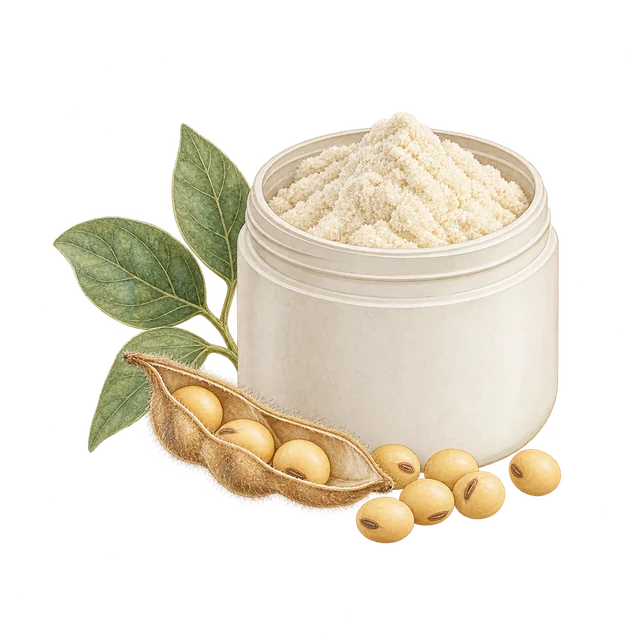
Concentrated soy protein and its amino acids; isoflavone content depends on processing and is not the muscle endpoint here.
Uses in brief

- Soy protein isolate can help meet protein needs during resistance training. A leucine-matched trial found no significant difference from whey in lean-mass and strength gains.
History, folklore and reported uses
History, folklore and traditional uses
FAO’s food-technology history places the development of food-grade soy isolates in the early 1950s, after earlier industrial protein applications. Manufacture starts with defatted soy flour or flakes, separates a protein-rich water phase, then recovers and dries the protein. This creates a different material from a whole bean or tofu.
Food manufacturers also use soy isolate for practical texture and formulation functions: binding moisture and fat, stabilizing emulsions, and adding protein to products such as specialty bread and pasta. Those uses explain its versatility without making a medical claim.
Traditional, historical and reported uses
- Food texture and emulsions
Food or household practiceWhy this label?
Identifies the source-supported production, formulation or dated research context; no additional therapeutic effect is inferred.
FAO describes food-grade soy isolate as a moisture- and fat-binding ingredient and an emulsion stabilizer in formulated foods.
- Protein fortification in foods
Food or household practiceWhy this label?
Identifies the source-supported production, formulation or dated research context; no additional therapeutic effect is inferred.
The FAO chapter documents soy-isolate use to add protein to specialty bread and pasta; this is a food-formulation role, separate from a training supplement trial.
Source-backed material history, manufacturing or food-use context is separated from efficacy evidence; no additional uses are invented.
Health topics: evidence and cautions
These notes describe a specific research context and preparation. A topic link is not a treatment recommendation.
Muscle mass · Support during care
Form and route: Oral daily isolate supplying 26 g soy protein and 2 g leucine; comparison supplied 19 g whey protein and the same leucine. · oral
Condition and setting: Protein provision during resistance training in healthy adults
Soy protein isolate can help meet protein needs during resistance training. A leucine-matched trial found no significant difference from whey in lean-mass and strength gains.
Evidence: Direct resistance-training comparison
Lynch et al. 2020: 61 untrained adults aged 18–35 enrolled; 48 completed, including 17 men. Supervised resistance training three times weekly for 12 weeks. Lean mass and leg torque increased in both groups; between-group differences were not significant. The increase in thigh-muscle thickness was not statistically significant.
Limits
No non-protein placebo arm; this does not isolate a supplement effect above training, prove universal equivalence, or establish that every soy food delivers the tested dose.
Cautions
- Avoid with soy allergy; read blended-product labels.
Identity & detailed reference
Identity
Protein isolated from soybean seed; related food material is Glycine max.
Ingredient details, preparation and research
Source plant or material
Protein isolated from soybean seed; related food material is Glycine max.
Plant family / material: Fabaceae (source soybean).
Forms and route
Studied oral preparation: Oral daily isolate supplying 26 g soy protein and 2 g leucine; comparison supplied 19 g whey protein and the same leucine. Research exposure only; this is not a recommended dose or personal regimen.
Vitamins and minerals
This is a preparation-specific supplement reference. No generic food serving, Daily Value badge, or nutrient quantity is assigned; the label and study preparation must be checked.
Absorption and preparation
No special food pairing or absorption-enhancement recipe is established here. Trial findings apply to the specified oral material and cannot be transferred to a tea, whole food or different supplement blend.
Traditional and reported uses
- Soy protein isolate can help meet protein needs during resistance training. A leucine-matched trial found no significant difference from whey in lean-mass and strength gains.
Contraindications and cautions
- Avoid with soy allergy; read blended-product labels.
Population, preparation and outcome
Lynch et al. 2020: 61 untrained adults aged 18–35 enrolled; 48 completed, including 17 men. Supervised resistance training three times weekly for 12 weeks. Lean mass and leg torque increased in both groups; between-group differences were not significant. The increase in thigh-muscle thickness was not statistically significant.
What the result does not establish
No non-protein placebo arm; this does not isolate a supplement effect above training, prove universal equivalence, or establish that every soy food delivers the tested dose.
Preparation and safety boundaries
Avoid with soy allergy; read blended-product labels.
Evidence limits
- No non-protein placebo arm; this does not isolate a supplement effect above training, prove universal equivalence, or establish that every soy food delivers the tested dose.
- Focused educational review, not a systematic review or a personal supplement plan.
Entry sources
- Lynch et al. 2020: Leucine-matched soy and whey during resistance training
- FDA: Food Allergies
- FAO: Technology of edible soy flours and proteins, Chapter 6
Reference entry 600 · Recorded content review: 2026-10-11 · Review scope and dates