


Key cautions
- Confirm the plant: French thyme can also mean a Thymus vulgaris cultivar; Spanish oregano is not a unique botanical name.
- Do not ingest essential oil or use concentrated medicinal preparations in pregnancy, breastfeeding or children without professional guidance.
- Confirm the species before connecting this research to “French thyme” or “Spanish oregano.” Those common names can refer to different plants; do not apply concentrated leaf oil or borrow a study preparation.
What’s inside
Volatile terpenes including carvacrol, thymol and related compounds vary widely between samples and extraction methods.
Uses in brief

- Aromatic leaf seasoning, documented under African thyme, French thyme and related regional names.
- Traditional medicinal uses are recorded, but laboratory activity does not establish effective home treatment.
- Mosquito-related research: essential oil studied under the name Plectranthus amboinicus, a synonym of Coleus amboinicus, showed repellency against adult Aedes aegypti in a controlled assay. This does not demonstrate that culinary leaves or a plant on a windowsill repel mosquitoes.
History, folklore and reported uses
History, folklore and traditional uses
SANBI describes an African aromatic plant carried through Indian Ocean routes into India and the Far East. Loureiro named Coleus amboinicus in 1790; its many thyme, mint and borage names reflect human use and travel rather than membership in those other genera.
Traditional, historical and reported uses
- Kitchen seasoning
Food or household practiceWhy this label?
The claim documents kitchen seasoning as a culinary, craft, gardening, or practical material use; it reports neither a treatment outcome nor measured nutrient content.
SANBI describes the aromatic leaves as a useful herb for flavoring food.
- Traditional swelling remedies
Traditional accountWhy this label?
The claim attributes swelling-remedy use to Taiwanese tradition, rather than a research outcome.
NParks records Taiwanese traditional use for inflammation or swelling; this is cultural documentation, not proof of efficacy.
- Bataknese postpartum leaf tradition
Traditional accountWhy this label?
The focus-group study documents a Bataknese postpartum belief and food practice; participants reporting tradition are not a clinical efficacy trial.
Damanik’s focus-group study in Simalungun, North Sumatra documents torbangun, identified as Coleus amboinicus, as a postpartum food believed to support milk production and recovery. This cultural record applies only to that species. LactMed finds the studies inadequate to establish milk-supply efficacy and notes the absence of nursing-mother and infant safety data.
- Mosquito repellency in research
Not yet classifiedWhy this label?
The attached abstract confirms a controlled mosquito assay but does not resolve whether the tested host was human; assay details are expressly unavailable, so no study-population label is inferred.
Mosquito-related research: essential oil studied under the name Plectranthus amboinicus, a synonym of Coleus amboinicus, showed repellency against adult Aedes aegypti in a controlled assay. This does not demonstrate that culinary leaves or a plant on a windowsill repel mosquitoes. No evidence here for a standing plant, leaf tea, mosquito-borne disease prevention or all plants called French thyme. Full assay details were not available in the retrieved abstract.
Only specifically supported historical or culinary uses are included; tradition is not evidence of effectiveness.
Historical-use additions reviewed 2026-10-08
Story sources
- SANBI PlantZAfrica: Coleus amboinicus
- RHS Digital Collections: Coleus amboinicus
- NParks: Coleus amboinicus
- Leaf essential oil GC-MS profile from Odisha
- Brazilian Plectranthus oil composition study
- Kew: Coleus amboinicus
- RHS: Thymus vulgaris horticultural names
- Damanik (2009): Torbangun, a Bataknese traditional cuisine perceived as lactagogue
- LactMed: Coleus
- Mosquito repellent activity of volatile oils from selected aromatic plants (2017)
Regional reading paths
These sourced notes describe cultivation, trade, food traditions or material history. A regional connection does not claim exclusive origin.
North America
Introduced kitchen herb; Trinidad and Tobago’s agriculture ministry lists Spanish thyme among locally grown herbs.
Aromatic, fleshy leaves season food; identity must be checked because regional thyme and oregano names overlap.
Identity & detailed reference
Identity
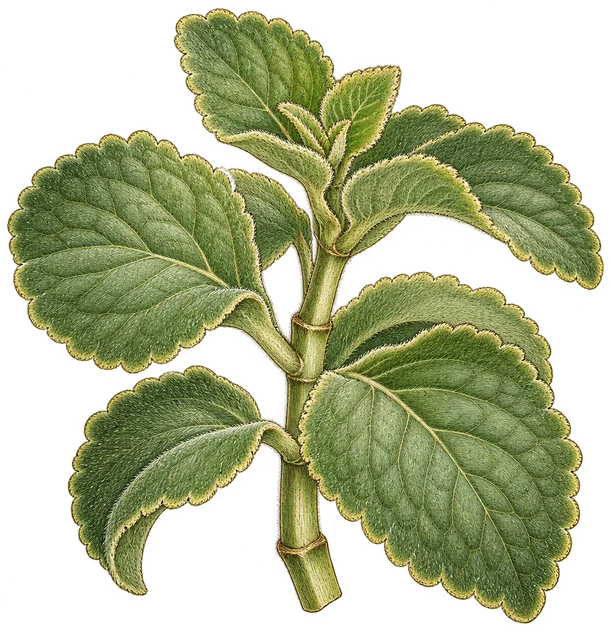
Provisionally interpreted as Coleus amboinicus: thick, aromatic, hairy, scalloped leaves. French thyme and Spanish oregano are regionally variable names; confirm species before using this card.
Ingredient details, preparation and research
Also known as: Cuban oregano; Indian borage; African thyme; Spanish thyme; Plectranthus amboinicus
Source plant or material
Provisionally interpreted as Coleus amboinicus: thick, aromatic, hairy, scalloped leaves. French thyme and Spanish oregano are regionally variable names; confirm species before using this card.
Plant family / material: Lamiaceae
Forms and route
Fresh culinary leaves and traditional leaf preparations; extracts and essential oils are different, concentrated materials.
Vitamins and minerals
No nutrient values are assigned without confirmed species, form and serving. A few seasoning leaves are not nutritionally equivalent to concentrated powder.
Absorption and preparation
Crushing leaves releases aroma, not a standardized medicinal dose. Oil composition does not establish absorption or benefit from eating leaves.
Traditional and reported uses
- Aromatic leaf seasoning, documented under African thyme, French thyme and related regional names.
- Traditional medicinal uses are recorded, but laboratory activity does not establish effective home treatment.
- Mosquito-related research: essential oil studied under the name Plectranthus amboinicus, a synonym of Coleus amboinicus, showed repellency against adult Aedes aegypti in a controlled assay. This does not demonstrate that culinary leaves or a plant on a windowsill repel mosquitoes.
Contraindications and cautions
- Confirm the plant: French thyme can also mean a Thymus vulgaris cultivar; Spanish oregano is not a unique botanical name.
- Do not ingest essential oil or use concentrated medicinal preparations in pregnancy, breastfeeding or children without professional guidance.
- Confirm the species before connecting this research to “French thyme” or “Spanish oregano.” Those common names can refer to different plants; do not apply concentrated leaf oil or borrow a study preparation.
Similar items and how they compare
- Thyme
The common names overlap.
Thymus vulgaris is a separate plant with smaller leaves; confirm the scientific name.
- Oregano
Both are aromatic mint-family seasonings.
Origanum vulgare is not Coleus amboinicus; chemistry and evidence differ.
Name resolution
SANBI identifies Coleus amboinicus and its Plectranthus synonym; RHS lists French thyme and Spanish thyme among common names. This supports a likely interpretation, not proof of the user’s particular plant or of every Spanish-oregano usage. RHS also lists French under Thymus vulgaris horticultural naming.
Chemistry and evidence
Primary analyses of different leaf oils found different proportions of carvacrol, thymol and other terpenes. Antimicrobial laboratory tests do not demonstrate that a leaf tea treats an infection.
Practical boundary
Culinary use applies to correctly identified food leaves. No general medicinal dose, pregnancy safety or ingestion protocol for concentrated oil is established by the sources used here.
Mosquito repellency in research
Adult mosquito landing/feeding assay. The identified P. amboinicus oil and a separate mixed-oil preparation showed repellency in the reported test. No evidence here for a standing plant, leaf tea, mosquito-borne disease prevention or all plants called French thyme. Full assay details were not available in the retrieved abstract.
Evidence limits
- Provisional identity until the user supplies a label, region or plant identification.
- Spanish oregano was not verified as a unique synonym; explicit ambiguity retained.
Entry sources
- SANBI PlantZAfrica: Coleus amboinicus
- RHS Digital Collections: Coleus amboinicus
- NParks: Coleus amboinicus
- Leaf essential oil GC-MS profile from Odisha
- Brazilian Plectranthus oil composition study
- Kew: Coleus amboinicus
- RHS: Thymus vulgaris horticultural names
- Damanik (2009): Torbangun, a Bataknese traditional cuisine perceived as lactagogue
- LactMed: Coleus
- Mosquito repellent activity of volatile oils from selected aromatic plants (2017)
Reference entry 202 · Recorded content review: 2026-10-07 · Review scope and dates