


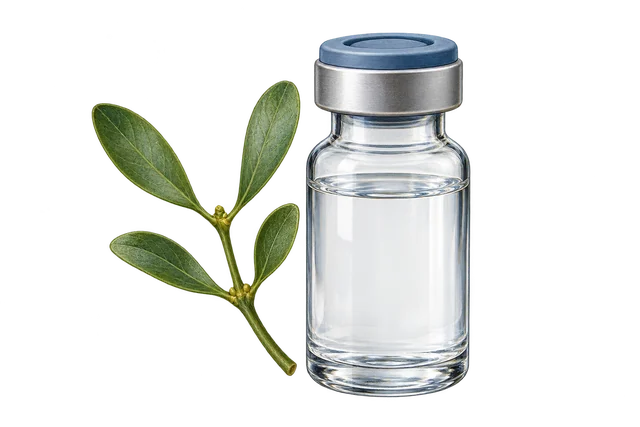
Key cautions
- Do not eat raw mistletoe or make injections. Severe allergy is possible; any use needs specialist oversight.
- Mistletoe extracts are not FDA-approved cancer treatments.
What’s inside
Mistletoe extracts can contain lectins and viscotoxins; composition varies by host tree, harvest and manufacture. The cited trial defines Iscador M special, not a universal extract.
Uses in brief

- A small breast-cancer study of Iscador M special reported quality-of-life improvement; benefit remains uncertain and survival benefit is unproven.
History, folklore and reported uses
History, folklore and traditional uses
NCI dates modern cancer interest in mistletoe to the 1920s. Older medicinal traditions do not establish this injection as an effective cancer treatment.
Traditional, historical and reported uses
- Twentieth-century cancer-use history
Historical recordWhy this label?
Documents this named use; does not support broader disease claims or interchangeable formulations.
NCI dates modern cancer interest in mistletoe to the 1920s. Older medicinal traditions do not establish this injection as an effective cancer treatment.
Only documented uses are included. Historical practice does not establish clinical benefit or safe home use.
Story sources
Health topics: evidence and cautions
These notes describe a specific research context and preparation. A topic link is not a treatment recommendation.
Cancer by type · Support during care
Form and route: Iscador M special: manufactured fermented aqueous fresh-herb extract from apple-host mistletoe · subcutaneous injection by clinical protocol
A small breast-cancer study reported better quality of life with a specific mistletoe extract.
Evidence: Small clinical study; uncertain benefit
A 95-person, three-arm trial published a comparison of 30 Iscador M special recipients and 31 controls during post-operative breast-cancer chemotherapy; quality-of-life scores favored the extract.
Limits
Open-label, small exploratory comparison of subjective scores: expectations and added injection attention could contribute. No established survival benefit or transfer to other products.
Cautions
- Do not eat raw mistletoe or make injections. Severe allergy is possible; any use needs specialist oversight.
- Mistletoe extracts are not FDA-approved cancer treatments.
Identity & detailed reference
Identity
Viscum album fresh herb grown on apple host trees, manufactured as Iscador M special. This is not a raw-berry or home-plant remedy.
Ingredient details, preparation and research
Source plant or material
Viscum album fresh herb grown on apple host trees, manufactured as Iscador M special. This is not a raw-berry or home-plant remedy.
Plant family / material: Santalaceae (European mistletoe source)
Forms and route
Defined fermented aqueous fresh-herb extract for clinician-administered subcutaneous use under a clinical protocol. Other mistletoe products are separate.
Vitamins and minerals
This is a clinical research preparation, not a food or nutrient supplement.
Absorption and preparation
Subcutaneous injection is a distinct clinical route. Oral tea, berries and supplements cannot reproduce this exposure.
Traditional and reported uses
- A small breast-cancer study of Iscador M special reported quality-of-life improvement; benefit remains uncertain and survival benefit is unproven.
Contraindications and cautions
- Do not eat raw mistletoe or make injections. Severe allergy is possible; any use needs specialist oversight.
- Mistletoe extracts are not FDA-approved cancer treatments.
- Only a qualified clinical team should decide whether a studied injection is appropriate. Never prepare or inject a plant extract yourself.
Exact clinical preparation
The primary trial used fermented aqueous fresh apple-host mistletoe extract called Iscador M special. Its published comparison included 30 recipients and 31 controls with early-stage nonmetastatic breast cancer during post-operative CAF chemotherapy (cyclophosphamide, doxorubicin and fluorouracil), within a 95-person three-arm study.
Outcome and bias
Quality-of-life scores favored the extract, but the comparison was small and open label. Subjective scores can be influenced by expectations and extra treatment attention; no survival conclusion follows.
Safety and regulatory boundary
NCI reports injection-site reactions, fever and occasional serious allergy. Mistletoe extracts are not FDA-approved cancer treatments. Raw plant material can be poisonous.
Evidence limits
- Open-label, small exploratory comparison of subjective scores: expectations and added injection attention could contribute. No established survival benefit or transfer to other products.
Entry sources
- NCI: Mistletoe extracts, health professional
- Tröger et al. Iscador M special breast-cancer pilot trial
- NCI: Mistletoe extracts, patient reference
- Kew: European mistletoe
Reference entry 598 · Recorded content review: 2026-10-11 · Review scope and dates