


Key cautions
- A truffle-flavoured oil or extract is not automatically whole truffle; check ingredients and species labels.
What’s inside
Characteristic volatile aroma compounds distinguish species and products. This group is not a standardized extract, and shared “truffle” flavour does not establish shared composition.
Uses in brief

- Aromatic cooking
- Diplomatic gifts
- Dog-assisted harvest and livelihoods
History, folklore and reported uses
History, folklore and traditional uses
Italian truffle gathering is a living practice involving trained dogs, seasonal knowledge and oral transmission. UNESCO inscribed that knowledge and practice in 2021. Its cultural importance belongs to the people and landscapes that sustain it, as well as to the truffles on the plate.
Specific species have specific histories. INRAE records Italian white truffles as diplomatic gifts of the Princes of Savoy in the eighteenth century, and reports controlled orchard production of that species in France. These stories do not make every underground fungus a European culinary truffle.
A closer look at its history
Knowledge shared with a dog
Italy’s truffle-hunting heritage joins oral knowledge of seasons, soil, trees and land with the working relationship between hunter and dog. The tradition is more than locating a luxury ingredient; its practitioners transmit an understanding of particular landscapes.
An orchard milestone, not an instant crop
INRAE reported verified T. magnatum harvests in a French orchard outside its natural range in 2019 and 2020. Researchers checked host-tree mycorrhizae by morphology and DNA. This is an unusual agricultural use of a tree–fungus partnership, and the dated result should not be mistaken for a promise of easy home cultivation.
Additional history reviewed 2026-10-09
Traditional, historical and reported uses
- Aromatic cooking
Food or household practiceWhy this label?
The claim documents aromatic cooking as a culinary, craft, gardening, or practical material use; it reports neither a treatment outcome nor measured nutrient content.
The named Tuber species are prized for their distinctive aromas in regional and restaurant food.
- Diplomatic gifts
Historical recordWhy this label?
The claim explicitly documents eighteenth-century Savoy diplomatic gifting as social history.
Italian white truffles were used as prestige gifts in Savoy diplomatic exchanges during the eighteenth century.
- Dog-assisted harvest and livelihoods
Mixed/contextual sourcesWhy this label?
The UNESCO account supports harvesting livelihoods and transmitted know-how; it is social/economic context rather than efficacy research.
Trained-dog gathering supports seasonal rural work and the passing on of practical knowledge.
- Cultivation with host trees
Food or household practiceWhy this label?
The claim documents cultivation with host trees as a culinary, craft, gardening, or practical material use; it reports neither a treatment outcome nor measured nutrient content.
Mycorrhizal-tree cultivation creates an agricultural route to truffle production; success varies by species and growing conditions.
- Community food heritage
Traditional accountWhy this label?
The claim describes orally transmitted knowledge and communal food heritage, an account of tradition.
Seasonal celebrations and orally transmitted knowledge form part of the Italian tradition recognized by UNESCO.
Features and lookalikes to study
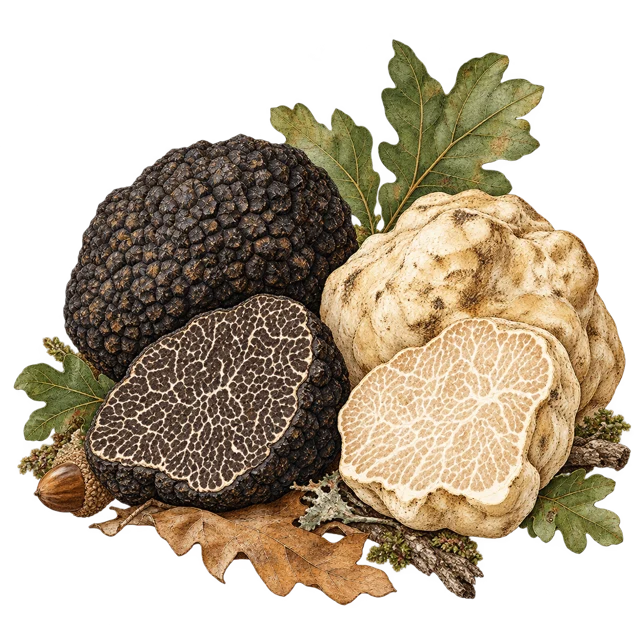
Tuber melanosporum (Périgord black truffle), T. magnatum (Italian white truffle) and T. aestivum (summer/Burgundy truffle). A clearly labelled culinary group.
Common names vary between regions and suppliers; the scientific scope above governs this card.
Morphology described in sources
- Tuber truffles are enclosed subterranean reproductive bodies whose internal fertile tissue develops characteristic veins and spores. Black Périgord, Italian white and summer/Burgundy truffles are different named taxa, not colour grades of one species.
- Habitat and substrate
- See the source-linked morphology and comparison notes below; a separate habitat summary has not been verified for this card.
- Geographic scope
- A complete regional range is not established here. Broad common names and commercial labels can span different species.
- Season in the cited region
- No region-specific fruiting season has been verified for this card. Do not infer a local season from trade availability.
Scleroderma earthballs (poisonous)
Earthballs can be mistaken for truffles. Many develop a tough rind and dark spore-filled interior; young interiors may be pale.
Pale flesh, a rounded underground form, apparent marbling or an attractive smell is not an identification test. NAMA documents poisoning after earthballs were mistaken for truffles.
Tuber indicum complex and other traded Tuber
Asian black truffles can resemble T. melanosporum closely. Microscopic spore characters are useful, but CNRS describes DNA authentication to distinguish very similar traded black truffles.
This is often a provenance/value substitution issue, not a claim that T. indicum is poisonous. A photograph cannot authenticate the premium species.
Limits and regional differences
- Expert examination of peridium, gleba, mature spores and provenance is needed; DNA is useful for cryptic or processed trade material. A dog finding it is not an edibility test.
- Educational comparison only. Neither this card, an illustration, a photograph, a spore-print colour nor a checklist establishes that a wild collection is safe to eat. A qualified local mycologist must assess uncertain material; do not taste an unknown fungus. Cooking does not reliably eliminate mushroom toxins.
- Missouri Department of Conservation: Common earthball
- NAMA: Mushroom poisoning in North America, 2015–2016
- CNRS: Tuber melanosporum and T. indicum authentication
- INRAE: Controlled production of Italian white truffles
- Italian Ministry of Culture: Truffle hunting knowledge and practices
- NC Poison Control: Mushrooms
Regional reading paths
These sourced notes describe cultivation, trade, food traditions or material history. A regional connection does not claim exclusive origin.
Europe
Native/wild-collected and cultivated: Italy and France.
Identified culinary truffles provide aroma; species and origin matter.
Identity & detailed reference
Identity
Tuber melanosporum (Périgord black truffle), T. magnatum (Italian white truffle) and T. aestivum (summer/Burgundy truffle). A clearly labelled culinary group.
Ingredient details, preparation and research
Also known as: Périgord black truffle (T. melanosporum); Italian white truffle (T. magnatum); Summer / Burgundy truffle (T. aestivum)
Source plant or material
Underground fruiting bodies of the named Tuber species, authenticated for culinary sale.
Fungal family: Tuberaceae
Forms and route
Fresh culinary truffles and labelled preserved truffle products; a flavoured oil may contain added aroma rather than whole truffle.
Vitamins and minerals
Usually valued for aroma rather than as a dependable vitamin or mineral serving. No common nutrient profile is assigned across fresh truffles, preserved products and flavoured oils.
Absorption and preparation
Culinary handling aims to retain aroma and suits the named species and product. There is no established medicinal dose or absorption-enhancing pairing for these materials.
Traditional and reported uses
- The named Tuber species are prized for their distinctive aromas in regional and restaurant food.
- Italian white truffles were used as prestige gifts in Savoy diplomatic exchanges during the eighteenth century.
- Trained-dog gathering supports seasonal rural work and the passing on of practical knowledge.
- Mycorrhizal-tree cultivation creates an agricultural route to truffle production; success varies by species and growing conditions.
- Seasonal celebrations and orally transmitted knowledge form part of the Italian tradition recognized by UNESCO.
Contraindications and cautions
- A truffle-flavoured oil or extract is not automatically whole truffle; check ingredients and species labels.
Similar items and how they compare
- Kalahari truffle
Both have truffle food histories and depend on particular landscapes.
European culinary truffles are Tuber species; Kalahari truffle is Kalaharituber pfeilii in another family.
Fungus, family and material
Tuber melanosporum, Tuber magnatum and Tuber aestivum (culinary group). Tuberaceae. Underground fruiting bodies of the named Tuber species, authenticated for culinary sale.
Preparation and evidence
Culinary handling aims to retain aroma and suits the named species and product. There is no established medicinal dose or absorption-enhancing pairing for these materials.
Constituents and nutrition
Characteristic volatile aroma compounds distinguish species and products. This group is not a standardized extract, and shared “truffle” flavour does not establish shared composition. Usually valued for aroma rather than as a dependable vitamin or mineral serving. No common nutrient profile is assigned across fresh truffles, preserved products and flavoured oils.
History and documented uses
Italian truffle gathering is a living practice involving trained dogs, seasonal knowledge and oral transmission. UNESCO inscribed that knowledge and practice in 2021. Its cultural importance belongs to the people and landscapes that sustain it, as well as to the truffles on the plate. Specific species have specific histories. INRAE records Italian white truffles as diplomatic gifts of the Princes of Savoy in the eighteenth century, and reports controlled orchard production of that species in France. These stories do not make every underground fungus a European culinary truffle.
Safety and interpretation
A truffle-flavoured oil or extract is not automatically whole truffle; check ingredients and species labels. Cultural recognition and food value do not establish medicinal efficacy.
Entry sources
- UNESCO: Italian truffle hunting and extraction
- INRAE: controlled production of Italian white truffles
- Kew taxonomy: Tuber, Tuberaceae
Reference entry 223 · Recorded content review: 2026-10-08 · Review scope and dates