


Key cautions
- Avoid during pregnancy and breastfeeding.
- Rare liver injury is reported. Stop and seek care for jaundice or other possible liver symptoms.
What’s inside
Withanolides are a characteristic group of constituents. Their presence does not identify an effective dose, prove a hormone benefit or make different extracts equivalent.
Uses in brief

- Ayurvedic medicinal history (traditional account).
- Perimenopause research (human research).
History, folklore and reported uses
History, folklore and traditional uses
Ashwagandha has a long Ayurvedic medicinal history. Modern supplement marketing spans many conditions, but each extract and outcome needs its own evidence.
Traditional, historical and reported uses
- Perimenopause research
Human researchWhy this label?
The source is retained with its design and preparation limits; reported use is not upgraded to clinical effectiveness.
A small eight-week randomized trial reported improvement with a specified root extract. It does not establish the same result for root powder or long-term treatment.
Includes only uses and context documented for this material. Historical reporting is not proof of benefit; no use-count quota is applied.
Women’s Health: traditions, evidence and cautions
Historical use does not establish benefit or safety. Pregnancy, breastfeeding and fertility care require particular caution: food, tea, essential oil and concentrated extract are not interchangeable. These records are not treatment, dosing or pregnancy-management instructions. Discuss supplements with a qualified clinician or pharmacist; do not delay evaluation of persistent symptoms.
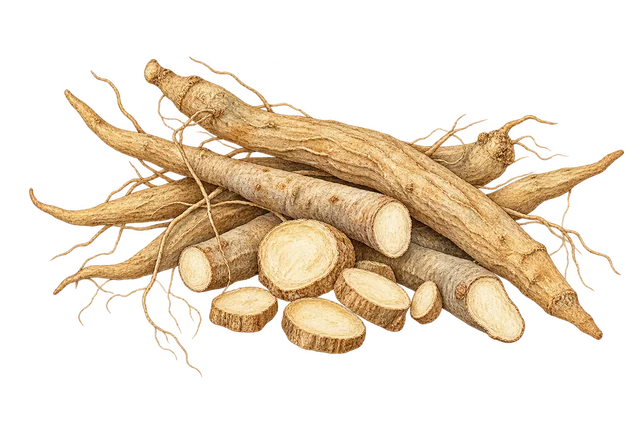
Ashwagandha root
Withania somnifera (L.) Dunal
- Plant part / material
- Root
- Preparation studied or reported
- Traditional root powder and specifically identified root extracts. Leaf extracts and root/leaf mixtures are outside this card’s evidence scope.
Only the exact part and formulation described here; related existing cards do not inherit these claims.
Ashwagandha has a long Ayurvedic medicinal history. Modern supplement marketing spans many conditions, but each extract and outcome needs its own evidence.
Perimenopause research
Human research
Reported or traditional useA small eight-week randomized trial reported improvement with a specified root extract. It does not establish the same result for root powder or long-term treatment.
What the evidence supportsThe source is retained with its design and preparation limits; reported use is not upgraded to clinical effectiveness.
Avoid during pregnancy and breastfeeding. Rare liver injury is reported. Stop and seek care for jaundice or other possible liver symptoms. Discuss thyroid or autoimmune disease, upcoming surgery, sedatives, thyroid hormones, immunosuppressants, seizure medicines, blood-pressure medicines and diabetes medicines with a clinician. Drowsiness and digestive upset can occur; long-term safety is uncertain.
Only the exact part and formulation described here; related existing cards do not inherit these claims.
- Avoid during pregnancy and breastfeeding.
- Rare liver injury is reported. Stop and seek care for jaundice or other possible liver symptoms.
- Discuss thyroid or autoimmune disease, upcoming surgery, sedatives, thyroid hormones, immunosuppressants, seizure medicines, blood-pressure medicines and diabetes medicines with a clinician.
- Drowsiness and digestive upset can occur; long-term safety is uncertain.
Read the complete historical reference and its material distinctions
Health topics: evidence and cautions
These notes describe a specific research context and preparation. A topic link is not a treatment recommendation.
Male fertility & sperm health · Support during care
Form and route: KSM-66 root extract standardized to at least 5% withanolides · oral
Condition and setting: Oligospermia in men with infertility
A small pilot trial reported improved sperm concentration, motility and semen volume. It did not establish a pregnancy or live-birth benefit.
Evidence: Limited pilot-trial evidence
Double-blind placebo-controlled trial; 46 men; 675 mg/day of the specified root extract for 90 days.
Limits
Exploratory sample without a power calculation. Widely quoted percentage improvements compare the treated group with its own baseline, not with placebo. Findings cannot establish a general fertility or testosterone treatment.
Cautions
- Drowsiness and digestive upset can occur; liver injury has been reported. Discuss liver or thyroid disease and medicines with a clinician. Long-term safety is uncertain. Avoid with hormone-sensitive prostate cancer.
Stress · Symptom support
Form and route: High-concentration full-spectrum root extract in capsules; leaf and root/leaf products differ · oral
Condition and setting: Persistent perceived stress in adults
A small placebo-controlled trial found lower self-reported stress scores with one root extract. This does not establish treatment for diagnosed anxiety disorders.
Evidence: Limited clinical evidence; short formulation-specific trial
Sixty-four adults with chronic stress were randomized for 60 days; the tested exposure was 300 mg root extract twice daily. Stress-scale scores and cortisol were lower than placebo.
Limits
Single-center, short trial; results cannot be transferred to root powder, leaf extracts or every commercial product. Cortisol is a biomarker, not a complete measure of recovery.
Cautions
- May cause drowsiness or stomach upset; rare liver injury has been reported. Avoid with hormone-sensitive prostate cancer. Thyroid or autoimmune disease, surgery and medicines require clinician review. Avoid during pregnancy and breastfeeding.
Identity & detailed reference
Identity
Ashwagandha root is Withania somnifera, sometimes called Indian ginseng. It is not a Panax ginseng species; the nickname does not establish similar effects.
Ingredient details, preparation and research
Also known as: Indian ginseng root
Source plant or material
Withania somnifera (L.) Dunal; Root
Plant family / material: Solanaceae
Forms and route
Traditional root powder and specifically identified root extracts. Leaf extracts and root/leaf mixtures are outside this card’s evidence scope.
Absorption and preparation
No absorption-enhancement directions are established for this material. An extract, food, infusion and isolated chemical can deliver different substances; study results do not establish a home preparation.
Traditional and reported uses
- Perimenopause research: A small eight-week randomized trial reported improvement with a specified root extract. It does not establish the same result for root powder or long-term treatment.
Contraindications and cautions
- Avoid during pregnancy and breastfeeding.
- Rare liver injury is reported. Stop and seek care for jaundice or other possible liver symptoms.
- Discuss thyroid or autoimmune disease, upcoming surgery, sedatives, thyroid hormones, immunosuppressants, seizure medicines, blood-pressure medicines and diabetes medicines with a clinician.
- Drowsiness and digestive upset can occur; long-term safety is uncertain.
Identity and exact material
Ashwagandha root is Withania somnifera, sometimes called Indian ginseng. It is not a Panax ginseng species; the nickname does not establish similar effects. Traditional root powder and specifically identified root extracts. Leaf extracts and root/leaf mixtures are outside this card’s evidence scope.
Evidence and preparation boundaries
The trial enrolled 100 women and 91 completed it. Reported symptom and hormone changes concern one root extract in perimenopause, not all women or all preparations. NCCIH still finds menopause and female-infertility evidence insufficient; some preparations have support for stress and insomnia, but that evidence cannot be transferred wholesale to this exact material.
Safety and uncertainty
Avoid during pregnancy and breastfeeding. Rare liver injury is reported. Stop and seek care for jaundice or other possible liver symptoms. Discuss thyroid or autoimmune disease, upcoming surgery, sedatives, thyroid hormones, immunosuppressants, seizure medicines, blood-pressure medicines and diabetes medicines with a clinician. Drowsiness and digestive upset can occur; long-term safety is uncertain.
Evidence limits
- This is a focused source review, not a systematic clinical review. A traditional indication or laboratory result does not establish an effective or safe treatment.
- A lack of reported adverse effects is not proof of safety. No therapeutic dose or preparation is recommended.
Entry sources
- NCCIH: Ashwagandha
- Gopal et al. 2021: Ashwagandha root extract during perimenopause
- Kew Plants of the World Online: Withania somnifera
- National Medicinal Plants Board: Agro-techniques, Volume II, Withania somnifera p.103
Reference entry 545 · Recorded content review: 2026-10-11 · Review scope and dates