


Key cautions
- Heavy or persistent bleeding needs medical assessment. Bark should not delay diagnosis.
- Avoid unsupervised medicinal use in pregnancy or breastfeeding; these sources do not establish safety.
What’s inside
A reliable composition profile for the exact preparation was not established in this review; chemistry from another plant part is not transferred.
Uses in brief

- Menstrual and vaginal complaint history (traditional account).
History, folklore and reported uses
History, folklore and traditional uses
Kerala Agricultural University researchers describe a sacred tree in Hindu and Buddhist traditions, but a sacred association is not medical evidence.
Their 2005 paper connects declining bark availability with destructive harvesting and adulteration. Traceable sourcing therefore matters both for identity and conservation.
Traditional, historical and reported uses
- Menstrual and vaginal complaint history
Traditional accountWhy this label?
The source is retained with its design and preparation limits; reported use is not upgraded to clinical effectiveness.
The study records stem bark in Ayurvedic preparations for heavy menstrual bleeding and abnormal vaginal discharge. It tested ways to distinguish bark, not whether those treatments work.
Includes only uses and context documented for this material. Historical reporting is not proof of benefit; no use-count quota is applied.
Women’s Health: traditions, evidence and cautions
Historical use does not establish benefit or safety. Pregnancy, breastfeeding and fertility care require particular caution: food, tea, essential oil and concentrated extract are not interchangeable. These records are not treatment, dosing or pregnancy-management instructions. Discuss supplements with a qualified clinician or pharmacist; do not delay evaluation of persistent symptoms.
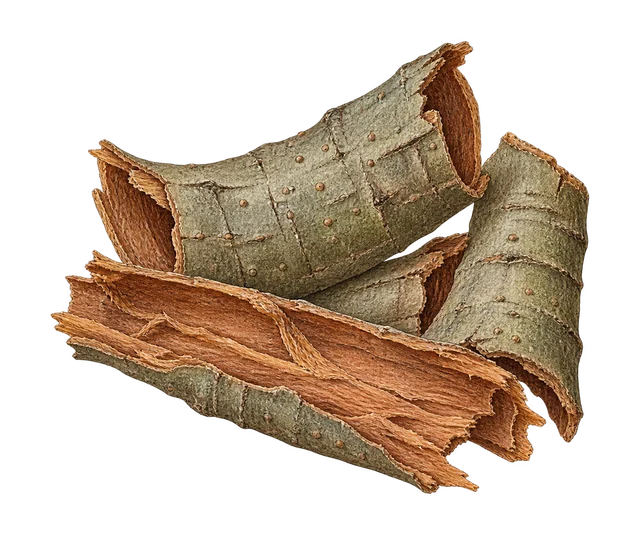
Ashoka bark
Saraca asoca (Roxb.) W.J.de Wilde
- Plant part / material
- Stem bark
- Preparation studied or reported
- Authenticated Saraca asoca stem bark and named Ayurvedic compound preparations; no assumption that a compound is equivalent to bark alone.
Only the exact part and formulation described here; related existing cards do not inherit these claims.
Kerala Agricultural University researchers describe a sacred tree in Hindu and Buddhist traditions, but a sacred association is not medical evidence.
Their 2005 paper connects declining bark availability with destructive harvesting and adulteration. Traceable sourcing therefore matters both for identity and conservation.
Menstrual and vaginal complaint history
Traditional account
Reported or traditional useThe study records stem bark in Ayurvedic preparations for heavy menstrual bleeding and abnormal vaginal discharge. It tested ways to distinguish bark, not whether those treatments work.
What the evidence supportsThe source is retained with its design and preparation limits; reported use is not upgraded to clinical effectiveness.
Heavy or persistent bleeding needs medical assessment. Bark should not delay diagnosis. Avoid unsupervised medicinal use in pregnancy or breastfeeding; these sources do not establish safety. Do not substitute ornamental false-ashoka bark. A shared common name does not establish medicinal equivalence.
Only the exact part and formulation described here; related existing cards do not inherit these claims.
- Heavy or persistent bleeding needs medical assessment. Bark should not delay diagnosis.
- Avoid unsupervised medicinal use in pregnancy or breastfeeding; these sources do not establish safety.
- Do not substitute ornamental false-ashoka bark. A shared common name does not establish medicinal equivalence.
Read the complete historical reference and its material distinctions
Identity & detailed reference
Identity
This is bark of Saraca asoca. The ornamental tree historically called Polyalthia longifolia is a documented substitute, not the same species. Saraca indica is not silently treated as an accepted synonym.
Ingredient details, preparation and research
Also known as: asoka bark
Source plant or material
Saraca asoca (Roxb.) W.J.de Wilde; Stem bark
Plant family / material: Fabaceae
Forms and route
Authenticated Saraca asoca stem bark and named Ayurvedic compound preparations; no assumption that a compound is equivalent to bark alone.
Absorption and preparation
No absorption-enhancement directions are established for this material. An extract, food, infusion and isolated chemical can deliver different substances; study results do not establish a home preparation.
Traditional and reported uses
- Menstrual and vaginal complaint history: The study records stem bark in Ayurvedic preparations for heavy menstrual bleeding and abnormal vaginal discharge. It tested ways to distinguish bark, not whether those treatments work.
Contraindications and cautions
- Heavy or persistent bleeding needs medical assessment. Bark should not delay diagnosis.
- Avoid unsupervised medicinal use in pregnancy or breastfeeding; these sources do not establish safety.
- Do not substitute ornamental false-ashoka bark. A shared common name does not establish medicinal equivalence.
Similar items and how they compare
- False ashoka
Its bark has been used as an adulterant.
Historically Polyalthia longifolia, it is an unrelated taxon and is not a substitute for Saraca asoca.
Identity and exact material
This is bark of Saraca asoca. The ornamental tree historically called Polyalthia longifolia is a documented substitute, not the same species. Saraca indica is not silently treated as an accepted synonym. Authenticated Saraca asoca stem bark and named Ayurvedic compound preparations; no assumption that a compound is equivalent to bark alone.
Evidence and preparation boundaries
An anatomical or chemical authentication test answers which bark is present; it does not demonstrate clinical benefit. Compound products may have additional ingredients. No reliable exact-bark pregnancy or lactation safety standard, drug-interaction profile or clinical fertility benefit was established by the sources reviewed.
Safety and uncertainty
Heavy or persistent bleeding needs medical assessment. Bark should not delay diagnosis. Avoid unsupervised medicinal use in pregnancy or breastfeeding; these sources do not establish safety. Do not substitute ornamental false-ashoka bark. A shared common name does not establish medicinal equivalence.
Evidence limits
- This is a focused source review, not a systematic clinical review. A traditional indication or laboratory result does not establish an effective or safe treatment.
- A lack of reported adverse effects is not proof of safety. No therapeutic dose or preparation is recommended.
Entry sources
- Mathew et al. 2005: Differentiation of Saraca asoca crude drug from its adulterant
- Kew Plants of the World Online: Saraca asoca
- Ayurvedic Pharmacopoeia of India, Part I Volume I, reproduced government monographs
Reference entry 543 · Recorded content review: 2026-10-11 · Review scope and dates