


Key cautions
- Caffeine limits are individual; count every source.
- Pregnancy: keep caffeine below 200 mg/day.
- Decaf still has caffeine; avoid scalding drinks.
- Avoid caffeine for children and teens, following American Academy of Pediatrics guidance.
What’s inside
Caffeine, phenolic compounds including chlorogenic acids, and preparation-dependent diterpenes. Brew strength, bean mixture, cup volume and filtration affect what reaches the cup.
Uses in brief

- Roasted and brewed drink
- Turkish coffee tradition
- Arabic coffee hospitality
History, folklore and reported uses
History, folklore and traditional uses
Arabica is native to northeastern tropical Africa, with Yemen important in the history of cultivation and trade. Origin stories and early dates vary, so this card does not repeat a legendary first discovery as settled fact.
Brewing and serving are cultural practices as well as kitchen techniques. UNESCO records Turkish coffee and Arabic coffee traditions with their own methods, social settings and hospitality customs.
Traditional, historical and reported uses
- Roasting, grinding and brewing
Food or household practiceWhy this label?
The specific claim documents a food preparation or recorded culinary practice; safety qualifications remain attached and no treatment effect is inferred.
The drink is an extraction from roasted, ground seeds. Paper filtering, pressure brewing and steeping produce different cups; preparation affects caffeine and other constituents.
- Turkish coffee and conversation
Traditional accountWhy this label?
An attributed cultural account documents preparation and hospitality, without a clinical benefit claim.
UNESCO documents finely ground roasted coffee slowly brewed in a pot and served in small cups, linked with coffeehouses, friendship and family occasions. This records a living food tradition, not a health effect.
- Arabic coffee as hospitality
Traditional accountWhy this label?
An attributed cultural account documents preparation and hospitality, without a clinical benefit claim.
UNESCO’s 2015 nomination account describes beans roasted and ground for coffee served to guests in small cups. Its account concerns the participating communities in the UAE, Saudi Arabia, Oman and Qatar, not one universal recipe for the entire Arab world.
- Decaffeinated coffee
Food or household practiceWhy this label?
The specific claim documents a food preparation or recorded culinary practice; safety qualifications remain attached and no treatment effect is inferred.
Decaf offers a lower-caffeine version of the beverage. FDA notes residual caffeine, so someone who must avoid caffeine entirely should not assume decaf meets that requirement.
4 supported featured uses; food practices are not claims of treatment benefit.
Historical-use additions reviewed 2026-10-09
Story sources
- Kew: Arabica coffee
- Kew POWO: Coffea arabica, general information
- Kew POWO: Coffea canephora
- FDA: Spilling the Beans: How Much Caffeine is Too Much?
- ACOG: How much coffee can I drink while I am pregnant?
- Oregon State Linus Pauling Institute: Coffee
- Morck, Lynch and Cook (1983): Inhibition of food iron absorption by coffee
- UNESCO: Turkish coffee culture and tradition
- UNESCO Decision 10.COM 10.B.32: Arabic coffee
- IARC: Evaluation of drinking coffee, maté, and very hot beverages
- CDC: Preventing Food Poisoning
Health topics: evidence and cautions
These notes describe a specific research context and preparation. A topic link is not a treatment recommendation.
Cancer by type · Risk reduction
Form and route: Coffee beverage · oral
Coffee drinking is linked with lower liver and endometrial cancer risk.
Evidence: Expert assessment of observational evidence
WCRF judges these associations strong, but does not advise starting coffee for cancer prevention.
Limits
Mostly observational evidence; ideal amount and preparation are not settled. No cancer-treatment claim.
Cautions
- Avoid scalding-hot drinks and consider caffeine tolerance.
Regional reading paths
These sourced notes describe cultivation, trade, food traditions or material history. A regional connection does not claim exclusive origin.
Africa
Native/cultivated: Ethiopian and neighboring African coffee diversity and production.
Roasted seeds brewed as a caffeinated beverage.
South America
introduced/traded and cultivated; Colombia, Brazil
Roasted seed beverage.
Australia & Oceania
introduced/traded and cultivated; Papua New Guinea
Roasted coffee beverage.
Identity & detailed reference
Identity
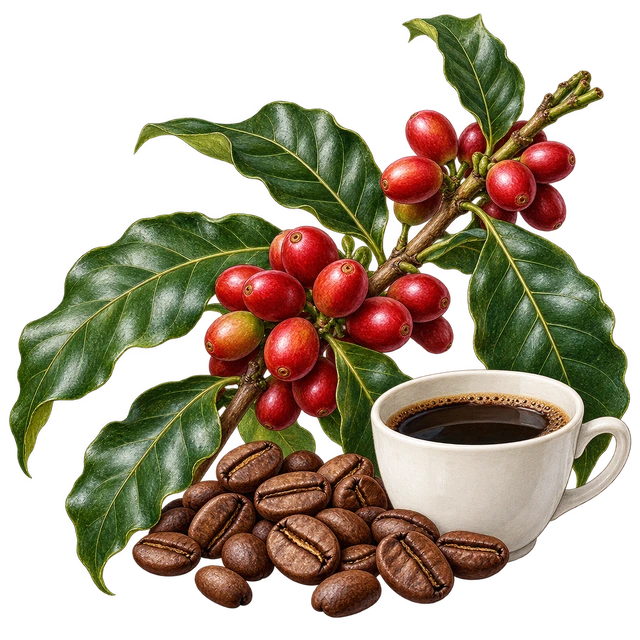
Coffee seeds, commonly called beans, from Arabica and robusta source plants, usually roasted and brewed. This card covers the food beverage, not green-coffee extracts, pure caffeine or other concentrated supplements.
Ingredient details, preparation and research
Also known as: Coffee bean; Coffee beans; Coffee beverage; Arabica coffee; Robusta coffee; Brewed coffee; Decaf coffee; Decaffeinated coffee
Source plant or material
Coffea arabica L. and Coffea canephora Pierre ex A.Froehner
Plant family / material: Rubiaceae
Forms and route
Roasted whole or ground beans; paper-filtered, espresso, steeped or boiled coffee; instant coffee and decaffeinated versions. Ready-to-drink products may contain milk, sugar or other ingredients.
Vitamins and minerals
Brewed coffee is not nutritionally equivalent to eating roasted beans, a milk-based latte or a sweetened bottled drink. This card assigns no vitamin/mineral nutrient tag; caffeine is a stimulant, not an essential nutrient. Check the actual drink ingredients and serving volume.
Absorption and preparation
Human test-meal research found that coffee can reduce nonheme-iron absorption. That result does not mean every coffee drinker becomes iron deficient or establish a universal timing rule; seek individual advice when iron status matters.
Practical preparation
Use food-grade roasted beans or a labeled beverage and clean brewing equipment. Prepare by the chosen method, let very hot coffee cool, and refrigerate perishable milk-containing drinks appropriately.
Combination context
No medicinal food pairing is established.
Combination notes
Milk, plant beverages, spices or sugar change flavor and composition. They do not cancel caffeine; take iron-timing questions to a clinician or pharmacist if needed.
Traditional and reported uses
- Roasted and brewed drink
- Turkish coffee tradition
- Arabic coffee hospitality
- Lower-caffeine decaf option
Contraindications and cautions
- FDA cites 400 mg caffeine per day as an amount generally not associated with negative effects for most adults, not a target or a safe limit for everyone. Count all sources and adjust with your clinician for sensitivity, medical conditions or medicines.
- Pregnancy: ACOG advises keeping caffeine below 200 mg/day. Discuss pregnancy, trying to conceive or breastfeeding with your clinician; cup size and strength make cup-count rules unreliable.
- Reduce intake if it causes insomnia, anxiety, palpitations or stomach symptoms. The American Academy of Pediatrics recommends avoiding caffeine for children and teens; adult caffeine references do not apply to them.
- Decaf is not caffeine-free. Avoid pure or highly concentrated caffeine products; their risks and dosing are not covered by a coffee-food card.
- Let scalding drinks cool before drinking. IARC’s very-hot-beverage assessment concerns drinking temperature, not a claim that ordinary-temperature coffee is carcinogenic.
- Coffee with a meal can reduce nonheme-iron absorption. If iron deficient or taking iron, ask your clinician or pharmacist about timing. Unfiltered coffee also retains more cholesterol-raising diterpenes than paper-filtered coffee.
Similar items and how they compare
- Cacao/cocoa (entry 246)
Another roasted seed used in drinks.
Theobroma cacao is a different plant with different compounds and food forms.
- Decaffeinated coffee
Still a coffee beverage.
Most caffeine has been removed, but it is not zero-caffeine and the remaining amount varies.
- Green-coffee extract or pure caffeine
May be marketed using coffee-related language.
Concentrated supplements are outside this food profile and do not inherit beverage safety or servings.
Arabica and robusta are distinct source species
Kew distinguishes Coffea arabica from Coffea canephora, the source associated with robusta. A blend label and roast color do not establish a fixed caffeine content.
Preparation matters beyond caffeine
Paper filters remove much of coffee’s cafestol and kahweol; boiled or unfiltered preparations retain more. This is a preparation distinction, not a prescription to drink coffee for a health outcome.
Evidence is not a remedy dose
The food profile does not turn observational associations into disease-treatment claims or suggest a preventive daily coffee dose. The adult caffeine reference is a safety context, with individual exceptions.
Iron evidence is meal-specific
The primary Morck, Lynch and Cook study tested food-iron absorption with coffee. An acute absorption result alone does not diagnose long-term deficiency in an individual.
Evidence limits
No disease-prevention or treatment recommendation, supplement dose or universal safe cup count is established. Species, roast, brew method, serving size and individual sensitivity vary.
Entry sources
- Kew: Arabica coffee
- Kew POWO: Coffea arabica, general information
- Kew POWO: Coffea canephora
- FDA: Spilling the Beans: How Much Caffeine is Too Much?
- ACOG: How much coffee can I drink while I am pregnant?
- Oregon State Linus Pauling Institute: Coffee
- Morck, Lynch and Cook (1983): Inhibition of food iron absorption by coffee
- UNESCO: Turkish coffee culture and tradition
- UNESCO Decision 10.COM 10.B.32: Arabic coffee
- IARC: Evaluation of drinking coffee, maté, and very hot beverages
- CDC: Preventing Food Poisoning
- American Academy of Pediatrics: The Effects of Caffeine on Kids: A Parent’s Guide
Reference entry 288 · Recorded content review: 2026-10-09 · Review scope and dates