


Key cautions
- Avoid in pregnancy/when trying to conceive unless specifically advised; check duplicate vitamins A/D
- Check fish allergy, medicines and high-dose use; oil weight is not the EPA+DHA dose
What’s inside
This is a mixture of fats and fat-soluble nutrients, not a single omega-3 compound. EPA and DHA are distinct fatty acids; vitamin A and vitamin D contribute different nutritional functions.
NCCIH: Omega-3 supplements, including fish-liver oils and product differences
Constituents and different preparations
EPA and DHA are the principal long-chain omega-3s of interest. The vitamin-A component is preformed vitamin A, unlike beta-carotene from carrots. Vitamins A/D vary by product; some manufacturers add them to reach a declared amount. For example, the cited capsule ingredient list includes retinyl palmitate and cholecalciferol. Antioxidants, flavorings, capsule gelatin and other excipients also differ.
NCCIH: Omega-3 supplements, including fish-liver oils and product differences · NIH ODS: Vitamin A and carotenoids, reference intakes, excess and interactions · Möller’s: Cod liver oil capsules, manufacturer-declared composition per four capsules, checked 6 October 2026
Concrete label examples, without a universal serving
On 6 October 2026, Möller’s international Natural liquid page declared, per 5 mL, 1,130 mg total omega-3, including 510 mg DHA and 370 mg EPA, plus vitamin A 250 mcg, vitamin D 10 mcg and vitamin E 3 mg. Its capsule page declared, per four capsules, 2,400 mg cod-liver oil, 588 mg total omega-3, including 268 mg DHA and 192 mg EPA, plus vitamin A 250 mcg and vitamin D 15 mcg. Thus neither equal brand names nor an oil-weight figure establish nutrient equivalence. These are manufacturer declarations for these versions, not independent measurements or advice to take these servings; check the actual pack in your country.
Möller’s: Cod Liver Oil Natural, manufacturer-declared composition per 5 mL, checked 6 October 2026 · Möller’s: Cod liver oil capsules, manufacturer-declared composition per four capsules, checked 6 October 2026
Reference intake versus upper limit
For U.S. adults aged 19 and over, vitamin-A RDAs are 900 mcg RAE/day for men and 700 for women; the adult upper limit for preformed vitamin A is 3,000 mcg RAE/day. Vitamin-D RDAs are 15 mcg (600 IU)/day through age 70 and 20 mcg (800 IU) thereafter, with an adult upper limit of 100 mcg (4,000 IU)/day. These concern total intake, not how much oil to take, and upper limits are not goals or guarantees of safety. National advice differs: NHS cautions against long-term vitamin-A intakes above 1,500 mcg/day, particularly for people at osteoporosis risk.
NIH ODS: Vitamin A and carotenoids, reference intakes, excess and interactions · NIH ODS: Vitamin D, reference intakes, absorption and interactions · NHS: Vitamin A, food sources and long-term excess precautions
Absorption and taking it with food
A small human study found that meal fat changed uptake of fish-oil EPA/DHA, especially ethyl esters. That is formulation-specific pharmacokinetic evidence, not a reason to deliberately eat a high-fat meal or claim a universally superior oil. Follow the chosen product’s meal instructions. Fat malabsorption and medicines such as orlistat can reduce fat-soluble-vitamin uptake; increasing the oil blindly is not a solution.
Lawson and Hughes (1988): Human fish-oil absorption with meals · NIH ODS: Vitamin D, reference intakes, absorption and interactions
Uses in brief

- Nutritional source of EPA/DHA and product-dependent vitamins A/D
- Traditional winter tonic; limited rheumatoid-arthritis adjunct research
History, folklore and reported uses
Material, species and family
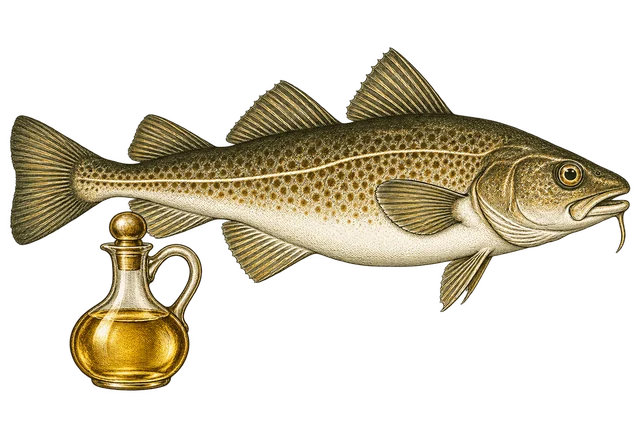
The source material is fish liver, not a plant or cod muscle. Atlantic cod is Gadus morhua in Gadidae; Pacific cod is Gadus macrocephalus. Species names help identify the raw material, while extraction, purification, blending and added nutrients determine the finished supplement. Read both the fish source and the ingredient list. It is classified here as a dietary fixed oil, not an essential oil or a general-purpose cosmetic carrier; topical preparations require their own evidence and labeling.
NOAA Fisheries: Atlantic cod, Gadus morhua and Gadidae classification · NOAA Fisheries: Pacific cod, Gadus macrocephalus · Möller’s: Cod liver oil capsules, manufacturer-declared composition per four capsules, checked 6 October 2026
Coastal medicine and an unmistakable taste
Cod liver oil’s story begins in the practical medicine of northern European fishing communities. Long before anyone could name vitamins A or D, the oil had a reputation as something strengthening to give when health was failing. The Smithsonian’s account places this coastal tradition before its adoption by the medical establishment. Its stubborn taste became part of the story too: families and manufacturers searched for ways to make a valued but unappealing oil easier to swallow.
Smithsonian National Museum of American History: Whitman Emulsion of Cod Liver Oil with Hypophosphites (household and commercial history) · McCollum, Simmonds, Becker and Shipley (1922): Studies on Experimental Rickets XXI (original vitamin-D research) · Hector F. DeLuca (2014): History of the discovery of vitamin D and its active metabolites · Imperial War Museums: Food Flashes, Ministry of Food, 1944 (period film record) · Science Museum Group: Ministry of Food welfare-foods poster, 1945–1951
Nineteenth-century tonics and emulsions
In 1841, Edinburgh physician John Hughes Bennett published an English-language treatise that helped bring cod liver oil to a wider medical audience. It entered the nineteenth-century world of restorative tonics, offered for rickets and illnesses associated with wasting. Surviving bottles tell another part of that history: the Smithsonian holds a Whitman emulsion made around 1910, a reminder of the effort to turn a coastal remedy into a marketable household medicine.
Smithsonian National Museum of American History: Whitman Emulsion of Cod Liver Oil with Hypophosphites (household and commercial history) · McCollum, Simmonds, Becker and Shipley (1922): Studies on Experimental Rickets XXI (original vitamin-D research) · Hector F. DeLuca (2014): History of the discovery of vitamin D and its active metabolites · Imperial War Museums: Food Flashes, Ministry of Food, 1944 (period film record) · Science Museum Group: Ministry of Food welfare-foods poster, 1945–1951
Vitamin discovery and public-health bottles
The discovery of vitamins gave the old reputation a new explanation. In 1922, Elmer McCollum and colleagues distinguished the oil’s anti-rickets factor from vitamin A and named it vitamin D. In Britain, cod liver oil then became an emblem of childhood nutrition: Ministry of Food films promoted free oil in 1944, and a postwar welfare poster pictured it beside orange juice in a baby’s pram. Folk experience, commercial tonic-making and public-health nutrition meet in this one familiar bottle.
Smithsonian National Museum of American History: Whitman Emulsion of Cod Liver Oil with Hypophosphites (household and commercial history) · McCollum, Simmonds, Becker and Shipley (1922): Studies on Experimental Rickets XXI (original vitamin-D research) · Hector F. DeLuca (2014): History of the discovery of vitamin D and its active metabolites · Imperial War Museums: Food Flashes, Ministry of Food, 1944 (period film record) · Science Museum Group: Ministry of Food welfare-foods poster, 1945–1951
Reading historical nutrition advice
The 1944 Ministry of Food films also urged expectant mothers to take cod liver oil. That is a record of wartime advice, not advice to follow today: current NHS guidance advises avoiding fish-liver oil during pregnancy or when trying for a baby unless a clinician specifically advises otherwise.
Imperial War Museums: Food Flashes, Ministry of Food, 1944 (period film record) · NHS: Fish and shellfish, fish-liver oil and pregnancy/trying-to-conceive precautions
Rickets and childhood bone growth
Nineteenth-century medical practice used cod liver oil for rickets, later explained through vitamin D research. This is one of the oil’s best-documented therapeutic lineages and helped carry it into twentieth-century child-nutrition programs.
Smithsonian: Whitman Emulsion of Cod Liver Oil with Hypophosphites · DeLuca, 2014: History of the discovery of vitamin D and its active metabolites
Consumption and wasting illness
Physicians in the nineteenth century gave cod liver oil as a restorative for consumption, now called tuberculosis, and other wasting illnesses. The Smithsonian documents that practice; nutritional support did not make the oil an antibacterial cure.
Smithsonian: Whitman Emulsion of Cod Liver Oil with Hypophosphites
Rheumatism and painful joints
A 1782 London Medical Journal report records cod liver oil for chronic rheumatism and other painful disorders. This gives joint-pain use a traceable history earlier than vitamin discovery, without equating the period’s broad word “rheumatism” with one modern diagnosis.
London Medical Journal, 1782: Cod liver oil in chronic rheumatism and other painful disorders
Resistance to respiratory infections
During the 1920s–1930s enthusiasm for vitamin A as an anti-infective agent, investigators frequently supplied it as cod liver oil to try to reduce respiratory and other infections. The oil’s childhood “resistance” reputation therefore has a specific medical and advertising history beyond rickets.
Semba, Journal of Nutrition 1999: Vitamin A as anti-infective therapy, 1920–1940
Traditional-food revival and allergy claims
In a 2016 Weston A. Price Foundation article, Sally Fallon Morell promotes cod liver oil as a convenient source of fat-soluble nutrients, favors low-temperature or fermented products, and reports personal success with allergy symptoms. These are the movement’s attributed nutritional and product claims, not proof that fermentation improves safety or efficacy.
Which oil was used in the arthritis trial?
The rheumatoid-arthritis study described below used Seven Seas Marine Oil 1 (SSMO1), a blend of cod-liver oil and fish oil. It was not a trial of an interchangeable spoonful of pure cod-liver oil. The study’s medication-reduction endpoint was assessed within clinical supervision; it is not permission to alter prescribed anti-inflammatory treatment.
Galarraga et al. (2008): Full rheumatoid-arthritis trial, including SSMO1 composition
Identity & detailed reference
Identity
Oil extracted from cod livers, commonly Atlantic cod (Gadus morhua); check the species and full ingredient list. It is an animal-derived fish-liver oil, distinct from cod fillet and ordinary fish-body oil. A dietary fixed oil; it is not an essential oil or a general cosmetic carrier.
Ingredient details, preparation and research
Source plant or material
Animal-derived material: oil from cod livers, commonly Gadus morhua (Atlantic cod). Gadus macrocephalus is Pacific cod; verify the species actually named by the manufacturer rather than assuming every “cod” product is identical.
Plant family / material: Not a plant. Cod belongs to the animal family Gadidae, order Gadiformes.
Forms and route
Bottled liquid, flavored oil, softgel capsules and emulsified products. Some formulas blend oils or add vitamins A, D or E. Liquid volume, capsule count, fatty-acid concentration and vitamin content are product-specific; forms are not interchangeable by teaspoon or capsule. This card concerns dietary use, not homemade skincare or essential-oil dilution.
Food sources
For EPA/DHA, oily fish such as salmon, sardines, herring and mackerel are alternatives; cod fillet is much leaner. For vitamin A, eggs/dairy provide retinol and orange or dark-green vegetables provide provitamin-A carotenoids. For vitamin D, use appropriate oily fish and labeled fortified foods. These foods supply different combinations of nutrients, rather than matching one spoon of liver oil.
Vitamins and minerals
There is no universal nutrient value per spoon or capsule. Current manufacturer-label examples are detailed below: Möller’s liquid lists 370 mg EPA + 510 mg DHA, vitamin A 250 mcg and vitamin D 10 mcg per 5 mL; its four-capsule serving lists 192 mg EPA + 268 mg DHA, vitamin A 250 mcg and vitamin D 15 mcg. These are declared product values checked 6 October 2026, not independent assays, a brand recommendation or a dose for this reader. No dependable iodine contribution should be assumed from the words “cod liver oil.”
Absorption and preparation
Use the intended oral product according to its meal directions. EPA/DHA absorption varies with chemical form and food; studies of fish-oil ethyl esters are not proof that every cod-liver oil needs a high-fat meal. Vitamin A/D absorption depends partly on fat digestion. Oil already contains fat; extra oil, a special “booster,” or a larger serving is not automatically helpful. Fat malabsorption or orlistat can change vitamin uptake.
Practical preparation
Use a labeled oral product and an accurate mL measure when needed, rather than an unmeasured kitchen spoon. Follow its directions for meals, refrigeration and discard-after-opening period; bottle and capsule instructions can differ. Do not use rancid oil or rely on a strong flavor to demonstrate freshness. Dietary oil is not a sterile wound product or a general cosmetic carrier.
Combination notes
Make one list of all daily EPA, DHA, vitamin A and vitamin D sources before combining products. Cod-liver oil plus fish oil may duplicate omega-3; a multivitamin or vitamin-D supplement may duplicate vitamins. This entry does not recommend a cod-liver oil, NAC and iodine stack, and the three ingredients do not establish a special absorption or treatment combination.
Traditional and reported uses
- Nutrition: supplies marine omega-3 fatty acids EPA and DHA, with variable vitamins A and D. It can contribute to intake when these are needed; more of an already adequate nutrient does not necessarily improve health.
- Tradition/history: a longstanding northern-European nutritional tonic, especially for winter vitamin-D intake; distributed in Britain during and after the Second World War. Its historical role in rickets prevention relates to vitamin D and adequate overall nutrition.
- Joint research: one small rheumatoid-arthritis trial found reduced NSAID use in some participants, without better disease-activity measures. It does not establish treatment for all joint pain or authorize reducing prescribed medicines.
- Limits: cod-liver oil is not established as a general infection-prevention, cancer-prevention or cardiovascular treatment. Evidence for a specific prescription omega-3 product cannot be assigned to a bottle of liver oil.
Contraindications and cautions
- Avoid cod-liver oil during pregnancy or when trying to conceive unless a clinician specifically recommends it. Preformed vitamin A (retinol/retinyl esters) can harm fetal development in excess; fish-body or algal products also need their ingredients checked.
- Count vitamins A and D from all supplements and fortified products. Regular liver intake, multivitamins and vitamin-D drops can make duplication easy. Do not use an adult bottle serving for a child; NHS specifically warns against combining children’s vitamin drops with cod-liver oil.
- Fish allergy requires individual advice; purification does not establish that a particular oil is safe for someone with allergy. Stop use for a reaction. Reflux, fishy taste, nausea or diarrhea can occur.
- Review regular or high-dose use with anticoagulants/antiplatelets and with a history of atrial fibrillation. The clearest rhythm-risk signals come from high-dose omega-3 trials in cardiovascular-risk patients; they should not be portrayed as equivalent to ordinary food intake.
- Ask a pharmacist or clinician before combining vitamin-A-containing oil with oral retinoid medicines, or substantial vitamin D with thiazide diuretics. Existing high vitamin A/D, high calcium, significant kidney or liver disease, and fat-malabsorption disorders need individual assessment.
- Choose a clearly labeled product with credible quality testing; use and store it as directed. Neither “natural,” “fermented,” nor a purity seal proves superior clinical benefit. Do not increase oil to reach a high omega-3 target without recalculating its vitamin A and D.
Similar items and how they compare
- Fish-body oil
Also supplies marine EPA and DHA.
Usually chosen for fatty acids rather than the liver’s vitamin-A/D package. Check added vitamins and actual EPA/DHA amounts; it is not automatically equivalent to a prescription.
- Algal oil
Provides preformed long-chain omega-3 without relying on conversion from plant ALA.
A non-fish source, often DHA with or without EPA; generally a separate choice from vitamins A/D. Check formulation and allergy-related excipients.
- Vitamin D alone
Can address a specific vitamin-D intake requirement.
Provides no EPA/DHA and allows vitamin D to be adjusted without also increasing preformed vitamin A. Deficiency treatment still depends on clinical context.
- Flaxseed oil
Another dietary omega-3 oil.
Provides ALA, not an equivalent measured dose of EPA/DHA. Conversion is limited; it does not reproduce cod-liver oil’s vitamin content.
Traditional use and history
Cod-liver oil has a long winter-nutrition tradition in Norway. A surviving British Ministry of Food bottle documents distribution during and after the Second World War, when food availability was restricted. Its importance in preventing vitamin-D-deficiency rickets is a nutritional history, not proof that every modern health claim works. Rickets can have other causes and needs appropriate assessment.
Bone, eye and immune nutrition
Vitamin A is required for normal vision and vitamin D for calcium regulation and bone health. Supplying a nutrient when intake is insufficient differs from treating eye disease, osteoporosis or recurrent infections with a mixed oil. If only vitamin D is needed, a single-nutrient preparation avoids tying each increase to more vitamin A or fish oil. This is a formulation advantage, not a claim that everyone needs supplementation.
Human trial: rheumatoid arthritis
A nine-month trial randomized 97 adults with rheumatoid arthritis to an oil regimen described as 10 g/day cod-liver oil containing 2.2 g n-3 fatty acids or placebo. A reduction in NSAID use greater than 30% occurred in 39% versus 10%, but only 60% completed the trial and disease-activity measures did not differ. This is a limited adjunct signal in a specific disease, not evidence of cartilage repair or treatment of every painful joint. The study dose is not a self-treatment instruction.
Human trial: infection prevention
The CLOC trial randomized 34,601 Norwegian adults to 5 mL/day of a specified cod-liver oil or corn-oil placebo for up to six months. It found no reduction in SARS-CoV-2 infection, serious covid-19 or other acute respiratory infections. Most participants in the measured subsample had adequate vitamin-D levels initially, so it was not a trial of treating severe deficiency. Nutrient roles in immunity therefore should not be rewritten as a promise of fewer colds.
Heart evidence is product- and population-specific
VITAL tested a marine omega-3 capsule in 25,871 older adults and found no significant reduction in its primary major-cardiovascular-event or invasive-cancer endpoints; some secondary findings differed. REDUCE-IT found cardiovascular benefit from prescription icosapent ethyl in selected statin-treated high-risk patients. Neither trial tested ordinary cod-liver oil. A prescription EPA outcome, or a triglyceride-lowering effect, does not establish the same benefit from a vitamin-containing liver oil.
Pregnancy, children and vitamin stacking
NHS advises avoiding fish-liver oil during pregnancy or when trying for a baby unless specifically advised by a clinician. Consider retinol in multivitamins and liver foods as well as this oil. For children, age-specific needs and smaller safety margins make the whole supplement list important; NHS warns against cod-liver oil plus vitamin drops. Vitamin-D excess can raise calcium and damage kidneys. A low-dose retail product and repeated large doses deserve different risk assessments.
Interactions, bleeding and heart rhythm
High-dose EPA/DHA deserves review with anticoagulants and antiplatelets, but ordinary supplementation is not consistently associated with clinically important bleeding. Omega-3 trials using about 4 g/day for years in people with cardiovascular disease or elevated risk found more atrial fibrillation; that context matters. Review existing rhythm problems and do not stop prescribed drugs on your own. Vitamin-A supplements can add to oral-retinoid toxicity; vitamin D with thiazide diuretics may raise calcium, especially with renal impairment.
Food alternatives and iodine distinction
Oily fish supplies EPA/DHA alongside protein and other nutrients. Carotenoid-rich vegetables, eggs/dairy and suitable fortified foods offer different ways to meet vitamin needs. Although cod flesh can be an iodine source, its iodine value cannot be assigned to extracted liver oil. Do not count an unspecified oil as an iodine supplement: require a declared, dependable iodine amount if that is the purpose. Iodine is assessed separately in its own entry.
Quality, storage and practical selection
Seek transparent species, EPA/DHA and vitamin labeling plus credible contaminant and quality testing. Independent certification can support label accuracy and manufacturing quality, but does not prove health benefit or suitability for one person. Check the program’s actual scope rather than assuming all seals cover oxidation. Follow the bottle’s own storage rules: Möller’s FAQ, for example, specifies refrigeration and replacement within three months of opening; that period is not universal. Compare the actual serving, intended nutrient goal and total vitamin exposure before choosing a product.
Entry sources
- NCCIH: Omega-3 supplements, including fish-liver oils and product differences
- NIH ODS: Omega-3 fatty acids, food sources, intake and safety
- NIH ODS: Vitamin A and carotenoids, reference intakes, excess and interactions
- NIH ODS: Vitamin D, reference intakes, absorption and interactions
- NHS: Vitamin A, food sources and long-term excess precautions
- NHS: Vitamin D, bone health and excessive supplementation
- NHS: Fish and shellfish, fish-liver oil and pregnancy/trying-to-conceive precautions
- NHS: Vitamins for children, avoiding duplicate cod-liver oil and vitamin drops
- NOAA Fisheries: Atlantic cod, Gadus morhua and Gadidae classification
- NOAA Fisheries: Pacific cod, Gadus macrocephalus
- Science Museum Group: Ministry of Food cod-liver oil bottle and wartime nutrition history
- Galarraga et al. (2008): Cod-liver oil randomized trial in rheumatoid arthritis
- Brunvoll et al. (2022): CLOC randomized trial, cod-liver oil and respiratory infection prevention
- Manson et al. (2019): VITAL trial of marine omega-3 and cardiovascular/cancer outcomes
- Bhatt et al. (2019): REDUCE-IT trial of prescription icosapent ethyl
- Lawson and Hughes (1988): Human fish-oil absorption with meals
- Möller’s: Cod Liver Oil Natural, manufacturer-declared composition per 5 mL, checked 6 October 2026
- Möller’s: Cod liver oil capsules, manufacturer-declared composition per four capsules, checked 6 October 2026
- Möller’s: Product questions and opened-bottle storage instructions
- NIH ODS: Frequently asked questions, independent supplement quality testing
- NIH ODS: Iodine, foods and supplement sources
Reference entry 108 · Recorded content review: 2026-10-06 · Review scope and dates