


Key cautions
- Warfarin: keep vitamin-K intake consistent; discuss major changes.
- Wash away grit and avoid cross-contamination.
What’s inside
Fiber, carotenoids including beta-carotene, vitamin C, calcium and vitamin K occur in the edible leaves. Variety, maturity and preparation influence composition.
Uses in brief

- Southern braised greens and potlikker
- New Year’s food symbolism
- Brazilian couve in sautéed dishes and soups
History, folklore and reported uses
History, folklore and traditional uses
Collards are nonheading forms of the European-Mediterranean cabbage species Brassica oleracea. Their botanical background is distinct from the African and African American culinary knowledge that helped shape Southern greens traditions.
The Smithsonian documents Southern African Americans carrying greens foodways to other parts of the United States during the Great Migrations. Collards also appear as couve manteiga in Brazilian vegetable references; a shared crop does not mean one universal recipe.
Traditional, historical and reported uses
- Southern braised greens and potlikker
Food or household practiceWhy this label?
The claim records a named culinary preparation or food practice, preserving the regional and exact-form limits; it makes no clinical-efficacy claim.
The Smithsonian’s Florida Avenue Grill stockpot records the place of collards in African American foodways. Illinois Extension describes the cooking liquid, potlikker, being eaten with cornbread or saved for soups.
- New Year’s food symbolism
Traditional accountWhy this label?
The source attributes a New Year’s prosperity custom to Southern food culture; this records symbolism rather than evidence that the food changes financial outcomes.
Colorado State’s food-history account describes eating collard greens on New Year’s Day as a Southern custom associated with hoped-for financial prosperity. This is cultural symbolism, not a claim that a food brings money or luck.
- Brazilian couve in sautéed dishes and soups
Food or household practiceWhy this label?
The claim records a named culinary preparation or food practice, preserving the regional and exact-form limits; it makes no clinical-efficacy claim.
Embrapa’s Brazilian vegetable catalogue identifies couve manteiga or couve de folhas as leafy Brassica oleracea and records sautéing it or adding it to soups, farofa and cooked dishes. These uses concern leafy types rather than headed cabbage.
- Fresh leafy wraps and salads
Food or household practiceWhy this label?
The claim records a named culinary preparation or food practice, preserving the regional and exact-form limits; it makes no clinical-efficacy claim.
UIC’s Heritage Garden describes collards eaten raw in salads or used as wraps. This is a contemporary food preparation; wash the leaves carefully and choose a texture suitable for the meal.
Featured uses reflect distinct documented practices, up to seven where warranted. Food traditions and historical symbolism do not establish treatment benefits.
Historical-use additions reviewed 2026-10-09
Story sources
- UF/IFAS Gardening Solutions: Collards
- University of Georgia Extension: Commercial production of cabbage and leafy greens
- Colorado State University Food Source Information: Collard greens
- Smithsonian National Museum of African American History and Culture: Foodways
- Illinois Extension: Preparing collards
- Embrapa and Sebrae: Catálogo brasileiro de hortaliças, Couve (Portuguese)
- University of Illinois Chicago Heritage Garden: Collard greens
- NIH Office of Dietary Supplements: Vitamin K, health-professional fact sheet
- FDA: Selecting and serving produce safely
Regional reading paths
These sourced notes describe cultivation, trade, food traditions or material history. A regional connection does not claim exclusive origin.
North America
Introduced vegetable with a long cultivation history in the southern United States and strong African American food traditions.
Leaves are cooked as greens; Smithsonian food-history material documents slow-cooked collards and potlikker.
South America
Introduced and cultivated in Brazil; finely sliced couve has a specifically documented place in Minas Gerais cuisine.
Leaves are sautéed, cooked or added to soups and farofa.
Identity & detailed reference
Identity
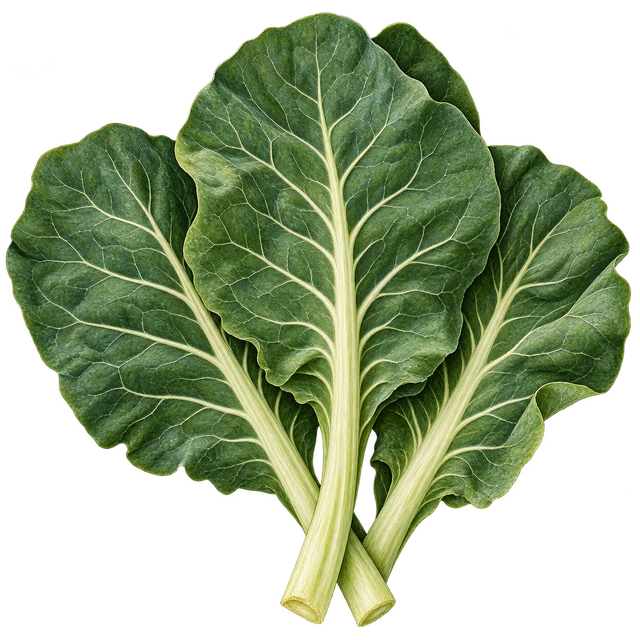
Broad, nonheading leaves of cultivated Brassica oleracea collard types. Horticultural sources use Acephala Group or var. viridis. These are distinct market greens, not a synonym for every kale, mustard green or wild brassica.
Ingredient details, preparation and research
Also known as: Collards; Collard; Collard green; Couve manteiga (Brazilian leafy types); Couve de folhas (Brazilian leafy types)
Source plant or material
Brassica oleracea L., collard types (Acephala Group; often var. viridis)
Plant family / material: Brassicaceae (cabbage family)
Forms and route
Washed fresh leaves, braised, steamed or sautéed greens, and suitable raw leaves in salads or wraps; frozen greens. Cooked broth and a whole cooked dish have their own composition.
Vitamins and minerals
Collards contribute fiber and leaf nutrients such as beta-carotene, vitamin C, calcium and vitamin K. Raw leaves, boiled/drained greens and a dish cooked with broth or meat do not have identical nutrient profiles. No numerical serving value is assigned here.
Absorption and preparation
Some meal fat can improve absorption of vitamin K from leafy vegetables; no special supplement or large amount of oil is needed. Do not interpret this general nutrition principle as a treatment claim.
Practical preparation
Wash leaves and remove tough stalks or central ribs if desired. Slice and cook until tender for the chosen recipe; mature leaves generally need longer than tender young leaves. Raw leaves used for wraps still need safe produce handling.
Combination notes
Vinegar, onion, garlic and pepper are recorded flavor partners. Potlikker can be served with cornbread or used in soup; it also contains whatever salt and other ingredients went into the pot.
Traditional and reported uses
- Southern braised greens and potlikker
- New Year’s food symbolism
- Brazilian couve in sautéed dishes and soups
Contraindications and cautions
- If you take warfarin or a similar vitamin-K antagonist, keep vitamin-K intake reasonably consistent and discuss major changes with your anticoagulation team. This is not a blanket instruction to avoid greens.
- Wash leaves thoroughly, remove grit and damaged areas, and prevent cross-contamination. Ready-to-eat prewashed greens can be used as labeled.
- Broth, smoked meats and added salt can make a greens dish salty. Assess the finished recipe rather than assuming all collard dishes have the same composition.
Similar items and how they compare
- Kale
Another nonheading Brassica oleracea leafy crop.
Named cultivars, leaf textures and market foods differ; this card specifically concerns collards.
- Mustard (seed and plant), card 129
Mustard greens can be cooked alongside collards.
Mustard greens come from other Brassica species; mustard seeds, oils and condiments have separate composition and risks.
Cultivar-group names
UF/IFAS uses Brassica oleracea var. viridis, while UGA groups collards with the nonheading Acephala forms. This horticultural naming variation does not make collards a new species or turn mustard greens into collards.
Vitamin K and medicines
NIH recommends consistent vitamin-K intake for people using warfarin and similar drugs. A major change in greens intake should be discussed with the prescribing team rather than managed by stopping medication or avoiding all greens.
Cooking liquid and nutrient uncertainty
Illinois Extension notes that some nutrients enter the cooking water. Keeping the broth does not recover everything changed by heat, and salty potlikker is not equivalent to plain leaves. A numerical nutrient table is not reproduced here.
Evidence limits
Regional accounts document foodways, not an exclusive origin for every cooking method. Broad claims about detoxification, cancer prevention or cholesterol lowering from nonclinical comparisons are not adopted. No exact nutrient figures are transferred between raw leaves, cooked greens and potlikker.
Entry sources
- UF/IFAS Gardening Solutions: Collards
- University of Georgia Extension: Commercial production of cabbage and leafy greens
- Colorado State University Food Source Information: Collard greens
- Smithsonian National Museum of African American History and Culture: Foodways
- Illinois Extension: Preparing collards
- Embrapa and Sebrae: Catálogo brasileiro de hortaliças, Couve (Portuguese)
- University of Illinois Chicago Heritage Garden: Collard greens
- NIH Office of Dietary Supplements: Vitamin K, health-professional fact sheet
- FDA: Selecting and serving produce safely
Reference entry 263 · Recorded content review: 2026-10-09 · Review scope and dates