


Key cautions
- Cook fully; never use raw.
- Food cormels, mother corm and leaves are different materials.
- Avoid ornamental and unidentified aroids.
What’s inside
Tannia cormels supply starch. Species, cultivar, plant part and cooking affect composition; a leaf or dried-flour analysis is not a cooked-cormel serving. This card makes no high-mineral, hypoallergenic or disease-treatment claim.
Uses in brief

- Cooked cormel sides
- West African fufu
- Flour for cooked foods
History, folklore and reported uses
History, folklore and traditional uses
Kew gives Xanthosoma sagittifolium a native range from Costa Rica to southern tropical America and notes that Xanthosoma crops were cultivated in tropical America before European colonization. The species is one part of a broader cultivated genus.
CARDI’s Saint Vincent guide identifies tannia as an important crop in Dominica, Saint Vincent and the Grenadines, Saint Lucia and Grenada. It describes Caribbean preference for underground food parts, while leaf use and later cultivation elsewhere broaden the crop’s food history.
Traditional, historical and reported uses
- Cooked cormel sides
Food or household practiceWhy this label?
The claim records a named culinary use of the stated plant part and preparation. Regional and modern-recipe boundaries are retained; no clinical efficacy is asserted.
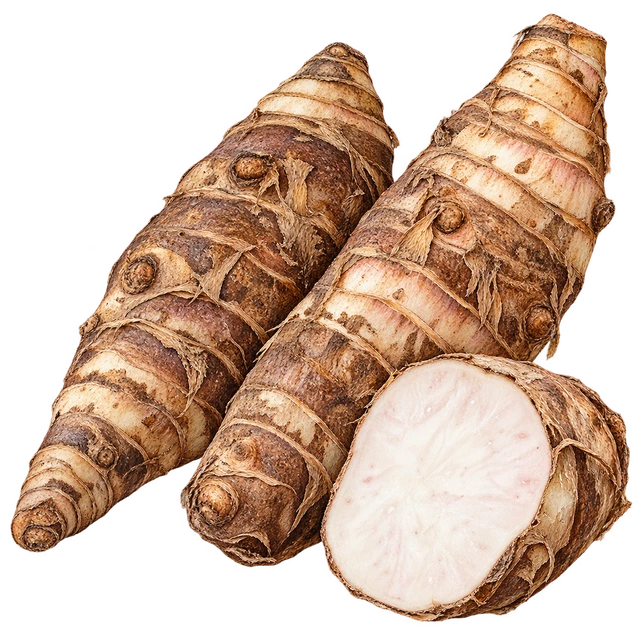
UF/IFAS records cooked malanga baked, mashed or fried as a starchy accompaniment. Its edible cormels cluster around the central mother corm; the name is not a license to cook an unidentified ornamental.
- West African fufu
Food or household practiceWhy this label?
The claim records a named culinary use of the stated plant part and preparation. Regional and modern-recipe boundaries are retained; no clinical efficacy is asserted.
FAO records Xanthosoma cormels boiled and pounded into fufu, commonly eaten with soup. This is a regional preparation after the American crop’s wider dispersal.
- Flour for cooked foods
Food or household practiceWhy this label?
The claim records a named culinary use of the stated plant part and preparation. Regional and modern-recipe boundaries are retained; no clinical efficacy is asserted.
ICAR’s Indian crop bulletin describes tannia flour in noodle mixtures and other cooked preparations. The flour has a different water content from fresh cormels, so serving values cannot be exchanged directly.
- Selected cooked leafy vegetables
Food or household practiceWhy this label?
The claim records a named culinary use of the stated plant part and preparation. Regional and modern-recipe boundaries are retained; no clinical efficacy is asserted.
Kew records food use of Xanthosoma leaves, and ICAR describes boiled greens. Use only a cultivar and leaf material specifically sold or grown for this purpose; ordinary market cormel identity does not establish that every leaf is suitable.
4 distinct food uses are featured. Regional accounts describe culinary practice, not clinical treatment; no biblical identification is asserted.
Historical-use additions reviewed 2026-10-09
Story sources
- UF/IFAS: Malanga, Xanthosoma species, HS623 (reviewed 2018; preserved original leaflet)
- UF/IFAS: Malanga plant-identification module, Xanthosoma species and cormels
- Kew Plants of the World Online: Xanthosoma sagittifolium, accepted taxonomy and native range
- Pathleen Titus / CARDI (2008): Tannia Crop Production Technical Guide, Saint Vincent and the Grenadines
- FAO EcoCrop: Xanthosoma sagittifolium, crop uses and names
- Royal Botanic Gardens, Kew: Delicious monsters and tasty elephants, edible aroids
- FAO: Traditional post-harvest technology, aroid root crops and regional dishes
- ICAR–Central Tuber Crops Research Institute (2023): Minor Tuber Crops, Technical Bulletin 99
- Hong Kong Centre for Food Safety (2020): Calcium-oxalate raphides and why cooking cannot make wild taro safe
- FAO: Starches and starchy roots, food-composition categories
Regional reading paths
These sourced notes describe cultivation, trade, food traditions or material history. A regional connection does not claim exclusive origin.
South America
Tropical American crop; Kew places Xanthosoma sagittifolium from Costa Rica into southern tropical South America.
Identified food-grade cormels are thoroughly cooked; raw aroids and unidentified ornamental plants are unsafe.
Australia & Oceania
Introduced tropical American aroids grown in the South Pacific; FAO’s Pacific food guide distinguishes Xanthosoma from Colocasia, Alocasia and Cyrtosperma.
Identified food-grade cormels are thoroughly cooked; raw aroids and unidentified ornamental plants are unsafe.
Identity & detailed reference
Identity
Tannia, yautía and malanga are overlapping commercial names for cultivated edible Xanthosoma aroids. Xanthosoma sagittifolium is a major cultivated species, but a market name alone does not authenticate the species. “Tanya” is interpreted here as tannia.
Ingredient details, preparation and research
Also known as: Tania; Tanier; Yautía; Yautia; Malanga (overlapping regional name); New cocoyam; Tanya (search spelling; this entry covers tannia)
Source plant or material
Cultivated Xanthosoma spp., commonly Xanthosoma sagittifolium (L.) Schott
Plant family / material: Araceae
Forms and route
Cooked food-grade cormels; cultivar-appropriate cooked leafy greens; processed flour or starch. Do not assume the large mother corm, leaves and market cormels have the same edibility or preparation.
Absorption and preparation
Cooking and other processing change starch and acridity, but no unique human absorption advantage is established. Do not equate reduced irritation with complete removal or destruction of every oxalate crystal.
Practical preparation
Buy edible cormels from a reliable food supplier. Prepare them by a recognized tannia method and cook completely. Obtain separate, crop-specific guidance for leaves; do not apply a cormel recipe to greens or unknown mother corms.
Food notes
Use the stated edible part and preparation; whole foods, isolated starches and extracts are different materials.
Combination context
No special medicinal pairing or nutrient-absorption combination is established for this named food.
Combination notes
Cooked cormels can accompany a meal or be pounded for soup accompaniments. Flour blends and leafy dishes need their own recipe and ingredient checks.
Traditional and reported uses
- Cooked cormel sides
- West African fufu
- Flour for cooked foods
- Selected cooked leafy vegetables
Contraindications and cautions
- Never eat tannia cormels or leaves raw. Follow a reliable method for the identified edible crop and plant part; cooking time cannot be generalized across all aroids.
- Choose authenticated food material. Ornamental elephant ears and wild lookalikes are not substitutes, and cooking is not a universal way to make them safe.
- The mother corm can be substantially more acrid than market cormels. Do not assume every underground part is an equivalent vegetable.
- Raw tissue may irritate skin and the mouth. Stop eating if it burns or causes swelling; seek medical help for significant symptoms or any breathing or swallowing difficulty.
Similar items and how they compare
- Dasheen / taro
Both are tropical edible aroids.
Dasheen is Colocasia esculenta. Malanga and cocoyam can refer to either genus in some markets, so common names need qualification.
- Leafy Xanthosoma crops
They are in the same genus.
Some types are selected for greens rather than cormels. Edibility and preparation must follow the particular crop, not the genus name alone.
- Tannia flour
It comes from processed crop material.
Dry flour differs from cooked fresh cormels and is not established as allergy-proof or suitable for every infant.
Use a qualified scientific identity
UF/IFAS describes the commercial crop as Xanthosoma species and explicitly notes name confusion. Kew accepts X. sagittifolium, including several names older sources treated separately. A sack marked yautía does not prove a species or cultivar.
Mother corm and cormels are not a single preparation
ICAR distinguishes the often more acrid mother corm from the smaller food cormels. FAO’s crop account likewise separates the main underground structure from the edible marketed parts.
Cooking language needs care
CARDI requires cooked use but uses older shorthand about destroying irritants. This card does not repeat that as a claim that all calcium-oxalate crystals disappear; food-safety guidance warns against relying on cooking for unknown aroids.
Evidence limits
Commercial identity remains genus-qualified. No claim is made that every Xanthosoma species, cultivar, mother corm or leaf is edible. No standardized cooked serving or clinical benefit was established.
Entry sources
- UF/IFAS: Malanga, Xanthosoma species, HS623 (reviewed 2018; preserved original leaflet)
- UF/IFAS: Malanga plant-identification module, Xanthosoma species and cormels
- Kew Plants of the World Online: Xanthosoma sagittifolium, accepted taxonomy and native range
- Pathleen Titus / CARDI (2008): Tannia Crop Production Technical Guide, Saint Vincent and the Grenadines
- FAO EcoCrop: Xanthosoma sagittifolium, crop uses and names
- Royal Botanic Gardens, Kew: Delicious monsters and tasty elephants, edible aroids
- FAO: Traditional post-harvest technology, aroid root crops and regional dishes
- ICAR–Central Tuber Crops Research Institute (2023): Minor Tuber Crops, Technical Bulletin 99
- Hong Kong Centre for Food Safety (2020): Calcium-oxalate raphides and why cooking cannot make wild taro safe
- FAO: Starches and starchy roots, food-composition categories
Reference entry 266 · Recorded content review: 2026-10-09 · Review scope and dates