


Key cautions
- Remove stones. Do not crush or chew cherry kernels, which can release cyanide.
- Check juice/concentrate sugar and serving size; do not substitute cherry products for gout or persistent-sleep-problem care.
- For medicinal cherry-stalk preparations, EMA reports no interaction data; that absence does not establish compatibility with medicines.
What’s inside
Anthocyanins, particularly cyanidin glycosides, contribute red color; levels differ by cultivar and processing. Other phenolics and organic acids accompany sugars and fiber. Melatonin has been detected in some samples, but other analyses found none detectable: fruit and juice do not supply a dependable standardized melatonin dose.
Mulabagal et al. (2009): Sweet- and sour-cherry anthocyanins and laboratory antioxidant/enzyme assays · Burkhardt et al. (2001): Melatonin measured in Montmorency and Balaton cherries · LC-MS/MS analysis (2014): Melatonin measurements in fruit and concentrate samples · Meng et al. (2017): Dietary Sources and Bioactivities of Melatonin, composition review
Nutrients in a pitted-fruit cup
One USDA cup of raw sour red cherries without pits (155 g) provides approximately 78 kcal, 18.9 g carbohydrate, 13.2 g sugars, 2.5 g fiber, 1.6 g protein, 15.5 mg vitamin C, 268 mg potassium and 99 micrograms vitamin A RAE. Half a cup gives about half these amounts. Values are from USDA SR28 food 09063; cultivar, processing and sweetening change the result.
USDA SR28: Cherries, sour, red, raw, food 09063, PDF pages 210–212
Cyanidin pigments and cultivar differences
Anthocyanins are the red-purple pigments. Chemical analysis of Balaton and Montmorency fruit identified cyanidin attached to different sugars, including cyanidin-3-O-glucosylrutinoside and cyanidin-3-O-rutinoside, with smaller amounts of cyanidin-3-O-glucoside. Their measured proportions differed between cultivars. The same paper also tested extracts in laboratory oxidation and enzyme assays; those tests do not establish a pain-relieving effect from eating cherries.
Identity and whole-fruit nutrition
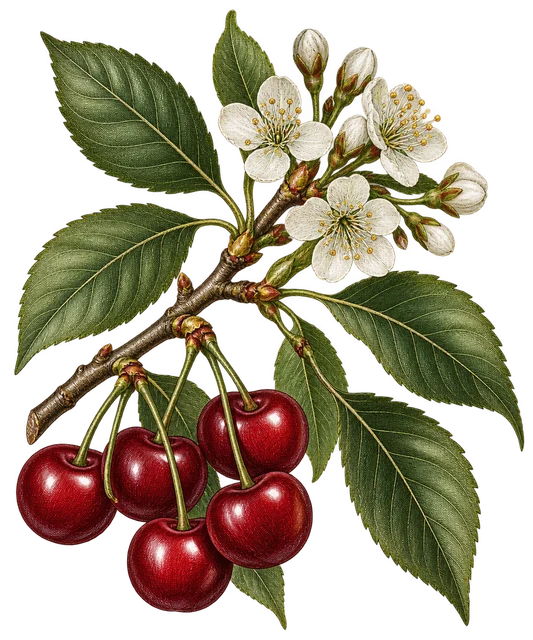
Sour cherry is a distinct fruit species, with Montmorency and Balaton among its cultivars. This card’s nutrition describes flesh and skin with stones excluded. It should not be transferred to a syrup, dried sweetened cherry or capsule; each product needs its own serving information.
Kew Plants of the World Online: Prunus cerasus identity and native range · USDA SR28: Cherries, sour, red, raw, food 09063, PDF pages 210–212
Melatonin is not standardized in this food
One original analysis measured melatonin in Montmorency and Balaton cherries at differing levels, while another method found none detectable in its sour-cherry samples. Cultivar, sampling and analytical method matter. A marketing claim about natural melatonin cannot establish a consistent dose or explain every observed sleep effect.
Burkhardt et al. (2001): Melatonin measured in Montmorency and Balaton cherries · LC-MS/MS analysis (2014): Melatonin measurements in fruit and concentrate samples · Meng et al. (2017): Dietary Sources and Bioactivities of Melatonin, composition review
Uses in brief

- Enjoy pitted fruit in oats, yogurt, sauces, compotes or baking; unsweetened frozen fruit is a practical option.
- Juice/concentrate trials suggest possible short-term sleep or strenuous-exercise recovery benefits, with small samples and variable results.
History, folklore and reported uses
Fruit, juice and concentrate in the kitchen
Whole pitted fruit retains its skin, flesh and fiber. A strained drink is a different food, and a concentrate is intended for the dilution given on its label. Neither a fruit-equivalent count nor a sour taste tells you how much anthocyanin or melatonin a product supplies. Read the actual serving, carbohydrate and added-sugar information rather than treating fruit, juice and capsules as interchangeable.
USDA SR28: Cherries, sour, red, raw, food 09063, PDF pages 210–212 · Hillman et al.: Thirty-day tart-cherry juice or capsule sleep trial, online 2022 · Meng et al. (2017): Dietary Sources and Bioactivities of Melatonin, composition review
An orchard fruit with mixed ancestry
Sour cherry’s ancestry helps explain why it is more than a sweet cherry that happens to taste sharp. Kew records Prunus cerasus from the North Caucasus, and Michigan State’s genetic work describes ancestry involving ground cherry, Prunus fruticosa, and sweet cherry, Prunus avium. Cultivation carried this complex orchard fruit across Europe and western Asia and into North America.
Kew Plants of the World Online: Prunus cerasus identity and native range · Michigan State University (2023): Complexity of the Montmorency tart-cherry genome
Montmorency and Balaton across borders
The name Montmorency preserves a French connection: a USDA historical growing handbook places the cultivar in France’s Montmorency Valley before the seventeenth century. In the American orchard industry described by that handbook, sour cherries were chiefly frozen or canned for pastries, especially pies. The exchange continued in modern times: Michigan State documents importing and testing Hungary’s Ujfehertoi Furtos, marketed as Balaton after the Hungarian lake. Its dark juice offered another expression of the sour-cherry harvest.
USDA (1974): Growing Sour Cherries, Agriculture Handbook 451 · Michigan State University: From Seed to Fruit, Balaton introduction and breeding · Michigan State University: Amy Iezzoni, Balaton cherry introduction
Compotes, lambic and serving customs
The same tartness inspired very different drinks. Türkiye’s Ministry of Culture records vişne hoşafı, fruit simmered with water and sugar and served chilled alongside dishes such as pilaf. In Belgium, sour cherries are steeped in lambic to make kriek. Cantillon records a vivid serving custom: drinkers received sugar lumps and a small steel masher, the stoemper, to adjust the sourness in the glass. These traditions speak to taste and hospitality, not to the results of modern juice studies.
Türkiye Ministry of Culture and Tourism: Vişne hoşafı, sour-cherry compote · 3 Fonteinen: Kriek, the brewery’s sour-cherry lambic process · Cantillon brewery: Kriek and its serving traditions
A separate history of cherry stalks
Even the stalk left beside a bowl of cherries had a separate herbal life. The European Medicines Agency documents sweet- and sour-cherry stalk infusions and decoctions in European practice, including French pharmacopoeial traditions and recorded Romanian uses. Its assessment recognizes a traditional role in minor urinary complaints alongside sufficient fluids, while finding inadequate clinical evidence for a well-established efficacy claim. This is the history of a different plant part, not proof that eating cherries treats urinary infection, kidney stones or gout.
EMA: Assessment report on sweet- and sour-cherry stalk preparations
Cherry-stalk urinary preparations
European herbal practice used sweet- and sour-cherry stalk infusions and decoctions for minor urinary complaints. EMA documents that traditional role with adequate fluid intake; it concerns the stalk, not a claim that tart-cherry fruit treats urinary infection or stones.
EMA: Assessment report on sweet- and sour-cherry stalk preparations
Gout remedies
Cherry products have a modern complementary-use reputation as gout remedies, including tart-cherry juice and concentrate. This patient-led use prompted clinical investigation of the concentrate as an addition to gout care.
Stamp et al. (2020): Randomized tart-cherry concentrate trial in fifty people with gout
Bedtime juice and sleep support
Tart-cherry juice and concentrate have become modern bedtime drinks used in hopes of improving sleep. Their sleep-aid reputation has led to studies of both drinks and capsules, a recent supplement history rather than an ancient folk claim.
Howatson et al. (2012): Twenty-person cherry-concentrate sleep crossover trial · Hillman et al.: Thirty-day tart-cherry juice or capsule sleep trial, online 2022
Recovery after strenuous exercise
Tart-cherry juice has entered modern sports-nutrition routines with the aim of easing soreness and helping strength recover after strenuous exercise. Marathon runners and other exercising adults feature in the research that followed this recovery use.
Howatson et al. (2010): Twenty-runner marathon recovery trial
Preserving fruit and welcoming guests
USDA records Montmorency cherries frozen or canned for pies, while Turkish vişne hoşafı and Belgian kriek show sour cherries in hospitality drinks. Preserving the harvest and welcoming guests connect these distinct culinary traditions.
USDA (1974): Growing Sour Cherries, Agriculture Handbook 451 · Türkiye Ministry of Culture and Tourism: Vişne hoşafı, sour-cherry compote · Cantillon brewery: Kriek and its serving traditions
Regional reading paths
These sourced notes describe cultivation, trade, food traditions or material history. A regional connection does not claim exclusive origin.
Europe
Cultivated and culinary: USDA records the Montmorency cultivar in France before the seventeenth century; European orchard traditions also include Hungarian sour-cherry cultivars.
Tart fruit for cooked dishes and preserves. Fruit, pits and cherry-stalk herbal preparations are not interchangeable.
Identity & detailed reference
Identity
Tart or sour cherry is Prunus cerasus L., a rose-family fruit tree. Montmorency and Balaton are cultivars. It is distinct from sweet cherry, Prunus avium, and from cherry-stalk herbal preparations.
Ingredient details, preparation and research
Source plant or material
Prunus cerasus. The food is the ripe fruit’s flesh and skin after removing its stone. Fruit juice, concentrate, dried powder, extracts and stalk teas differ in composition and use.
Plant family / material: Rosaceae (rose family).
Forms and route
Fresh or unsweetened frozen pitted fruit; canned fruit; dried cherries; juice; juice concentrate; powder or extract capsules. Many dried fruits and drinks are sweetened. Concentrates require label-specific dilution. Cherry-stalk tea is a different herbal preparation.
Food sources
Fresh pitted sour cherries when available; unsweetened frozen sour cherries; canned products with their packing liquid and added sugar identified. A practical food portion is 1/2–1 cup pitted fruit. This is a meal-planning amount, not a therapeutic dose.
Absorption and preparation
Cherry phenolics are transformed during digestion. A small human concentrate study measured circulating phenolic metabolites, which demonstrates exposure rather than guaranteed health benefit. No special combination has been established to boost cherry anthocyanin or melatonin effects in people. Yogurt, oats or nuts are sensible culinary pairings for a more varied snack. Keep the skin and flesh to retain the usual whole-fruit matrix and fiber; juice and capsules cannot be assumed equivalent.
Traditional and reported uses
- Food: a sour fruit for snacks, cooked dishes, preserves and drinks, with fiber retained in whole fruit.
- Sleep: small trials of particular juice/concentrate preparations report some benefits, while another longer trial did not find between-group sleep improvements. Evidence is preliminary and mixed.
- Exercise recovery: small trials around strenuous exercise have found improvement in selected recovery measures, not all soreness or muscle-damage outcomes.
- Gout: a randomized study in people with gout did not find a useful effect on serum urate or flare frequency. Cherries are not a replacement for prescribed urate-lowering treatment.
Contraindications and cautions
- Remove all stones before eating or blending. Do not crush or chew the kernels inside them. An accidentally swallowed intact stone is a different exposure from crushed kernels.
- Whole cherries are a choking hazard for young children. Remove stones, quarter lengthways and adapt the size and texture to eating skills; supervise eating.
- Fruit allergy is possible. Stop eating the fruit and seek appropriate help for an allergic reaction.
- Cherries can aggravate bloating, abdominal discomfort or diarrhea in some people with IBS or sensitive digestion, especially in large portions; cultivar-specific tolerance varies.
- Juice and concentrates can add substantial carbohydrate without the fiber of whole fruit. Check actual labels, especially if managing blood glucose.
- No universally effective sleep dose or optimal bedtime timing is established. Do not combine products on the assumption that more natural melatonin is always better.
- Pregnancy, breastfeeding and medicine considerations for concentrated supplements or medicinal stalk teas differ from normal food amounts. Obtain individualized advice before medicinal use.
- For medicinal cherry-stalk preparations, EMA reports no interaction data; that absence does not establish compatibility with medicines.
Similar items and how they compare
- Sweet cherries
A closely related rose-family fruit, usually Prunus avium.
Different flavor, varieties and nutrient profiles; results from one cherry type or product should not automatically be assigned to another.
- Tart-cherry juice or concentrate
Processed from the same fruit and used in many human trials.
Less fiber and product-specific carbohydrate and phytochemical levels. A stated fruit-equivalent count is not an active-compound standard.
- Melatonin supplements
Both are discussed in relation to sleep.
Cherry products do not contain a predictable supplement-equivalent melatonin dose.
- Cherry-stalk tea
A traditional preparation from a different part of the cherry tree.
Stalk urinary-use traditions do not establish that fruit treats urinary infections, stones or gout.
What the sleep studies actually show
A seven-day crossover trial in 20 healthy volunteers found improvements in measured sleep with a specific concentrate. A later insomnia pilot had only eight completers and mixed questionnaire results despite a sleep-time signal. A 30-day juice/capsule study with 44 participants who completed sleep records found no between-group benefit. Together these support further study, not a reliable insomnia treatment or a promise of extra minutes of sleep.
Recovery from strenuous exercise
In a 20-runner marathon trial, cherry juice improved strength recovery and some inflammatory measures, but not every muscle-damage outcome or soreness measure. Such short studies do not establish long-term training gains or show that everyone needs juice after routine activity.
Gout claims need a separate evidence check
A randomized dose study in 50 people with gout tested concentrate for 28 days and found no significant benefit for serum urate, urate excretion or flare frequency. It is therefore inappropriate to present tart cherry as a substitute for urate-lowering medication or acute gout care.
Preparation and product safety
Pit the fruit before eating or blending, and never grind kernels into a smoothie. Whole fruit offers fiber that juice largely lacks. Concentrates and sweetened products may supply substantial sugar in a small volume, while larger fruit portions can trouble a sensitive gut. A medicinal stalk preparation belongs to a different safety discussion.
- National Capital Poison Center: Cherry pits and cyanide risk
- Monash University: High- and low-FODMAP food guidance
- EMA: Assessment report on sweet- and sour-cherry stalk preparations
- USDA SR28: Cherries, sour, red, raw, food 09063, PDF pages 210–212
- NHS: Preparing fruit safely for babies and young children
- Kingswinford Medical Practice (NHS): Cut round fruit lengthways into quarters
Entry sources
- Kew Plants of the World Online: Prunus cerasus identity and native range
- Howatson et al. (2012): Twenty-person cherry-concentrate sleep crossover trial
- Hillman et al.: Thirty-day tart-cherry juice or capsule sleep trial, online 2022
- Stamp et al. (2020): Randomized tart-cherry concentrate trial in fifty people with gout
- Mulabagal et al. (2009): Sweet- and sour-cherry anthocyanins and laboratory antioxidant/enzyme assays
- Burkhardt et al. (2001): Melatonin measured in Montmorency and Balaton cherries
- LC-MS/MS analysis (2014): Melatonin measurements in fruit and concentrate samples
- Keane et al. (2016): Human uptake of Montmorency cherry phenolic metabolites
- Losso et al. (2018): Eight-completer tart-cherry juice insomnia pilot
- Howatson et al. (2010): Twenty-runner marathon recovery trial
- National Capital Poison Center: Cherry pits and cyanide risk
- Monash University: High- and low-FODMAP food guidance
- EMA: Assessment report on sweet- and sour-cherry stalk preparations
- CDC: Preparing fruit safely for young children
- NHS: Preparing fruit safely for babies and young children
- Kingswinford Medical Practice (NHS): Cut round fruit lengthways into quarters
- USDA SR28: Cherries, sour, red, raw, food 09063, PDF pages 210–212
- Michigan State University (2023): Complexity of the Montmorency tart-cherry genome
- USDA (1974): Growing Sour Cherries, Agriculture Handbook 451
- Michigan State University: From Seed to Fruit, Balaton introduction and breeding
- Türkiye Ministry of Culture and Tourism: Vişne hoşafı, sour-cherry compote
- 3 Fonteinen: Kriek, the brewery’s sour-cherry lambic process
- Cantillon brewery: Kriek and its serving traditions
Reference entry 112 · Recorded content review: 2026-10-06 · Review scope and dates