


Key cautions
- Cook all edible parts; never eat raw.
- Leaves need a leaf-specific preparation.
- Do not use ornamental or unidentified elephant ears.
What’s inside
Taro corm is predominantly a starchy food, with relatively little protein or fat. Cooked leaves are a separate vegetable food. No leaf nutrient numbers, generic raw-corm analysis or sweetened taro-drink label is assigned to a cooked dasheen serving.
Uses in brief

- Boiled and mashed dasheen
- Dasheen-leaf callaloo
- Soup provisions
History, folklore and reported uses
History, folklore and traditional uses
Kew places taro’s native range in tropical Asia, while its long cultivation history extends far beyond that range. Its Caribbean food identity is part of a wider history of crop movement, rather than proof of Caribbean botanical origin.
The crop now belongs firmly to Caribbean provisions cooking. Contemporary regional recipes use both the corm and separately prepared leaves; Tobago’s callaloo illustrates why “taro food” cannot be reduced to a single plant part.
A closer look at its history
Dasheen belongs to a much older Asian crop story
A genetic study of taro places its evolutionary background in Southeast Asia while examining both wild and cultivated lineages. Modern Caribbean dasheen is part of a much wider cultivation history; a species’ evolutionary origin does not by itself reveal the route or date of a particular island introduction.
Callaloo is a regional name, not one botanical identity
NYBG describes taro leaves as callaloo in Caribbean cooking, but its Jamaican research identifies garden callaloo as Amaranthus viridis and records other amaranths too. A recipe name therefore cannot safely identify a plant. Dasheen is Colocasia esculenta; the name alone is no permission to substitute another elephant-ear ornamental.
Conservation includes named food qualities
A 2008 CTAHR account describes the Hawaiian Taro Collection assembled in 1928–1935 to prevent further loss, and later field days sharing varieties with communities. The accompanying varietal record for Mana Ulu describes yellow cooked flesh and a name referring to resemblance to breadfruit poi. These are particular Hawaiian records, not evidence that Caribbean dasheen has identical names or uses.
Additional history reviewed 2026-10-12
Traditional, historical and reported uses
- Boiled and mashed dasheen
Food or household practiceWhy this label?
The claim records a named culinary use of the stated plant part and preparation. Regional and modern-recipe boundaries are retained; no clinical efficacy is asserted.
WFP’s Caribbean cookbook records Chef Brigette Joseph’s Trinidad and Tobago mash: the peeled corm is boiled soft, then combined with seasoned milk.
- Dasheen-leaf callaloo
Food or household practiceWhy this label?
The claim records a named culinary use of the stated plant part and preparation. Regional and modern-recipe boundaries are retained; no clinical efficacy is asserted.
Tobago Tourism documents callaloo made with dasheen leaves, okra, coconut milk and seasonings. This is a cooked leaf dish; the name callaloo can describe different greens elsewhere.
- Soup provisions
Food or household practiceWhy this label?
The claim records a named culinary use of the stated plant part and preparation. Regional and modern-recipe boundaries are retained; no clinical efficacy is asserted.
The WFP collection includes dasheen-and-corn soup from Trinidad and Tobago, placing cooked corm pieces in a substantial soup rather than treating the plant as a raw salad vegetable.
- Hawaiian poi and paʻiʻai
Food or household practiceWhy this label?
The claim records a named culinary use of the stated plant part and preparation. Regional and modern-recipe boundaries are retained; no clinical efficacy is asserted.
The University of Hawaiʻi records cooked taro pounded into paʻiʻai and poi. This is a distinct Pacific food tradition, not evidence that Caribbean dasheen originated in Hawaiʻi.
- Cooked-corm baking mixtures
Food or household practiceWhy this label?
The claim records a named culinary use of the stated plant part and preparation. Regional and modern-recipe boundaries are retained; no clinical efficacy is asserted.
The WFP collection includes a contemporary cheese-bread adaptation that first boils and mashes dasheen, then bakes it with tapioca starch and cheese. This is a named modern recipe, not an ancient Caribbean claim.
5 distinct food uses are featured. Regional accounts describe culinary practice, not clinical treatment; no biblical identification is asserted.
Historical-use additions reviewed 2026-10-09
Story sources
- Kew Plants of the World Online: Colocasia esculenta, accepted name, range and cooked food parts
- FAO: Traditional post-harvest technology, aroid root crops and regional dishes
- University of Hawaiʻi CTAHR (2015): Taro, Postharvest Quality-Maintenance Guidelines, VC-5
- University of Hawaiʻi Nutrition Center: Taro, island staple foods
- Tobago Tourism Agency: Callaloo, dasheen-leaf food practice
- World Food Programme Caribbean: Returning to Our Roots, Exploring the Root Crop Cuisine of the Caribbean
- Hong Kong Centre for Food Safety (2024): Food Poisoning from Consumption of Wild Taro
- Hong Kong Centre for Food Safety (2020): Calcium-oxalate raphides and why cooking cannot make wild taro safe
Growing notes
Edible Colocasia esculenta grown without permanent flooding. This excludes giant swamp taro, Xanthosoma and unidentified ornamental elephant ears.
- Climate and planting system
- A warm, moist-climate perennial harvested within a crop cycle. Hawaiʻi permits year-round planting in suitable sites. Elsewhere, ask extension whether enough warm months are available; frost avoidance is a precaution. Wetland loʻi is a different system. [1]
- Starts and cultivar
- Use healthy cormels or huli (a corm top with lower leaf stalks) of a known edible cultivar. CTAHR distinguishes table, poi and small-cormel types. A beautiful ornamental name does not establish eating quality or safe preparation. [1]
- Soil, water and spacing
- For upland culture choose deep, friable, well-drained loam, roughly pH 5.5–6.5. Irrigate when rain is insufficient. CTAHR’s home guide uses approximately 18–24 inches between plants and rows; do not treat upland taro as a drought-tolerant crop. [1]
- Harvest and pollination
- UF reports about 6–10 months for Florida taro; named cultivars and sites can take longer. Harvest depends on corm development, not pollination. Save only sound propagating material; inspect rather than using the calendar alone. [2] [1]
- Pests and crop care
- CTAHR flags aphids and other crop problems in its home guide. Keep planting material healthy, weed while plants establish, and seek local advice for leaf lesions or corm rot. Old publications’ chemical recommendations are not current label instructions. [1]
Growing sources and regional guidance
Growing notes reviewed 2026-10-12
Regional reading paths
These sourced notes describe cultivation, trade, food traditions or material history. A regional connection does not claim exclusive origin.
Asia
Native/cultivated: tropical Asia; longstanding Asian corm-food traditions.
Properly cooked corm; never treat raw taro as ready to eat.
Australia & Oceania
cultivated; Samoa, Hawaiʻi, Palau and Fiji
Cooked corm staple.
Identity & detailed reference
Identity
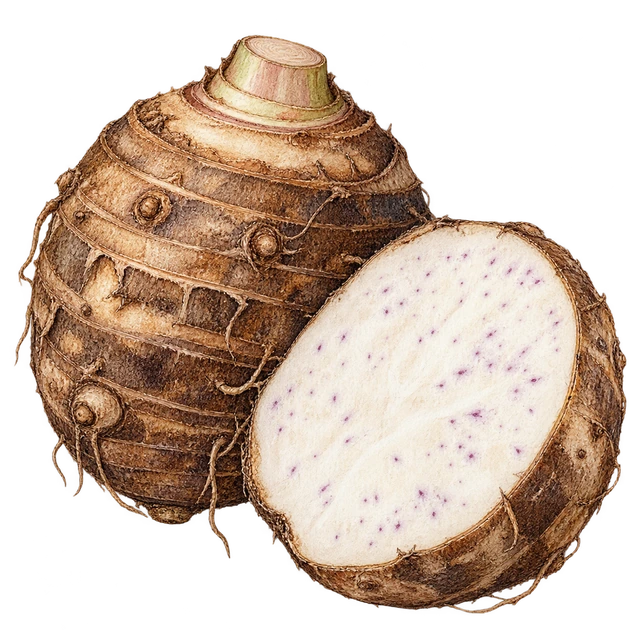
Dasheen is a Caribbean name for cultivated taro, Colocasia esculenta, especially large-corm types. Names overlap regionally; it is distinct from Xanthosoma tannia.
Ingredient details, preparation and research
Also known as: Taro; Dashin; Dasheen bush (edible leaf name); Eddoe (related taro type; regional usage varies); Kalo (Hawaiian name); Old cocoyam (regional name)
Source plant or material
Colocasia esculenta (L.) Schott
Plant family / material: Araceae
Forms and route
Thoroughly cooked edible corm or cormels; food-crop leaves prepared by a reliable leaf-specific method. Root, leaf, flour and sweetened taro products are different foods.
Absorption and preparation
Preparation reduces edible taro’s acridity, but it is inaccurate to say heat destroys all calcium-oxalate crystals. Soluble and insoluble oxalates behave differently; no special absorption advantage is established.
Practical preparation
Use a reliable recipe for the identified edible corm or leaf. Peel and cook corm portions completely. Treat leaves as a separate ingredient requiring thorough cooking, not a raw garnish. Do not taste uncooked batter or raw pieces.
Food notes
Use the stated edible part and preparation; whole foods, isolated starches and extracts are different materials.
Combination context
No special medicinal pairing or nutrient-absorption combination is established for this named food.
Combination notes
Traditional and modern dishes combine cooked taro with coconut, milk, herbs, okra or other foods. These pairings describe cuisine; none is a guarantee that an unknown aroid is safe.
Traditional and reported uses
- Boiled and mashed dasheen
- Dasheen-leaf callaloo
- Soup provisions
- Hawaiian poi and paʻiʻai
- Cooked-corm baking mixtures
Contraindications and cautions
- Never eat taro corms, stems or leaves raw. Food-crop leaves need their own thorough preparation; quick wilting like ordinary salad greens is not a safe substitute.
- Buy identified edible taro from a reliable supplier. Do not forage or substitute ornamental elephant ears. Cooking does not reliably make wild or unidentified aroids safe.
- Oxalate crystals and associated irritants can injure the mouth and throat. Stop eating if burning or swelling occurs and seek urgent medical help for significant symptoms, especially breathing or swallowing difficulty.
- Handling uncooked material may irritate skin. Avoid contact with the eyes or mouth, and use gloves if handling causes irritation.
Similar items and how they compare
- Tannia / yautía
Both are cultivated edible aroids.
Tannia belongs to Xanthosoma; its commercial cormels and cultivar-specific greens are not interchangeable with every taro form.
- Eddoe
Both are forms of Colocasia esculenta.
Eddoe often means types with smaller central corms and many cormels. Regional names and intermediate forms prevent a rigid market-name identification.
- Ornamental elephant ears
They can resemble food taro.
This garden name covers several aroids. Appearance or a shared common name does not establish edible crop identity or safe preparation.
Dasheen and eddoe are useful but flexible names
FAO distinguishes large-central-corm dasheen from many-cormel eddoe types, while warning that common names are not applied consistently. Both sit within Colocasia esculenta.
Cooked food crop versus wild lookalike
Hawaiʻi extension requires cooking every consumed taro part. Hong Kong food-safety guidance warns that wild-taro raphides withstand cooking; the safe conclusion is to use known edible crop material, not to promise universal detoxification.
Regional recipes are food evidence
The callaloo account and WFP chef contributions document cooking practices and personal food heritage. They do not test disease prevention or establish nutrient superiority.
Evidence limits
The card covers authenticated edible Colocasia crops. It does not supply a universal cooking time for all cultivars, authorize wild-plant use or transfer results from isolated starch to a whole meal.
Entry sources
- Kew Plants of the World Online: Colocasia esculenta, accepted name, range and cooked food parts
- FAO: Traditional post-harvest technology, aroid root crops and regional dishes
- University of Hawaiʻi CTAHR (2015): Taro, Postharvest Quality-Maintenance Guidelines, VC-5
- University of Hawaiʻi Nutrition Center: Taro, island staple foods
- Tobago Tourism Agency: Callaloo, dasheen-leaf food practice
- World Food Programme Caribbean: Returning to Our Roots, Exploring the Root Crop Cuisine of the Caribbean
- Hong Kong Centre for Food Safety (2024): Food Poisoning from Consumption of Wild Taro
- Hong Kong Centre for Food Safety (2020): Calcium-oxalate raphides and why cooking cannot make wild taro safe
Reference entry 265 · Recorded content review: 2026-10-09 · Review scope and dates