


Key cautions
- Remove the hard pit, including from products labeled pitted if fragments are present; prepare sticky pieces for the eater’s chewing ability.
- Portions matter: one large Medjool date already contains about 18 g carbohydrate. Count it within an individualized carbohydrate plan when relevant.
What’s inside
Ripe flesh contains sugars, chiefly glucose and fructose in many soft cultivars, fiber, potassium and smaller mineral contributions. Sugar pattern and moisture vary with cultivar and ripening stage; syrup loses much of the intact fruit matrix.
Uses in brief

- Use a measured portion of pitted dates for a compact fruit snack or chopped into food.
- Date paste and syrup are traditional sweetening ingredients; they remain concentrated sources of sugar.
In the King James Bible
In the King James Bible
Source plant or material; different preparation
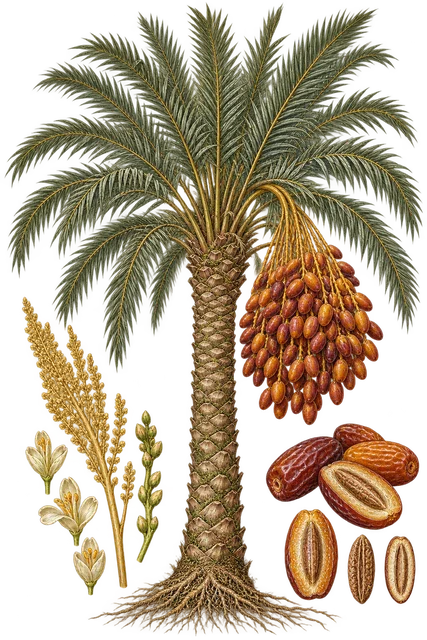
Dates are the edible fruit of the date palm. The KJV explicitly names palm trees; the quoted passages do not print a food called dates. This is a source-plant connection based on the conventional identification of the biblical palm as Phoenix dactylifera.
The righteous shall flourish like the palm tree: he shall grow like a cedar in Lebanon.
Psalm 92:12 (KJV)
And they came to Elim, where were twelve wells of water, and threescore and ten palm trees: and they encamped there by the waters.
Exodus 15:27 (KJV)
Scripture and identification sources
Words & their stories
WORDS & THEIR STORIES
The name behind the KJV
Biblical Hebrew · Psalm 92:12 (KJV); Psalm 92:13 in the Hebrew edition
כַּתָּמָרkattāmār
“Like the palm tree,” in an image of righteous flourishing.
Dictionary form: תָּמָר · tāmār
The prefix combines “like” with the article. The Hebrew edition counts the introductory line, shifting the verse number by one.
Biblical Hebrew · Exodus 15:27 (KJV)
תְּמָרִיםtəmārīm
Palm trees at Elim, where the travelers camp near water.
Dictionary form: תָּמָר · tāmār
This is the plural of the tree name, not an explicit word for a serving of dates.
What the language reveals
Landscape and poetry
Exodus counts palms beside springs; the psalm uses a palm as a comparison for a flourishing life.
The fruit connection is botanical
Brown–Driver–Briggs identifies tāmār as the date palm, Phoenix dactylifera. That connects the tree to dates without changing what these verses actually say.
These are source-plant references to the date palm. They do not explicitly name date fruit, date syrup, or a coconut palm.
History, folklore and reported uses
History, folklore and traditional uses
The palm at an oasis is a food tree and a working landscape. In Exodus, Elim is remembered for water and palms; in Psalm 92 the palm becomes an image of flourishing. Botanical identification connects that tree with the date palm, but the KJV lines themselves say palm, not dates. The distinction preserves what the text actually names.
FAO describes dates eaten at different ripening stages and used as fruit, a meal component or a compact food reserve. In date-growing societies, households combined pitted fruit with nuts and spices, cooked preserves and made relishes. Pressed paste later served bakers and confectioners. These practices depend on the whole flesh, unlike filtered juice and syrup.
The harvest was only part of the palm’s value. Date juice could be concentrated into syrup, while trunks, leaf midribs, leaflets and fibers supplied building and weaving materials. The tall canopy also sheltered people and other crops. A date-palm heritage therefore includes food processing, craft knowledge and the management of an oasis, not just a sweet snack.
Traditional, historical and reported uses
- Compact provisions and stored fruit
Food or household practiceWhy this label?
Fruit used as stored household provisions.
FAO describes dates as a food component that could help sustain households where other staples were scarce. Ripeness and moisture determined whether the crop was eaten promptly or stored.
- Syrup and other sweeteners
Food or household practiceWhy this label?
Date juice processed into syrup and sweeteners.
Extracted date juice is concentrated into syrup, with regional names including dibs and rub. It is a distinct processed ingredient rather than simply a whole date in liquid form.
- Nut-filled preserves and bakery pastes
Food or household practiceWhy this label?
Culinary preserves, bakery pastes and confectionery.
FAO records home preserves using dates, nuts and spices, as well as date paste for bakery and confectionery products. These combine fruit with other ingredients and should be described by the finished recipe.
- Weaving, cordage and building materials
Food or household practiceWhy this label?
Palm materials used in weaving, cordage and structures.
Palm leaflets and fibers were made into baskets, mats and ropes, while midribs and trunks furnished structural materials. These uses concern the source palm, not nutrients in its fruit.
- Oasis shade and a symbol of flourishing
Mixed/contextual sourcesWhy this label?
Combines practical agricultural shade with scriptural symbolism.
The date-palm canopy provided useful shade, and Psalm 92 uses the palm as an image of flourishing. Agricultural service and scriptural imagery are related layers of the tree’s cultural history.
Story sources
- FAO, W. H. Barreveld (1993): Date Palm Products, Chapter 1, Whole Dates
- FAO, W. H. Barreveld (1993): Date Palm Products, Chapter 2, Date Products and Preparations
- FAO, W. H. Barreveld (1993): Date Palm Products, Chapter 3, Derived Date Fruit Products
- FAO, W. H. Barreveld (1993): Date Palm Products, Chapter 5, Non-fruit Palm Products
- Psalm 92:12 (King James Version)
- FAO, W. H. Barreveld (1993): Date Palm Products, Chapter 5, traditional trunk and leaf uses
Women’s Health: traditions, evidence and cautions
Historical use does not establish benefit or safety. Pregnancy, breastfeeding and fertility care require particular caution: food, tea, essential oil and concentrated extract are not interchangeable. These records are not treatment, dosing or pregnancy-management instructions. Discuss supplements with a qualified clinician or pharmacist; do not delay evaluation of persistent symptoms.
Date fruit
Phoenix dactylifera L.
- Plant part / material
- Ripe edible fruit
- Preparation studied or reported
- Whole dates as food; not date-palm pollen, seeds or extracts.
A Thai clinical research report describes dates as a popular natural galactagogue among breastfeeding Muslim mothers; this is a reported practice, not a claim for all Muslim communities.
Lactation / milk-supply tradition
Small human trial; preliminary evidence
Reported or traditional useDate fruit is eaten to support milk supply.
What the evidence supportsA small randomized trial involving 48 mother–infant pairs reported greater pumped milk with dates but no difference in infant nutritional status. Larger confirmatory studies are needed.
The study concerns edible fruit and does not establish pregnancy safety for therapeutic use or safety of date-palm pollen/extracts. No postpartum bleeding-treatment claim follows.
- This concerns an ordinary food, not a recommendation for medicinal quantities in pregnancy or lactation. The cited studies do not establish safety of concentrated extracts.
Regional reading paths
These sourced notes describe cultivation, trade, food traditions or material history. A regional connection does not claim exclusive origin.
Africa
Cultivated: North African oasis systems, including Gafsa in Tunisia.
Fresh or dried fruit and date-based foods.
Asia
Cultivated: Arabian Peninsula, Iran, Iraq and Pakistan; long-established arid-region crop.
Fresh or dried fruit and processed date foods.
Identity & detailed reference
Identity
Dates are the edible fruit of the date palm. The KJV explicitly names palm trees; the quoted passages do not print a food called dates. This is a source-plant connection based on the conventional identification of the biblical palm as Phoenix dactylifera.
Ingredient details, preparation and research
Also known as: palm tree; palm trees
Source plant or material
Phoenix dactylifera L.; Edible date flesh is a modern food from the conventionally identified biblical palm; the quoted KJV verses name the tree only.
Plant family / material: Arecaceae (palm family)
Forms and route
Whole fresh or naturally semi-dry ripe dates; pitted, chopped or pressed dates; date paste, syrup, preserves and filled confections. Medjool and Deglet Noor differ in size and moisture. The hard pit, palm sap, leaves and concentrated extracts are separate materials.
Vitamins and minerals
One pitted Medjool date (24 g edible flesh): about 67 kcal, 18.0 g carbohydrate, 16.0 g sugars, 1.6 g fiber, 0.43 g protein, 167 mg potassium, 13 mg magnesium, 15 mg calcium and 0.22 mg iron; vitamin C is listed as 0 mg. USDA SR28 food 09421. A small Deglet Noor date weighs much less; use grams or its own composition entry rather than assuming one date is a standard size.
Absorption and preparation
Dates need no special soaking ritual for nutrient absorption. Soaking may soften a dry fruit, but it does not remove its carbohydrate. Dates are not a substantial vitamin-C source and supply only a small amount of nonheme iron per fruit; a vitamin-C-rich food can support plant-iron absorption in a mixed meal. Syrup is not nutritionally identical to whole dates.
Traditional and reported uses
- Use a measured portion of pitted dates for a compact fruit snack or chopped into food.
- Date paste and syrup are traditional sweetening ingredients; they remain concentrated sources of sugar.
- The palm also supplied shade, building material and woven household goods, separately from its edible fruit.
Contraindications and cautions
- Remove the hard pit, including from products labeled pitted if fragments are present; prepare sticky pieces for the eater’s chewing ability.
- Portions matter: one large Medjool date already contains about 18 g carbohydrate. Count it within an individualized carbohydrate plan when relevant.
- Do not treat the food fruit, pollen, seed extracts, leaf products and palm sap as interchangeable remedies.
- Syrup and filled or chocolate-coated dates may differ markedly from the plain fruit in fiber and added ingredients.
Similar items and how they compare
- Raisins
A compact naturally sweet fruit food.
Dried grapes rather than palm fruit, with a different portion weight and mineral profile.
- Figs
Another fruit eaten fresh, dried or pressed for storage.
Ficus fruit has a different structure and composition; date palm quotations do not name figs.
- Date syrup
A sweetener derived from dates.
Concentrated liquid sugars with less intact fruit fiber; it does not identify all biblical honey.
The source-plant connection is explicit
The Bible passages name palm trees; identifying them with date palm is a botanical interpretation. No particular date cultivar, syrup, medicinal preparation or modern nutrient is specified.
Human bowel-function research
A small randomized crossover study in healthy adults reported increased bowel movements with date consumption, without significant changes in the selected bacterial groups or short-chain fatty acids measured. It does not establish a universal laxative dose or treatment for intestinal disease.
Serving size and material matter
Medjool is a large date; counts cannot be exchanged one-for-one with small cultivars. Whole fruit, paste and filtered syrup differ in structure, and the hard pit is excluded from the USDA serving.
Evidence limits
- Explicit KJV tree; date-fruit connection is inferred from botanical identity
- These are source-plant references; they do not explicitly name date fruit, coconut, or date syrup.
Entry sources
- Lytton John Musselman, Old Dominion University: Palm
- FAO, W. H. Barreveld (1993): Date Palm Products, Chapter 1, Whole Dates
- FAO, W. H. Barreveld (1993): Date Palm Products, Introduction
- FAO, W. H. Barreveld (1993): Date Palm Products, Chapter 2, Date Products and Preparations
- FAO, W. H. Barreveld (1993): Date Palm Products, Chapter 3, Derived Date Fruit Products
- FAO, W. H. Barreveld (1993): Date Palm Products, Chapter 5, Non-fruit Palm Products
- Eid et al. (2015): Palm dates and large-intestinal health, randomized crossover human study
- USDA SR28: Dates, medjool, food 09421, PDF page 270
- NIH Office of Dietary Supplements: Vitamin C, Health Professional Fact Sheet
- Psalm 92:12 (King James Version)
- Exodus 15:27 (King James Version)
- FAO, W. H. Barreveld (1993): Date Palm Products, Chapter 5, traditional trunk and leaf uses
Reference entry 145 · Recorded content review: 2026-10-06 · Review scope and dates