


Key cautions
- Avoid combining with warfarin: a primary clinical case reports profound excess anticoagulation.
- Review anticoagulant and antiplatelet medicines with a clinician before considering this material.
What’s inside
A reliable composition profile for the exact preparation was not established in this review; chemistry from another plant part is not transferred.
Uses in brief

- Menstrual history (traditional account).
- Other traditional indications (traditional account).
History, folklore and reported uses
History, folklore and traditional uses
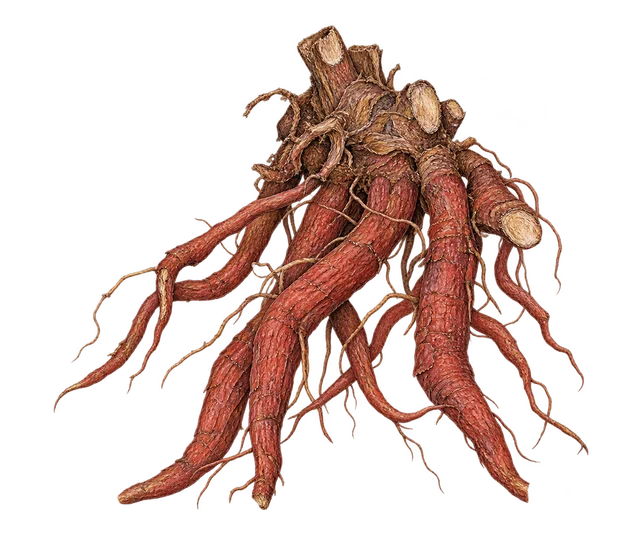
The university materia-medica record describes reddish, grooved roots and uses expressed in traditional blood-stasis language. The red root is a useful identity cue, but a picture cannot authenticate a commercial drug.
Traditional, historical and reported uses
- Menstrual history
Traditional accountWhy this label?
The source is retained with its design and preparation limits; reported use is not upgraded to clinical effectiveness.
The source records irregular or absent menstruation and menstrual pain. Historical use does not establish effective treatment of a cause of bleeding or pain.
- Other traditional indications
Traditional accountWhy this label?
The source is retained with its design and preparation limits; reported use is not upgraded to clinical effectiveness.
Chest or abdominal pain, sleeplessness and inflamed sores also appear in the account. These are reported indications, not recommendations for self-treatment.
Includes only uses and context documented for this material. Historical reporting is not proof of benefit; no use-count quota is applied.
Story sources
Women’s Health: traditions, evidence and cautions
Historical use does not establish benefit or safety. Pregnancy, breastfeeding and fertility care require particular caution: food, tea, essential oil and concentrated extract are not interchangeable. These records are not treatment, dosing or pregnancy-management instructions. Discuss supplements with a qualified clinician or pharmacist; do not delay evaluation of persistent symptoms.
Danshen / red sage root
Salvia miltiorrhiza Bunge
- Plant part / material
- Dried root and rhizome
- Preparation studied or reported
- Authenticated dried underground parts and their traditional preparations. Multi-herb pills, isolated constituents and injectable extracts require separate evidence and are not interchangeable.
Only the exact part and formulation described here; related existing cards do not inherit these claims.
The university materia-medica record describes reddish, grooved roots and uses expressed in traditional blood-stasis language. The red root is a useful identity cue, but a picture cannot authenticate a commercial drug.
Menstrual history
Traditional account
Reported or traditional useThe source records irregular or absent menstruation and menstrual pain. Historical use does not establish effective treatment of a cause of bleeding or pain.
What the evidence supportsThe source is retained with its design and preparation limits; reported use is not upgraded to clinical effectiveness.
Avoid combining with warfarin: a primary clinical case reports profound excess anticoagulation. Review anticoagulant and antiplatelet medicines with a clinician before considering this material. Pregnancy and breastfeeding safety is not established here. Unexplained bleeding should be assessed, not self-treated with danshen.
Other traditional indications
Traditional account
Reported or traditional useChest or abdominal pain, sleeplessness and inflamed sores also appear in the account. These are reported indications, not recommendations for self-treatment.
What the evidence supportsThe source is retained with its design and preparation limits; reported use is not upgraded to clinical effectiveness.
Avoid combining with warfarin: a primary clinical case reports profound excess anticoagulation. Review anticoagulant and antiplatelet medicines with a clinician before considering this material. Pregnancy and breastfeeding safety is not established here. Unexplained bleeding should be assessed, not self-treated with danshen.
Only the exact part and formulation described here; related existing cards do not inherit these claims.
- Avoid combining with warfarin: a primary clinical case reports profound excess anticoagulation.
- Review anticoagulant and antiplatelet medicines with a clinician before considering this material.
- Pregnancy and breastfeeding safety is not established here. Unexplained bleeding should be assessed, not self-treated with danshen.
Read the complete historical reference and its material distinctions
Identity & detailed reference
Identity
Danshen is Salvia miltiorrhiza root and rhizome. Common sage leaf and rosemary are different medicinal materials even though all belong to the mint family.
Ingredient details, preparation and research
Also known as: dan shen; red sage root; Salviae Miltiorrhizae Radix et Rhizoma
Source plant or material
Salvia miltiorrhiza Bunge; Dried root and rhizome
Plant family / material: Lamiaceae
Forms and route
Authenticated dried underground parts and their traditional preparations. Multi-herb pills, isolated constituents and injectable extracts require separate evidence and are not interchangeable.
Absorption and preparation
No absorption-enhancement directions are established for this material. An extract, food, infusion and isolated chemical can deliver different substances; study results do not establish a home preparation.
Traditional and reported uses
- Menstrual history: The source records irregular or absent menstruation and menstrual pain. Historical use does not establish effective treatment of a cause of bleeding or pain.
- Other traditional indications: Chest or abdominal pain, sleeplessness and inflamed sores also appear in the account. These are reported indications, not recommendations for self-treatment.
Contraindications and cautions
- Avoid combining with warfarin: a primary clinical case reports profound excess anticoagulation.
- Review anticoagulant and antiplatelet medicines with a clinician before considering this material.
- Pregnancy and breastfeeding safety is not established here. Unexplained bleeding should be assessed, not self-treated with danshen.
Similar items and how they compare
- Common sage and rosemary
Related names and mint-family membership can confuse readers.
Their leaves are not Salvia miltiorrhiza root and rhizome; they do not inherit danshen claims.
Identity and exact material
Danshen is Salvia miltiorrhiza root and rhizome. Common sage leaf and rosemary are different medicinal materials even though all belong to the mint family. Authenticated dried underground parts and their traditional preparations. Multi-herb pills, isolated constituents and injectable extracts require separate evidence and are not interchangeable.
Evidence and preparation boundaries
The sources establish identity, historical use and a serious interaction signal, not reproductive efficacy. A primary clinical report describes marked excess anticoagulation when danshen was combined with warfarin. It does not establish that every other anticoagulant has the same interaction, but medication review is needed. Injectable and mixed-product findings must not be assigned to a home root preparation.
Safety and uncertainty
Avoid combining with warfarin: a primary clinical case reports profound excess anticoagulation. Review anticoagulant and antiplatelet medicines with a clinician before considering this material. Pregnancy and breastfeeding safety is not established here. Unexplained bleeding should be assessed, not self-treated with danshen.
Evidence limits
- This is a focused source review, not a systematic clinical review. A traditional indication or laboratory result does not establish an effective or safe treatment.
- A lack of reported adverse effects is not proof of safety. No therapeutic dose or preparation is recommended.
Entry sources
- Hong Kong Baptist University: Dan-shen Root
- Izzat et al. 1998: A taste of Chinese medicine!
- Kew Plants of the World Online: Salvia miltiorrhiza
Reference entry 542 · Recorded content review: 2026-10-11 · Review scope and dates