


Key cautions
- Avoid with almond allergy unless an allergy clinician confirms suitability
- Do not substitute bitter-almond/fragrance products or swallow cosmetic blends
- With almond allergy, avoid almond-oil hair products unless an allergy clinician advises otherwise; a home skin trial cannot rule out serious allergy.
- Do not use almond oil for earwax if you are allergic to almonds, and do not use ear drops with a perforated eardrum. Seek pharmacist or medical advice for persistent blockage rather than continuing indefinitely.
What’s inside
Most of the oil consists of triglycerides, fats whose fatty acids are chiefly oleic and linoleic acids. Alpha-tocopherol is a characteristic minor constituent. Oil separation removes the bulk of the kernel solids, without certifying freedom from allergenic protein traces.
Özcan et al. (2020): Fatty acids and tocopherols in sweet-almond oils; minerals measured separately in kernels · Anaphylaxis UK: Plant-based oils, refining and food-allergy cautions
Composition: keep kernels and oil separate
A 2020 study of 31 genotypes measured oleic acid at about 62–76% and linoleic acid at about 14–30% of fatty acids in the oils; alpha-tocopherol predominated. The paper’s mineral measurements concerned kernels, not an equivalent serving of separated oil. This distinction prevents incorrectly assigning whole-almond calcium or magnesium to almond oil. Laboratory antioxidant measurements do not establish clinical disease prevention.
What the composition experiment measured
The 31-genotype study used kernels from Mersin, Turkey, and hot Soxhlet extraction with petroleum ether, a laboratory solvent method rather than retail cold pressing. The range above follows the paper’s abstract; Table 1 also lists an oleic-acid value of 58.89% for genotype T3, below the abstract’s stated minimum. These percentages describe the extracted oil’s fatty acids, not grams per 100 g whole almonds or a specification for every retail oil.
Nutrition per practical portion
The USDA tablespoon weighs 13.6 g. Multiplying 39.2 mg alpha-tocopherol/100 g by 0.136 gives 5.3312 mg, about 36% of the 15 mg vitamin E Daily Value. There is no comparable calcium, magnesium, protein or fiber contribution. Alpha-tocopherol content varies across cultivars and processing, so a specific food label is preferable where available.
USDA FoodData Central SR Legacy: Oil, almond, FDC 171031; nutrient and food-portion records · NIH Office of Dietary Supplements: Vitamin E, alpha-tocopherol, absorption and Daily Values · Özcan et al. (2020): Fatty acids and tocopherols in sweet-almond oils; minerals measured separately in kernels · USDA SR28 vitamin E table, hosted by NIH: almond oil, 13.6 g tablespoon and 5.33 mg alpha-tocopherol
Uses in brief

- Skin conditioning, massage and hair lubrication
- Food-grade oil supplies unsaturated fat and vitamin E
- Hair lengths: sweet almond oil can provide emollient softness and lubrication; direct detangling or regrowth evidence is limited.
In the King James Bible
Source-plant connection: almonds
Source plant or material; different preparation
Almonds accompany Jacob’s gift to the ruler of Egypt, and Aaron’s rod bears blossoms and almonds in Numbers. These verses connect the card to the almond plant and fruit; they do not specify pressed sweet-almond oil or a modern cultivar.
And their father Israel said unto them, If it must be so now, do this; take of the best fruits in the land in your vessels, and carry down the man a present, a little balm, and a little honey, spices, and myrrh, nuts, and almonds:
Genesis 43:11 (KJV)
And it came to pass, that on the morrow Moses went into the tabernacle of witness; and, behold, the rod of Aaron for the house of Levi was budded, and brought forth buds, and bloomed blossoms, and yielded almonds.
Numbers 17:8 (KJV)
Scripture and identification sources
Words & their stories
WORDS & THEIR STORIES
The name behind the KJV
Biblical Hebrew · Genesis 43:11 (KJV)
וּשְׁקֵדִיםūšəqēdīm
“And almonds,” among the gifts sent from Canaan to Egypt.
Dictionary form: שָׁקֵד · šāqēd
The initial ū- means “and”; the noun is plural.
Biblical Hebrew · Numbers 17:8 (KJV); Numbers 17:23 in the Hebrew edition
שְׁקֵדִיםšəqēdīm
Almonds produced by Aaron’s rod.
Dictionary form: שָׁקֵד · šāqēd
The same plural noun appears without the conjunction. The Hebrew edition numbers this verse 17:23.
What the language reveals
Fruit, not an oil preparation
Genesis lists gift produce; Numbers describes the rod flowering and bearing almonds. Neither passage specifies sweet-almond oil.
Almond is a well-established identification, but these passages establish no sweet cultivar, pressing method or medicinal effect.
History, folklore and reported uses
Botanical identity and route-specific names
Kew accepts Prunus amygdalus, with Prunus dulcis among its synonyms. Health Canada identifies almond oil as a seed-derived fixed oil and separates permitted oral and topical functions. Sweet fixed oil is a triglyceride material. A bottle labeled bitter-almond essential oil, perfume or almond flavoring is not the same ingredient and should not be substituted by name alone.
Kew Plants of the World Online: Prunus amygdalus, synonym Prunus dulcis and Rosaceae · Health Canada Natural Health Products Ingredients Database: Almond Oil, seed fixed oil and route-specific functions
Between orchard, kitchen and apothecary
Sweet almond oil belonged to a world in which the kitchen, perfumer and apothecary drew on the same orchard crop. Maud Grieve’s A Modern Herbal, published in 1931, describes pressed almond oil in soaps, skin care and medicinal emulsions, and even as a lubricant for delicate watch mechanisms. She also preserves earlier English herbal writing: Gerard praised the oil for smoothing the hands and face. The attraction was the kernel’s mild, workable fat, which could make a preparation spread, soften or mix more readily.
An Iranian household tradition
Iranian household history adds another thread. Encyclopaedia Iranica describes oil expressed from pounded almonds and records its use as a laxative, while tracing a much older food culture around the nuts. Those accounts show how nourishment and medicine overlapped without making every almond preparation the same. Sweet almond fixed oil, almond milk and the aromatic products of bitter almonds have distinct identities; the dangerous bitter-almond remedies appearing in old books are not instructions for using a present-day carrier oil.
Encyclopaedia Iranica: Bādām, almond food culture and expressed-oil use in Iran
Chapped hands and smoother skin
Grieve records sweet almond oil for chapped hands and preserves Gerard’s praise of freshly pressed oil for smoothing the hands and face. This is a genuine fixed-oil cosmetic tradition.
A soothing ingredient in cough preparations
A Modern Herbal describes the expressed fixed oil in older remedies for tickling coughs, hoarseness and bronchial complaints, sometimes in emulsified preparations. This is distinct from aromatic bitter-almond oil.
A mild laxative in Iranian household medicine
Encyclopaedia Iranica records expressed almond oil used as a laxative in Iran. The preparation was the oil obtained from pounded almonds, rather than almond milk or whole kernels.
Encyclopaedia Iranica: Bādām, almond food culture and expressed-oil use in Iran
Comfort for aches and colic in older herbals
Grieve reproduces Gerard’s account of sweet almond oil for aches, pleuritic pain and colic. These are historical apothecary purposes; chest pain associated with breathing needs medical assessment.
Earwax softening
Almond oil remains a household option for softening earwax in NHS guidance. This use is unsuitable for someone allergic to almonds or with a perforated eardrum.
Lubricating delicate watch mechanisms
Grieve’s 1931 herbal records expressed almond fixed oil as a lubricant for delicate watch mechanisms. This mechanical use concerns the bland fatty oil, not volatile bitter-almond fragrance material.
Toilet-soap manufacture
Grieve also records almond fixed oil as a raw material for toilet soap. This manufacturing role is distinct from the household practice of applying plain oil to chapped hands.
Identity & detailed reference
Identity
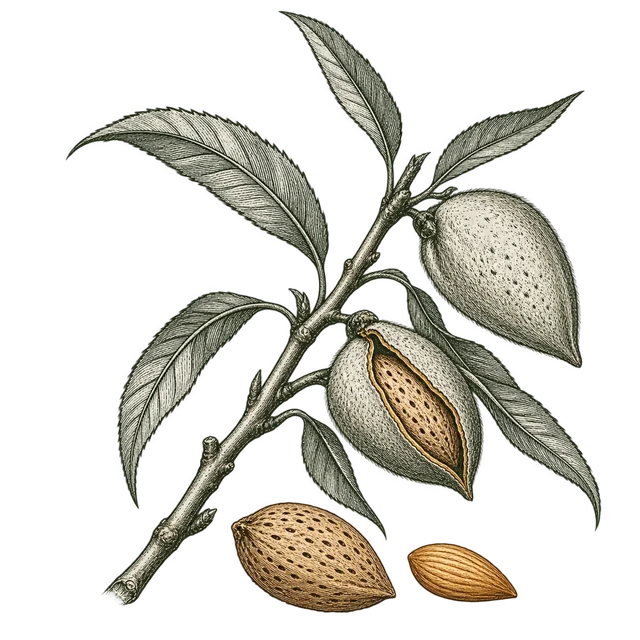
Sweet-almond fixed oil expressed from kernels of Prunus amygdalus Batsch (syn. Prunus dulcis). Cosmetic names often use Prunus amygdalus dulcis oil. It is distinct from bitter-almond aromatic materials and almond flavoring extracts.
Ingredient details, preparation and research
Source plant or material
Prunus amygdalus Batsch (syn. Prunus dulcis); the sweet kernel is a seed inside the hard stone of the fruit.
Plant family / material: Rosaceae (rose family).
Forms and route
Food-grade sweet-almond oil; separately labeled cosmetic carrier/massage oil, creams, body oils and hair conditioners. Whole almonds, almond flour, almond drink, flavoring extract, bitter-almond fragrance and volatile oil are different products.
Food sources
Use food-grade sweet-almond oil as a culinary fat according to its label. Choose whole almonds or other appropriate foods for protein, fiber and minerals; those nutrients are not supplied in comparable amounts by the separated oil.
Vitamins and minerals
USDA SR Legacy FDC 171031 specifies 1 tablespoon = 13.6 g: about 120 kcal, 13.6 g fat, 9.51 g total monounsaturates, 2.37 g linoleic acid, 1.12 g saturated fat and 5.33 mg alpha-tocopherol (36% of the 15 mg vitamin E Daily Value). Protein, fiber, calcium, magnesium and other listed major minerals are negligible in the oil, despite their presence in whole almonds. The database’s rounded zero protein is not an allergen-free certification.
Absorption and preparation
Dietary almond oil is digested and absorbed as meal fat; fat digestion supports vitamin E uptake. In a small Raman-microscopy study, almond oil was examined in the outer stratum corneum alongside other oils. Similar superficial uptake does not demonstrate systemic nutrient delivery or superior deep penetration.
Practical preparation
For food, measure a portion and use a clearly edible product in a dressing, sauce or suitable cooking preparation. Keep closed, cool and protected from light; follow the label. For cosmetics, use a product intended for that area and introduce it cautiously only when there is no known allergy. Do not use a homemade infant-eczema or bitter-almond preparation.
Combination notes
A food oil may replace another fat, but adding it to an unchanged diet is not the intervention tested in lipid research. Almond oil can reduce friction in a massage product; benefits of massage or a multi-ingredient cream are not proof of oil-specific synergy. Any additional essential oil or perfume introduces its own exposure.
Traditional and reported uses
- Health Canada identifies the fixed seed oil and lists topical conditioning/occlusive roles and an oral flavor-enhancer role.
- Used in cosmetic massage, body and hair preparations to soften and lubricate; this does not prove hair regrowth or permanent split-end repair.
- A small food-fat substitution study measured lipids; selected creams and massage protocols have also been studied. Their results cannot be generalized to every bottle of plain oil.
- Hair lengths: sweet almond oil can provide emollient softness and lubrication; direct detangling or regrowth evidence is limited.
Contraindications and cautions
- Avoid almond oil with known almond allergy unless an allergy clinician has assessed the specific preparation. Cold-pressed/unrefined oils can retain allergenic proteins, and refining is not a personal guarantee.
- A home tolerance test cannot rule out a food allergy. Stop for itching, swelling or rash and obtain urgent help for breathing difficulty or a severe systemic reaction.
- Infant eczema is a special concern: a published case linked repeated almond-oil application to possible sensitization. Do not assume food-derived oils are suitable for damaged infant skin.
- Use only food-labeled sweet-almond oil orally. Bitter-almond essential/aromatic oil, fragrance oil and flavoring extracts are not substitutes.
- Do not self-treat new pregnancy swelling with massage or oil. Skin-conditioning evidence also does not establish treatment of infection, open wounds or substantial burns.
- The cited studies do not establish a complete medicinal-dose interaction profile or a need to take extra oil with medicines; discuss supplement-like use separately from ordinary food use.
- With almond allergy, avoid almond-oil hair products unless an allergy clinician advises otherwise; a home skin trial cannot rule out serious allergy.
- Do not use almond oil for earwax if you are allergic to almonds, and do not use ear drops with a perforated eardrum. Seek pharmacist or medical advice for persistent blockage rather than continuing indefinitely.
Similar items and how they compare
- Hazelnut oil
Another oleic-rich kernel oil used in foods and cosmetics.
It comes from a different botanical family and has its own allergy profile; cross-use needs product-specific judgment.
- Argan oil
Both are kernel oils used for skin and hair conditioning.
Argan commonly has a larger linoleic fraction and gamma-dominant tocopherols; almond is characteristically alpha-tocopherol-rich.
- Whole almonds
The source food shares much of the oil’s fatty-acid fraction.
Whole almonds retain protein, fiber and mineral-rich solids. Similar lipid effects in one small trial do not make the foods nutritionally identical.
Food-fat replacement study
In a randomized crossover trial, 22 adults with normal lipids replaced roughly half their habitual dietary fat, approximately 14% of energy, with whole almonds or almond oil for six-week periods. Both interventions produced similar changes in measured plasma lipids; neither changed the in-vitro LDL-oxidation measure. The trial tested dietary replacement and surrogate markers, not extra oil, heart-attack prevention or nutritional equivalence between whole nuts and oil.
Stretch marks: specific creams, limited endpoints
A 160-woman trial compared sweet-almond-oil cream, aloe cream, base cream and no treatment during pregnancy. Some itching, redness and spread outcomes favored the active creams, but the three creams did not differ significantly in stretch-mark number or diameter. These formulation-specific findings do not justify a guarantee that plain sweet-almond oil prevents or removes stretch marks. Trials explicitly using bitter-almond oil are a separate material and are not imported here.
Massage evidence does not isolate the oil
In the 2020 pregnancy foot-massage study, sweet-almond and grapeseed massage groups both improved compared with usual care, with no significant difference between the oils. The intervention combined daily massage and oil, so it cannot distinguish friction reduction, massage or an oil-specific effect. It is not evidence to ignore new swelling; sudden pregnancy swelling requires prompt maternity advice.
Skin uptake: outer-layer evidence
The 2008 Raman study tested mineral oil, almond oil, jojoba and petrolatum on nine adults at 30 and 90 minutes. The separate seven-infant experiment tested only mineral and almond oils, at 30 minutes. The three oils had similar superficial penetration profiles in adults; almond and mineral oil also had similar profiles in infants. The adult oils caused less occlusive swelling than petrolatum. This short experiment does not establish eczema treatment, long-term infant safety or meaningful dietary vitamin delivery through skin.
Allergy and damaged infant skin
A 2000 report described a five-month-old infant with atopic dermatitis and almond sensitization after repeated topical almond-oil exposure. This is a cautionary case, not an incidence estimate. Anaphylaxis UK notes uncertainty about many refined nut oils; the low-risk evidence for refined peanut/soy oils cannot be used as blanket clearance for almond. A food-composition zero for protein cannot certify absence of trace allergens.
Safe preparation and interaction limits
Keep food use, cosmetics and aromatic preparations distinct. Ordinary food-fat digestion and local skin conditioning do not imply special drug delivery. The available trials neither establish a medicinal dose nor comprehensively assess medicine interactions. A finished cosmetic’s other ingredients may govern tolerance; small-area testing is an irritation screen only for people without a known relevant allergy.
Hair care: cosmetic role and evidence limits
Cosmetic-use evidence: sweet almond fixed oil is used to lubricate and soften dry-looking lengths. Shine and slip depend on the finished formula and hair; direct clinical evidence for faster growth or improved detangling is limited. Oil is not a way to deliver whole-almond protein or biotin to follicles. Cosmetic conditioning can improve the feel or appearance of existing lengths; it is not evidence of new hair growth. Oils do not add water to hair: laboratory moisture studies address changes in water movement, not a universal “hydration” effect. Use a small amount of a tolerated hair product on lengths or ends according to its label, alongside conditioner and gentle detangling. Stop for irritation; persistent scalp itching, redness or loss needs assessment.
Entry sources
- Kew Plants of the World Online: Prunus amygdalus, synonym Prunus dulcis and Rosaceae
- Health Canada Natural Health Products Ingredients Database: Almond Oil, seed fixed oil and route-specific functions
- Özcan et al. (2020): Fatty acids and tocopherols in sweet-almond oils; minerals measured separately in kernels
- Hyson et al. (2002): Whole almonds versus almond oil, randomized crossover lipid study in 22 adults
- Hajhashemi et al. (2018; online 2017): Sweet-almond oil and aloe creams in a 160-woman stretch-mark trial
- Stamatas et al. (2008): Lipid uptake and occlusion after oil application in nine adults and seven infants
- Guillet and Guillet (2000): Possible percutaneous almond sensitization in an infant with atopic dermatitis
- Navaee and Rakhshkhorshid (2020): Grape-seed/almond oil foot massage trial in pregnancy
- NHS: Swollen ankles, feet and fingers in pregnancy; warning signs requiring urgent assessment
- Anaphylaxis UK: Plant-based oils, refining and food-allergy cautions
- American Academy of Dermatology: How to test skin-care products
- NIDDK: Your digestive system and how it works
- USDA FoodData Central SR Legacy: Oil, almond, FDC 171031; nutrient and food-portion records
- NIH Office of Dietary Supplements: Vitamin E, alpha-tocopherol, absorption and Daily Values
- Stamatas et al. (2008): Full adult and infant oil-uptake protocols
- Maud Grieve (1931): Almonds, sweet fixed-oil section
- Keis et al. (2007): Effect of oil films on moisture vapor absorption on human hair
- AAD: How to stop damaging your hair
Reference entry 70 · Recorded content review: 2026-10-05 · Review scope and dates